


Stress support isn’t the same as hormone balance. That distinction matters when you’re weighing claims about adaptogens for female hormone balance, especially if fatigue, mood changes, or disrupted sleep leave you wondering what’s behind your symptoms.
It’s understandable to look for a natural way to feel more resilient. Some adaptogens, particularly ashwagandha, have evidence for supporting stress relief, but that doesn’t prove they treat a hormone condition or reliably balance reproductive hormones. Research varies by herb and outcome, and supplement safety can depend on your health, medications, and life stage.
This guide will help you separate stress support from treatment, understand what current evidence can and can’t tell you, and evaluate adaptogen claims. We’ll look at which ingredients were studied, whether the research applies to your situation, practical safety considerations, and when symptoms or supplement plans warrant a conversation with a healthcare professional. A more informed choice starts with clear expectations, not a promise of a quick fix.
Key Takeaways
- “Hormone balance” is a broad wellness phrase, not a diagnosis. Persistent or disruptive symptoms deserve a closer look at their possible causes.
- Understand how the stress-response system may relate to hormonal health without assuming cortisol explains every symptom or follows a simple pathway.
- Compare adaptogens for female hormone balance by the specific outcome studied, the limits of the evidence, and the safety questions each ingredient raises.
- Use a practical checklist to clarify your goal, review supplement details, and prepare for a conversation with a qualified healthcare professional.
- See how foundational habits and a transparent, multi-ingredient supplement example can fit into a thoughtful wellness routine without promising hormone outcomes.
What Does Female Hormone Balance Mean, and Where Do Adaptogens Fit?
Changes in energy, mood, menstrual cycles, sleep, or comfort can naturally prompt questions about hormones. Stress and major life transitions, including puberty, pregnancy, perimenopause, and menopause, can add to those questions. Looking for support makes sense, but a symptom by itself can’t identify its cause.
Why the phrase ‘hormone balance’ needs context
“Hormone balance” is common wellness language, not a diagnosis or a single measurable state that looks the same for everyone. Hormone levels shift in response to normal rhythms and circumstances, including time of day, menstrual-cycle phase, age, pregnancy, and menopause. A change in your cycle or energy level may be worth tracking, but it doesn’t automatically mean you have a hormone imbalance.
Clinical conditions are different from a broad wellness label. Polycystic ovary syndrome (PCOS) and thyroid disorders, for example, are medical conditions that require assessment in context. A healthcare professional may consider symptoms, health history, examination, and appropriate testing. No single feeling or supplement-related claim can establish a diagnosis. Persistent, new, or disruptive symptoms deserve attention rather than being written off as stress or assumed to be hormonal.
What people mean when they ask about adaptogens
Adaptogens are herbs or other substances traditionally described as helping the body adapt to stress. The term has a history and remains debated, and it doesn’t guarantee that different ingredients work in the same way. What are Adaptogens? offers background on the term and discussion around its definition. Traditional use can explain why an ingredient is popular, but it isn’t the same as evidence from human clinical studies.
That distinction matters for adaptogens for female hormone balance. A study might examine perceived stress, sleep, libido, or a particular hormone measurement. Those outcomes aren’t interchangeable. A finding related to stress doesn’t by itself show that an herb treats PCOS, thyroid disease, menstrual disorders, or another diagnosed condition. Evidence also depends on the ingredient, preparation, dose, and people studied.
In practical terms, treat an adaptogen claim as a question to examine, not a conclusion. What outcome was studied? Was the research done in people, and does it apply to your circumstances? Traditional use for stress support can be a starting point for learning, not proof of a universal mechanism or a hormone treatment. For a broader overview of how adaptogens are discussed in functional beverages, Gara Health’s adaptogenic coffee guide explores the topic in that context.
Adaptogens are substances traditionally used to support the body’s response to stress. That traditional framing, or evidence of stress support, does not establish that they balance hormones or treat hormonal disorders.
How Stress Signaling Connects to Hormones, and What Adaptogen Research Can Show
Stress and hormone health can intersect, but the biology isn’t a simple chain in which stress causes a specific hormone disorder. The hypothalamic-pituitary-adrenal (HPA) axis is one part of the body’s stress-response network. Understanding its role helps put adaptogen claims in perspective.
The stress response is connected to, but not identical with, the endocrine system
The hypothalamus, a region in the brain, signals the pituitary gland, which then communicates with the adrenal glands. In response, the adrenals can release cortisol, a hormone that helps coordinate functions such as energy availability and the body’s response to changing demands. Cortisol isn’t inherently harmful; its levels naturally shift, including across the day.
The HPA axis is connected with other body systems, including those involved in reproduction and thyroid function. That doesn’t mean a change in stress automatically produces a predictable change in reproductive hormones. Health, sleep, medications, life stage, and other factors can shape symptoms and hormone patterns. Low energy or cycle changes, for example, can have multiple possible explanations. Stress may affect wellbeing, but it shouldn’t be treated as a diagnosis.
How to read adaptogen evidence without overinterpreting it
Research may explore how an ingredient affects cells, animals, or biological pathways. Those findings can suggest questions for human research, but they don’t show that people will experience a meaningful health benefit. A plausible mechanism alone cannot prove hormone-balance benefits.
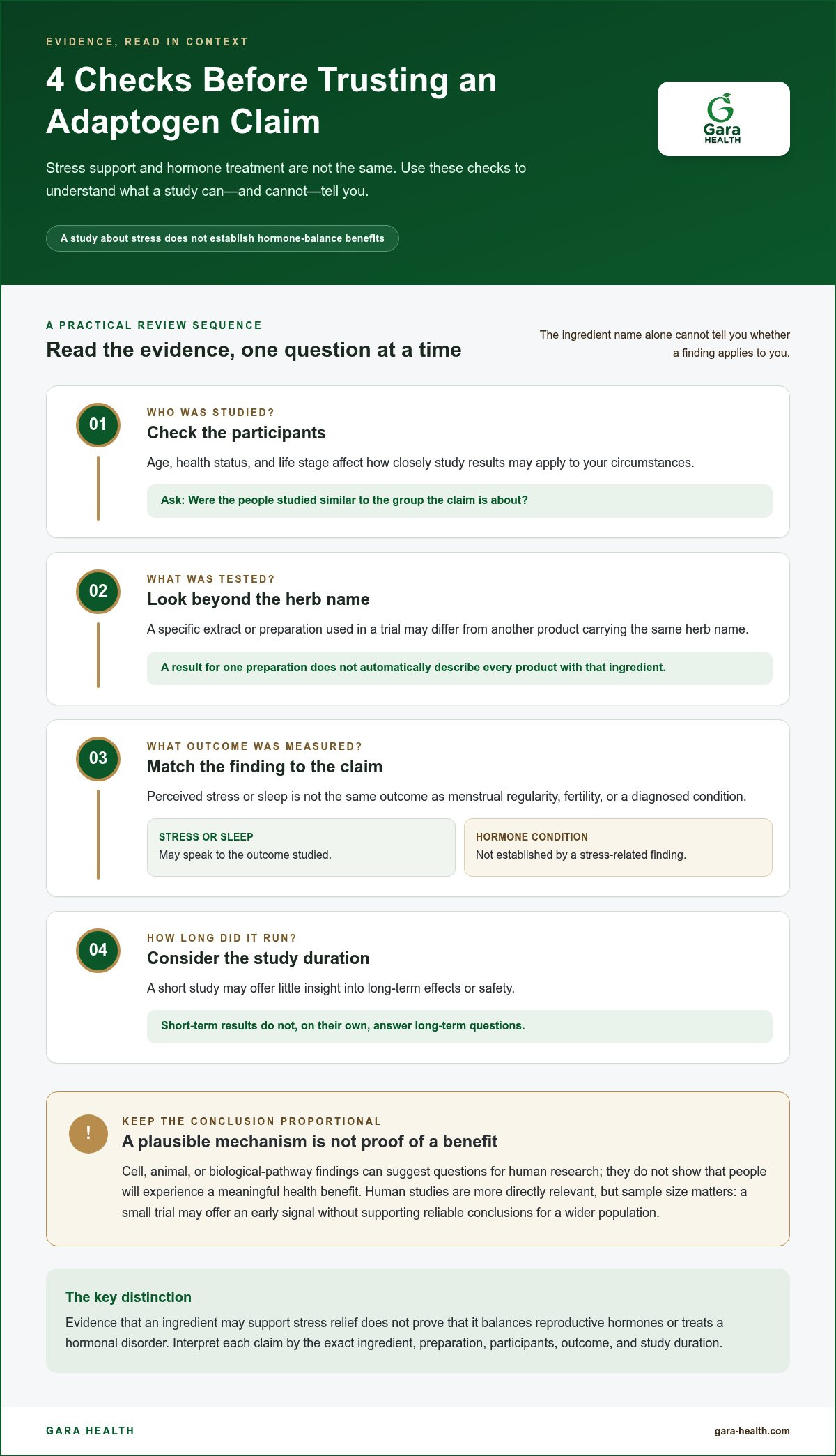
Human studies are more directly relevant, but the details matter. Before interpreting a claim about adaptogens for female hormone balance, look at:
- Who was studied: Participants’ age, health status, and life stage affect how closely the results may apply to you.
- What was tested: An extract or preparation used in a trial may differ from another product with the same herb name.
- What outcome was measured: Perceived stress or sleep is not the same as menstrual regularity, fertility, or a diagnosed condition.
- How long the study ran: A short study may offer little insight into long-term effects or safety.
Sample size matters, too. A small trial can provide an early signal, but it may not support reliable conclusions for a wider population. Even a change in a hormone measurement doesn’t automatically mean symptoms improved or a condition was treated. Results can vary by ingredient, preparation, dose, population, and outcome, so broad claims about “adaptogens” can hide important differences between studies.
For example, maca is often discussed in relation to sexual wellbeing. Memorial Sloan Kettering Cancer Center’s overview of Maca and Hormone Modulation helps distinguish proposed uses and mechanisms from the limits of current research. When evaluating a claim, look for the actual human outcome measured instead of assuming a proposed mechanism proves a hormone effect.
If you’re exploring multi-ingredient supplements, review each listed ingredient and consider how it fits your health questions. Explore Gara Health’s shilajit offerings as one example of products to assess by their ingredient information, not as hormone treatments.
Ashwagandha, Maca, and Other Adaptogens: Compare the Claims, Not Just the Names
Herbs are often grouped under a single “hormone support” label, but research asks different questions about each ingredient. Some studies examine stress or sleep, while others look at sexual wellbeing or hormone measurements. Compare the specific outcome, study preparation, and safety considerations rather than choosing an herb based on a life stage or broad promise.
| Ingredient | Commonly discussed purpose | Evidence limits | Safety questions |
|---|---|---|---|
| Ashwagandha | Stress, sleep, and wellbeing | Human research on stress doesn’t establish menstrual or fertility benefits. | Pregnancy, breastfeeding, thyroid conditions or medication, and other medicines. |
| Maca | Libido and sexual wellbeing | Evidence for libido doesn’t prove hormone changes or relief of other symptoms. | Health conditions, medications, and life-stage suitability. |
| Shilajit | Sexual wellbeing | A small and emerging area of research in women; results don’t establish hormone treatment. | Product quality, preparation, health conditions, and medications. |
Ashwagandha and women’s wellness claims
Ashwagandha has human research on perceived stress and sleep, and some studies have examined menopausal symptoms and hormone measurements. These are distinct outcomes. A change in stress scores doesn’t demonstrate a change in menstrual cycles or fertility, and a measured hormone shift doesn’t by itself establish meaningful symptom relief.
Safety deserves equal attention. Ashwagandha should be avoided during pregnancy and breastfeeding. It may affect thyroid hormones, so people with thyroid conditions or taking thyroid medication should seek medical guidance before use. Medication use and other health conditions are also good reasons to discuss a supplement with a qualified healthcare professional.
Maca and other popular adaptogens: what comparisons can, and cannot, tell you
Maca is commonly discussed for libido. Research on sexual desire is not evidence that it balances hormones or treats PMS, infertility, or menopause symptoms. A shilajit and ashwagandha comparison can offer ingredient context, but ingredient comparisons aren’t proof of a health outcome.
For shilajit, a 2023 clinical trial in women examined female sexual-function scores, including desire, arousal, and lubrication. That emerging evidence doesn’t establish effects on reproductive hormones or show that every shilajit product matches the purified preparation studied.
Across all three ingredients, a trial’s extract, dose, and duration may differ from products available to consumers. Results for one preparation can’t automatically be applied to another. These comparisons can help you frame better questions, not identify a universally “best” adaptogen for a particular condition or life stage.
How to Evaluate Adaptogen Supplements and Protect Your Health
A thoughtful supplement decision starts with a clear question, not a broad promise of “balance.” Adaptogens for female hormone balance may sound like one category of solution, but the relevant evidence and safety questions depend on the ingredient, your goal, and your health context. Use this checklist to make the decision more informed.
A practical checklist before trying an adaptogen
- Name the concern. Are you hoping to support stress, sleep, or another specific aspect of wellbeing? Write down what you’re experiencing and when it occurs. Avoid treating “hormone balance” as a diagnosis or assuming one supplement can address several unrelated symptoms.
- Match the evidence to your goal. Look for human studies on the same ingredient and the outcome you care about. Research on perceived stress, for example, doesn’t establish effects on menstrual cycles or fertility. Check who participated, how long the study lasted, and whether it tested a preparation similar to the product you’re considering.
- Read the product details closely. Review the full ingredient list, product form, and serving guidance. For blends, note every ingredient rather than focusing only on the one highlighted in marketing. More ingredients can mean more safety questions, especially if you already take supplements or medicines.
- Consider your personal safety factors. Check whether an ingredient may be unsuitable with your health conditions, medications, pregnancy, or breastfeeding. Ashwagandha, for example, should be avoided during pregnancy and breastfeeding. It may affect thyroid hormones, so people with thyroid conditions or taking thyroid medication should seek medical guidance. Don’t rely on a general product claim to resolve an individual safety concern.
- Decide how you’ll assess the result. If a qualified professional agrees a trial is appropriate, clarify what you’ll monitor and when to reassess. Keep track of symptoms and any unwanted effects, and don’t increase the serving beyond product directions in pursuit of faster results.
Discuss an adaptogen with a qualified healthcare professional before use if you’re pregnant or breastfeeding, take medication, have a health condition, or are unsure whether it’s appropriate for you. Bring the product label and a list of medicines and supplements so the conversation can address the specific ingredients.
When symptoms need professional evaluation
Supplements shouldn’t be the only response to persistent cycle changes, severe symptoms, fertility concerns, or symptoms that are new or worsening. A clinician can help assess possible causes and determine whether evaluation or treatment is appropriate. Don’t assume symptoms are caused by cortisol, estrogen, or another hormone based on how they feel. Different concerns can overlap, and a supplement trial can delay a clearer assessment.
Use supplements, if appropriate, as optional wellness products, not replacements for medical evaluation or prescribed care. As you review ingredient information, explore Gara Health’s shilajit offerings and assess each product against your needs and professional guidance.
Build a Thoughtful Wellness Routine Without Promising Hormone Balance
A supportive routine doesn’t need to be complicated or promise a quick reset. Start with one realistic goal, such as keeping a steadier sleep schedule or making time for regular movement. These everyday foundations can support general wellbeing, but they can’t diagnose or treat a hormone condition, and they shouldn’t delay care for symptoms that concern you.
Where supplement choices fit into a broader routine
Build habits you can sustain, then notice how you feel over time. A consistent bedtime, balanced meals, enjoyable movement, and stress-care practices such as quiet breaks or breathing exercises can create a steadier foundation for daily life. There’s no need to change everything at once. Choose one small step that fits your circumstances and adjust it as needed.
If you’re considering adaptogens for female hormone balance, keep your goal specific and evidence-minded. A supplement may be an optional part of a wellness routine, but it isn’t a substitute for evaluation or treatment of a diagnosed condition. Your routine can support wellbeing without proving that hormones are “balanced.”
Tracking can make health conversations more useful. Note what you’re experiencing, when it happens, how long it lasts, and whether anything seems to affect it. For cycle-related concerns, record changes in timing or symptoms rather than trying to interpret them as a particular hormone shift. Bring those observations, along with a list of supplements and medicines, to a qualified healthcare professional if symptoms persist or affect daily life.
A transparent look at Gara Health’s shilajit resin
Gara Health Himalayan Shilajit Resin is a 30 g resin infused with ashwagandha, turmeric, and tribulus. It also contains fulvic acid and 75+ trace minerals. The ingredient list tells you what the product contains; by itself, it does not show that the finished resin has been clinically studied for a particular outcome, balances hormones, or treats a women’s health condition. Research on an individual ingredient also can’t automatically establish the effects of a multi-ingredient product.
The resin comes in a food-grade glass jar with an included spoon and provides 30-60 servings, depending on the pea-sized amount used per serving. To use it, dissolve a pea-sized amount in warm water, milk, or tea. It is an adult supplement and is not intended for children. The listed price is $30.00, discounted from $40.00. These details can help you evaluate the product, but they don’t establish a hormone-related outcome.
That distinction is useful for any supplement: consider the specific product, its full ingredient list, and the evidence behind the health outcome being claimed. If you have questions about whether an ingredient is appropriate for you, especially alongside medication or a health condition, bring the label to a healthcare professional before use.
If you’d like to review the ingredient information for yourself, explore Gara Health’s wellness products. An ingredient list is a starting point for informed consideration, not a promise of hormone results.
Choose Your Next Step With Clarity
Let your next wellness choice begin with a question you can actually evaluate, not pressure to fix everything at once. If you’re exploring adaptogens for female hormone balance, set a realistic goal, keep track of what matters to you, and make room for professional guidance when symptoms need attention. Thoughtful care is built through steady decisions, not quick promises.
For a transparent product example, Gara Health Himalayan Shilajit Resin is infused with ashwagandha, turmeric, and tribulus. Those ingredients describe the formula, but they don’t establish that the finished product balances hormones or treats a health condition. Review product details with your own needs in mind, and consider discussing supplement choices with a qualified healthcare professional.
When you’re ready, browse Gara Health’s wellness products and review the ingredient details as you make your next wellness choice.
Frequently Asked Questions
Can adaptogens balance female hormones?
No, current evidence doesn’t establish adaptogens as reliable hormone balancers or treatments for endocrine or reproductive conditions. Research often focuses on other outcomes, such as stress scores, so it can’t be assumed to predict cycle changes or fertility effects. If you’re researching adaptogens for female hormone balance, match claims to human studies and your specific concern. For ongoing symptoms, discuss assessment and supplement plans with a qualified healthcare professional.
Which adaptogen is best for female hormone balance?
No single adaptogen has been established as best for female hormone balance. Ashwagandha and maca are discussed for different purposes, and research on one ingredient or preparation doesn’t establish that another will have the same effect. Start by naming the outcome you care about, such as sleep or libido, then check whether studies measured that outcome in people like you. A healthcare professional can help weigh this against your health history.
Can ashwagandha affect hormones or menstrual cycles?
Ashwagandha may be relevant to hormone-related questions, but research doesn’t show that it predictably changes everyone’s hormone levels or menstrual cycle. If your cycle changes after starting a supplement, note when the change began, the product and serving, and any other medicines or supplements you use. Share those details with a qualified healthcare professional rather than assuming the herb or a particular hormone is the cause.
Are adaptogens safe to take during pregnancy?
Don’t assume an adaptogen is safe in pregnancy because it’s plant-based or labeled natural. Safety information can be limited and differs by ingredient and product. Ashwagandha should not be used during pregnancy or while breastfeeding. If you’re pregnant, breastfeeding, or trying to conceive, speak with your obstetric or other qualified healthcare professional before taking any adaptogen, and bring the product label so they can review its full ingredient list.
Can adaptogens help with PMS or menopause symptoms?
Some supplements are promoted for PMS or menopause, but marketing language isn’t proof that they relieve those symptoms. Look for human research that measures the specific concern, such as sleep disruption or hot flashes, rather than relying on stress-related findings. Keep a record of symptoms and how they affect daily activities. If symptoms are severe, persistent, or disruptive, seek clinical guidance instead of relying on supplements alone.
Can adaptogens interact with medications?
Yes, an adaptogen may interact with medication or be unsuitable with certain health conditions, depending on its ingredients and preparation. This is especially important with blends, because several ingredients may need review at once. Before starting one, show a qualified healthcare professional or pharmacist the complete label, including serving directions and other ingredients. Mention prescription and over-the-counter medicines, as well as any other supplements you take.
How long does it take for adaptogens to work?
There’s no reliable timeline that applies to every adaptogen or person. Studies may use different preparations, durations, and measures, so a result for one product can’t set expectations for another. Be cautious of claims that promise a specific hormone result by a certain date. If you and a healthcare professional decide a supplement is appropriate, follow its directions, track the outcome you’re interested in, and seek advice if you notice unwanted effects.


