


A supplement may be worth discussing as part of ME/CFS care, but it isn’t a shortcut to recovery. If you’re weighing supplements for chronic fatigue syndrome while symptoms disrupt work and daily life, conflicting claims can make it hard to separate evidence from marketing.
It’s understandable to look for something that might ease fatigue or support your wellbeing. Research offers some early signals, but not a cure: a January 2025 systematic review of 14 studies involving 809 participants found that evidence for supplements such as CoQ10/NADH was limited by small studies and a high risk of bias.
This guide explains what supplements may and can’t do for ME/CFS, how to weigh the evidence, and what to discuss with your clinician or pharmacist before trying anything. You’ll also learn why interactions, product quality, and individual sensitivities matter, and how to make supplement decisions without relying on cure claims.
Key Takeaways
- Learn why chronic fatigue alone doesn’t establish ME/CFS, and why post-exertional malaise is important to discuss with a clinician.
- Assess supplements for chronic fatigue syndrome by separating evidence for correcting a documented deficiency from evidence for treating ME/CFS itself.
- Compare ingredient-specific claims with the type and strength of available evidence, and keep uncertainty in view.
- Prepare for a safety conversation by bringing the exact product label and a list of your medicines and health conditions.
- Build a grounded next step around clinical assessment, realistic expectations, and questions to take to your next appointment.
What chronic fatigue syndrome means, and why supplements are not a simple answer
Persistent fatigue can make familiar routines feel out of reach. But fatigue is a symptom, not a diagnosis: it can have many possible causes, and ongoing exhaustion deserves assessment by a qualified clinician rather than an assumption that it is ME/CFS. Myalgic encephalomyelitis/chronic fatigue syndrome is a complex condition involving more than feeling tired. For background on the condition’s symptoms and impact, see this overview of ME/CFS. Diagnosis belongs in a clinical conversation.
Current criteria describe a substantial reduction in a person’s ability to carry out usual activities, with profound fatigue lasting more than six months, post-exertional malaise (PEM), and unrefreshing sleep. At least one additional symptom, such as cognitive difficulties or orthostatic intolerance, is also part of the criteria. These details can help frame a discussion, but a short checklist can’t confirm ME/CFS or rule out other explanations.
How is ME/CFS different from feeling tired?
A key distinction is PEM: symptoms worsen after physical, cognitive, or emotional exertion. The effort might be a busy appointment, concentrating on a task, or completing everyday chores. The worsening can feel out of proportion to the activity and may disrupt plans afterward. Note what tends to precede a flare and how symptoms change, then share that pattern with a clinician. Don’t use this observation alone to diagnose yourself.
Why do people with ME/CFS look into supplements?
When symptoms interfere with work, relationships, or daily routines, it’s understandable to look for manageable ways to support wellbeing. Supplements can seem practical, especially when online claims promise more energy or a quick fix. Yet a product’s popularity, “natural” label, or proposed role in general wellness doesn’t show that it works for ME/CFS. Consider evidence ingredient by ingredient, alongside safety and personal circumstances.
General wellness support is not the same as proven treatment for ME/CFS. Even if a supplement is studied or widely discussed, it isn’t a cure, and interest in it doesn’t establish effectiveness for this condition. The phrase supplements for chronic fatigue syndrome covers many ingredients and claims, not one established approach that works for everyone.
In the sections ahead, you’ll find a practical way to examine those claims without losing sight of the bigger picture. A clinician can help assess persistent fatigue, consider other possible causes, and discuss whether a supplement is appropriate alongside your care. The goal is a thoughtful decision, not another promise that leaves you guessing.
What does the evidence say about supplements for chronic fatigue syndrome?
Research can offer clues, but a promising result is not the same as a dependable treatment. When considering supplements for chronic fatigue syndrome, ask whether the evidence applies to people with ME/CFS, measures outcomes that matter to them, and is strong enough to guide real-world decisions.
How to interpret supplement research
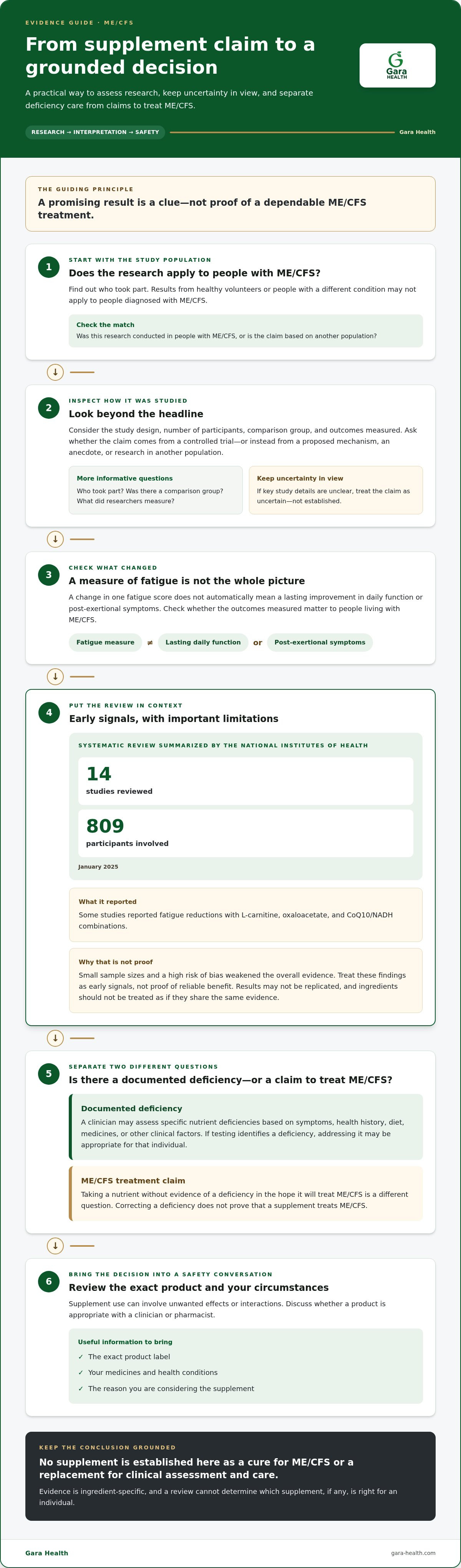
Start by checking who took part. Findings from healthy volunteers or people with a different condition may not apply to ME/CFS. Then look at the study design, number of participants, comparison group, and outcomes measured. A change in one fatigue score, for example, doesn’t automatically mean a lasting improvement in daily function or post-exertional symptoms.
A January 2025 systematic review summarized by the National Institutes of Health examined 14 studies involving 809 participants. It reported fatigue reductions in some studies of L-carnitine, oxaloacetate, and CoQ10/NADH combinations, but noted that small sample sizes and high risk of bias weakened the overall evidence. Treat these as early signals, not proof of reliable benefit. Results from one study may not be replicated, and different ingredients should not be grouped together as if they share the same evidence.
When reading a claim, ask whether it describes a controlled trial in people diagnosed with ME/CFS or relies on a proposed mechanism, anecdote, or research in another population. Check what researchers measured and whether the study was large and rigorous enough to support its conclusion. If those details aren’t clear, treat the claim as uncertain rather than established.
Why a deficiency is different from an ME/CFS treatment
A clinician may assess specific nutrient deficiencies based on symptoms, health history, diet, medicines, or other clinical factors. If testing identifies a deficiency, addressing it may be appropriate for that individual. That is different from taking a nutrient without evidence of a deficiency in the hope it will treat ME/CFS. Supplementing without guidance can also create risks, including unwanted effects or interactions.
Correcting a documented deficiency supports a specific health need; it doesn’t prove that a supplement treats ME/CFS. This distinction helps keep expectations grounded. A benefit from correcting a deficiency shouldn’t be used to claim that the same ingredient relieves the condition for people who aren’t deficient.
Evidence is ingredient-specific, and even encouraging findings need careful interpretation. The review’s results don’t establish which supplement, if any, is appropriate for a particular person. No supplement should be presented as a cure for ME/CFS or as a replacement for clinical assessment and care. Bring a product’s exact label and the reason you’re considering it to a clinician or pharmacist, so you can discuss evidence and safety together.
Gara Health’s general wellness offerings are not ME/CFS treatments. Evaluate any supplement on its own evidence and suitability, not on broad wellness positioning.
Compare ME/CFS Supplements Without Falling for Cure Claims
Supplement claims can sound similar while resting on very different kinds of evidence. Compare each ingredient on its own, and look for research in people with ME/CFS that measures outcomes relevant to the condition. A familiar ingredient name, polished packaging, or promise of “natural energy” doesn’t establish clinical effectiveness. Claims of a cure, guaranteed energy, or rapid recovery call for strong evidence, not just persuasive language.
What makes a supplement claim credible or questionable?
Give more weight to well-designed human clinical research in people diagnosed with ME/CFS than to testimonials, laboratory findings, or traditional use alone. Check whether the outcome is directly relevant to ME/CFS, such as fatigue or day-to-day function, rather than a general wellness measure. Study quality, limitations, and replication matter. Avoid ranking ingredients as effective unless current, relevant evidence supports that conclusion.
Use the comparison as a prompt for questions, not as a shopping list or treatment ranking. For any claim, look for what was tested, who participated, what changed, and what remains uncertain. A result in a small study or a proposed effect on a biological process may be a reason for further research, but it can’t by itself show that people will feel better or function differently.
How should readers think about shilajit and other wellness ingredients?
Gara Health’s Himalayan Shilajit Resin 30g, Gara Shilajit Coffee Powder, and Gara Health Mushroom Coffee are general wellness products, not ME/CFS treatments. Broad language about energy or vitality shouldn’t be read as evidence that a product treats this condition. For product-specific background, the Himalayan Shilajit Resin 30g guide describes the product but does not establish ME/CFS benefits.
With supplements for chronic fatigue syndrome, keep product quality and clinical effectiveness distinct. Even a familiar or carefully presented ingredient needs relevant evidence for the condition-specific claim being made. Bring the exact label and the claim that caught your attention to your clinician or pharmacist, and discuss whether the ingredient is appropriate for you before starting it.
How to discuss supplement safety with your clinician
Before starting, stopping, or changing a supplement, make room for a safety check with a clinician or pharmacist. Supplements can cause side effects and interact with medicines, and the risks depend on the specific ingredients and your health circumstances. Bring the actual product information, not just its name or a screenshot of a promotional claim. This gives your care team a clearer basis for discussing whether it fits your situation.
What information should you bring to an appointment?
A short, organized record can make the conversation more useful. Include everything you take, even products that seem unrelated to your main concern. Ask about possible interactions, contraindications, and whether monitoring is appropriate for you. Don’t make changes to prescribed medicines based on a supplement label or online advice.
- Bring the exact product label. Include the full ingredient list and directions, since similar product names may refer to different formulations.
- List all medicines and supplements. Include prescriptions, over-the-counter medicines, vitamins, herbal products, and anything you use occasionally.
- Note relevant health conditions. Share diagnoses, allergies, and other health details that may affect whether an ingredient is suitable.
- Record timing and symptoms. Note when you started or changed a product and when symptoms occur or shift. This timeline can help your clinician assess a possible connection.
- Ask specific safety questions. Find out whether the product could interact with your medicines, be unsuitable for a health condition, or require monitoring.
How can you avoid risky product decisions?
Keep supplement choices within your wider care conversation. Don’t replace prescribed care or delay a clinical assessment to try a product. Claims that promise a cure or guaranteed energy, or pressure you to stop medical treatment, are warning signs. Strong marketing doesn’t replace sound evidence or a review of your personal risks.
Interactions can be clinically important. CoQ10, for example, can interact with warfarin, a blood thinner. This example doesn’t predict what will happen for any one person, but it shows why an ingredient’s name alone isn’t enough to judge safety. Share the full label with a clinician or pharmacist before combining supplements and medicines.
Have a clinician or pharmacist review a supplement before combining it with medicines or other supplements. If you notice new, severe, or rapidly worsening symptoms, seek prompt clinical attention rather than waiting to see whether they pass. This section offers general information, not individualized medical advice; your care team can consider your medical history and current treatment.
If you’re exploring Gara Health’s general wellness offerings, consider them separately from ME/CFS care. General wellness positioning doesn’t establish a condition-specific benefit, so keep the product label and safety discussion central to any decision.
A grounded next step: make supplement choices part of a wider care conversation
Choosing what to try is only one part of making a thoughtful decision. For supplements for chronic fatigue syndrome, start with clinical assessment, realistic expectations, and a safety review that reflects your health history and current care. A supplement can’t replace diagnosis or individualized medical guidance, and a product shouldn’t be assumed suitable for ME/CFS simply because it is marketed for energy or wellness.
Build a careful personal decision process
Before your next clinical conversation, write down what you’re considering and what you hope to understand. If you already use a supplement, note its exact name, the date you started it, and any changes you noticed afterward. Bring the product label and your questions so your clinician or pharmacist can discuss ingredients, possible interactions, and whether the product makes sense for you.
Keep notes simple and avoid turning them into a self-directed experiment. Deliberately starting or changing products without professional input could complicate symptom tracking, create safety concerns, or delay assessment. If symptoms worsen after a change, record the timing and discuss it with your care team; don’t assume the supplement is the only possible cause.
If you’re looking for general context about symptoms associated with low vitality, Gara Health’s signs of low vitality guide covers that broader wellness topic. Low vitality is not the same as ME/CFS, and a general guide can’t diagnose the condition or replace clinical assessment.
Explore Gara Health’s general wellness range
Gara Health offers Himalayan Shilajit Resin 30g, Gara Shilajit Coffee Powder, and Gara Health Mushroom Coffee as general wellness products. They are not presented as products that prevent, treat, cure, or manage ME/CFS, and this article doesn’t establish their suitability for someone with the condition. Consider any product separately from your care plan, based on its own information and a safety discussion with your clinician or pharmacist.
A useful next step is modest: bring your questions, a current list of what you take, and the exact label of any product you’re considering to your next appointment. Ask what the evidence can support, what risks matter in your circumstances, and whether there’s a safer or more relevant way to address your concern. You don’t need to decide on the spot. Clear information and a measured conversation can help you make a choice that fits your care.
If you’re interested in general wellness products, explore Gara Health’s range separately from ME/CFS treatment decisions.
Take your next step with clarity and care
Your next step doesn’t have to be a quick decision about a product. Bring your questions and the label of anything you’re considering to a clinician or pharmacist, and make space for guidance that reflects your needs. With supplements for chronic fatigue syndrome, thoughtful decisions start with realistic expectations and professional advice, not pressure to try a cure.
Keep general wellness separate from ME/CFS treatment. Gara Health offers Himalayan Shilajit Resin 30g, Gara Shilajit Coffee Powder, and Gara Health Mushroom Coffee as general wellness products, not as products for treating the condition. To explore them in that context, browse Gara Health’s general wellness products.
Give yourself permission to move at a pace that feels manageable. A clear question, a careful conversation, and a decision grounded in your health circumstances are meaningful progress. You deserve support that respects both your wellbeing and your need for reliable information.
Frequently Asked Questions
Can supplements help chronic fatigue syndrome?
Some supplements have been studied for symptoms in people with ME/CFS, but the findings don’t establish reliable benefit for everyone. A result for one ingredient or group can’t predict how another person will respond. If considering supplements for chronic fatigue syndrome, check whether research involved people diagnosed with ME/CFS and measured outcomes relevant to daily life. A clinician can help weigh that evidence against your individual health needs.
What supplements are recommended for ME/CFS?
There isn’t a single supplement recommendation that applies to everyone with ME/CFS. A clinician may recommend addressing a nutrient deficiency if assessment identifies one, but that’s different from treating ME/CFS itself. Before choosing a product, consider why you’re taking it, what evidence supports that specific ingredient, and whether it fits your health history and medicines. Avoid starting several new products together, since that can make changes in symptoms harder to interpret.
Is there a supplement that cures chronic fatigue syndrome?
No supplement has been established as a cure for ME/CFS. Be cautious of products or sellers promising a guaranteed recovery, a rapid cure, or a way to replace medical care. Those claims require strong, relevant evidence, not testimonials or general wellness language. If a claim makes you feel pressured to buy or stop prescribed treatment, pause and discuss it with a clinician or pharmacist before making a decision.
Can shilajit help with chronic fatigue syndrome?
There isn’t enough condition-specific evidence to conclude that shilajit treats ME/CFS. Gara Health offers Himalayan Shilajit Resin 30g as a general wellness product, not as a treatment for the condition. Broad claims about vitality don’t show that an ingredient improves ME/CFS symptoms. If you’re considering shilajit, share the exact product label with a clinician or pharmacist and ask about its suitability alongside your current care.
Are supplements safe to take with ME/CFS medications?
Not always. Safety depends on the supplement’s ingredients, your medicines, and your health circumstances. For example, CoQ10 can interact with warfarin, a blood thinner, so tell your care team about supplements as well as prescriptions and over-the-counter products. Share the full label, including amounts per serving, and ask a clinician or pharmacist about interactions before combining products. Don’t change a prescribed medicine based on supplement advice.
What happens if a supplement makes my symptoms worse?
If symptoms worsen after you start a supplement, note when you took it and when the change began, then contact your clinician or pharmacist for guidance. Don’t assume the product is the cause, but make sure your care team knows about the timing and any other changes. Seek prompt clinical attention for severe, rapidly worsening, or alarming symptoms. Don’t stop or alter prescribed medicines without medical advice.
How do I know whether an ME/CFS supplement claim is trustworthy?
Look for human research involving people diagnosed with ME/CFS, and check what outcome the study measured. A laboratory result, traditional use, or personal story may prompt a question, but it can’t establish that a supplement works for the condition. Be wary of claims that promise a cure or guaranteed energy. Compare an advertisement’s wording with the study’s actual findings, and bring unclear claims to a health professional.
Should I see a doctor before trying supplements for chronic fatigue?
Yes. A clinician can assess persistent fatigue, consider possible causes, and help you think through supplement risks in light of your medicines and health history. Bring the product label and a list of everything you take, including occasional over-the-counter products. If arranging an appointment takes time, a pharmacist may be able to discuss potential interactions, but that conversation doesn’t replace assessment of ongoing or worsening symptoms.


