


What if better productivity starts with a steadier workday, not another stronger cup of coffee? If your focus fades before your to-do list does, it’s understandable to wonder whether mushroom coffee for productivity could help. A new drink alone, however, won’t build a dependable routine.
Small, repeatable habits can give your workday more structure: choose a clear priority, set aside focused time for it, and take deliberate breaks. Mushroom coffee may fit into that routine as a personal beverage choice, but claims about sharper focus deserve a closer look. Research on mushroom ingredients doesn’t automatically show that a serving of a commercial coffee will improve concentration or task completion.
This guide covers practical ways to support focus at work, what research on mushroom ingredients can and can’t tell us about mushroom coffee, and how to decide whether it belongs in your day. You’ll also find ways to compare coffee options and build a repeatable work routine, without expecting a guaranteed productivity boost.
Key Takeaways
- Build productivity around clear priorities and consistent work habits, rather than expecting one drink to do the work for you.
- Assess claims about mushroom coffee for productivity with care: research on individual mushrooms doesn’t automatically prove benefits from a finished coffee blend.
- Compare mushroom and regular coffee by taste, familiarity, and ingredient variation, and check the label for caffeine information.
- Try a simple workday structure with a focused work block, planned breaks, batched tasks, and a clear starting point for tomorrow.
- Consider Gara Health Mushroom Coffee as an optional beverage choice, while keeping sustainable work habits at the center of your routine.
Why productivity at work depends on more than a coffee choice
A message arrives just as you start a report. Your task list has six “top priorities,” and by mid-afternoon, even simple decisions feel harder. It’s tempting to reach for another coffee and push through, but interruptions, unclear expectations, and fading attention can all affect how much meaningful work gets done. A beverage may be part of your day, but it can’t resolve every barrier around the work.
Productivity is shaped by routines and working conditions: how tasks are defined, how often your attention is interrupted, and whether the workload fits the time available. If every request is urgent or your day is packed beyond capacity, the issue may not be a lack of willpower or caffeine. Consider mushroom coffee for productivity within that wider picture, rather than as a shortcut to completing more.
Workplace productivity is the steady completion of valuable work within realistic limits, not a demand to produce constantly. Answering messages all day can feel busy while leaving the task that requires your judgment untouched. Before changing your coffee, define what outcome would make the day feel genuinely useful.
Interest in functional mushrooms has a longer cultural and research history, but that context doesn’t establish that a coffee blend will improve work performance. For a broad overview, medicinal fungi have been used for centuries in traditional medicine, with scientific investigation into their pharmacological applications beginning in the 1960s. Claims about a particular product still need to be considered separately from that history.
Spot the workday barriers draining your focus
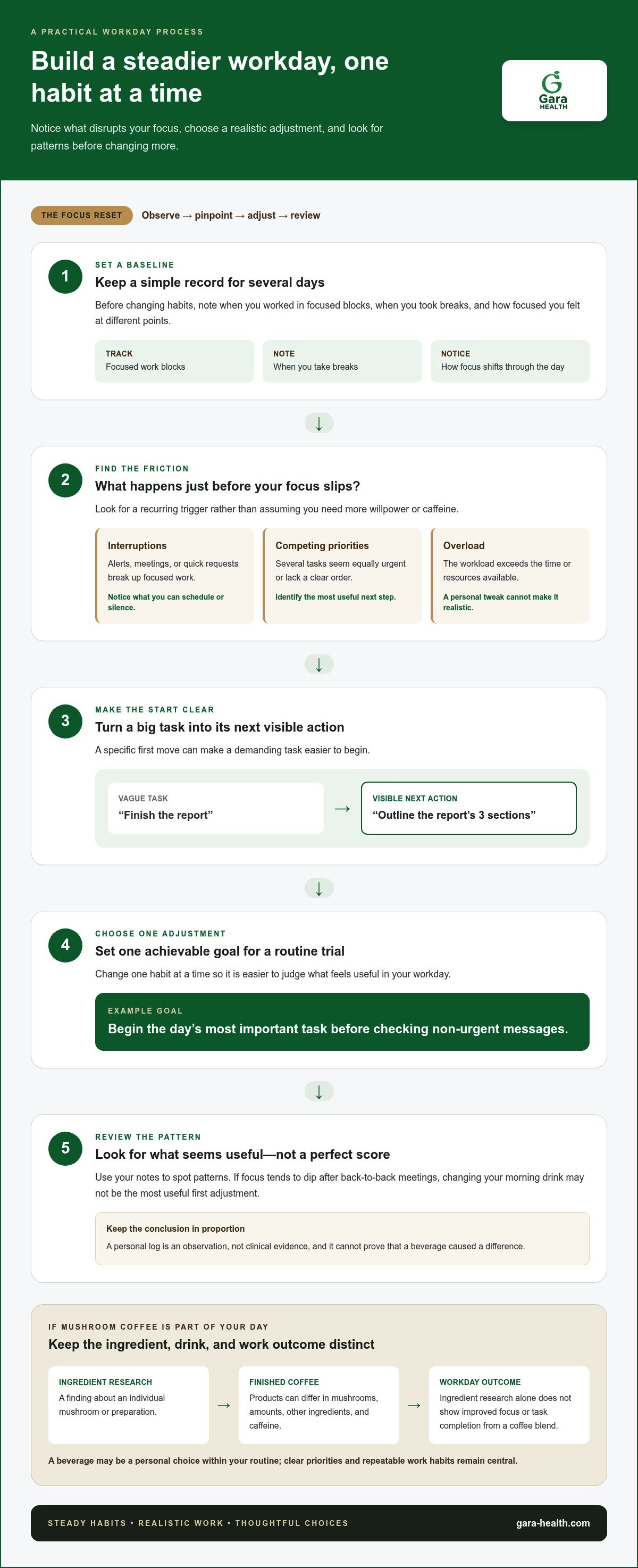
For a few days, notice what happens just before your focus slips. Is it an interruption, uncertainty about what comes first, or a project that feels too big to begin? Make a demanding task easier to start by defining its next visible action. For example, replace “finish the report” with “outline the report’s three sections.”
- Interruptions: Note whether alerts, meetings, or quick requests repeatedly break up focused work. Record which interruptions you can schedule or silence.
- Competing priorities: Identify tasks that need a clearer order or an agreed deadline. If several tasks seem equally urgent, decide which one has the most useful next step.
- Overload: Separate a fixable routine issue from a workload that exceeds the time or resources available. A personal productivity tweak can’t make an unrealistic workload realistic.
Set a realistic baseline before trying a new routine
Before changing several habits at once, keep a simple record for several days. Note when you worked in focused blocks, when you took breaks, and how focused you felt at different points. Look for patterns, not a perfect score. For example, if your attention tends to dip after back-to-back meetings, changing your morning drink may not be the most useful first adjustment.
Choose one achievable goal for a routine trial, such as beginning the day’s most important task before checking non-urgent messages. A short personal log can help you see whether a change feels useful in your workday. It’s an observation, not clinical evidence, and it can’t prove that a beverage caused a difference. Changing one habit at a time makes it easier to judge what works for you.
What mushroom coffee may, and may not, do for productivity
Mushroom coffee is a broad category, not one standard recipe. It generally combines coffee with mushroom powders or extracts, but the mushrooms, amounts, and other ingredients can differ by product. You can’t assume that every cup has the same composition, caffeine content, or potential effects.
Interest in mushroom coffee for productivity often centers on possible effects related to attention, energy, or cognition. These are reasonable questions to explore, but a claim about an ingredient isn’t proof that a finished drink helps people complete work tasks. A study may examine a specific mushroom preparation, amount, or group of participants. A commercial coffee blend can differ on all three.
What research on functional mushrooms can tell us
Lion’s mane, reishi, cordyceps, and chaga are examples of mushrooms used in this product category. Research on an individual mushroom can help investigate a particular ingredient, but its relevance depends on how the study was designed, what preparation and amount were used, and who took part. Those details limit how broadly a finding can be applied.
A result involving a measured ingredient in a controlled study doesn’t establish that a cup containing a different formulation will have the same effect. It also doesn’t show that people will focus longer, finish more tasks, or feel more productive at work. Keep the ingredient, finished product, and workplace outcome separate when weighing a claim.
Why a promising claim is not a guaranteed work benefit
An early or indirect finding can make an ingredient worth further study, but it isn’t a demonstrated result for a person’s workday. To support a productivity claim, evidence would need to relate to the finished product and a meaningful outcome, not just a proposed mechanism or a finding about one ingredient.
Formulas differ, and people can respond differently to the same beverage. Taste, caffeine content, expectations, and the rest of someone’s routine may also shape how a cup feels. Treat claims of sharper focus or higher output as possibilities to assess, not promises. If you try a blend, notice your own experience without assuming a change proves that the mushroom ingredients caused it.
A useful evidence check: Research on a mushroom may support scientific interest in that ingredient, but it doesn’t establish that mushroom coffee improves workplace productivity. That outcome needs evidence on the finished drink and the work results themselves.
If you’re curious about trying the category, Gara Health Mushroom Coffee is one beverage option to consider as part of your routine, not a guaranteed route to better focus.
Mushroom coffee vs. regular coffee: choose for your workday
Your best workday drink is the one that fits your preferences and routine, not the one with the boldest productivity claims. Regular coffee offers a familiar taste and caffeine experience. Mushroom coffee adds mushroom ingredients to a coffee-based blend, but formulas vary. Neither beverage guarantees sharper focus or better work results. Weigh what you enjoy, how you respond, and what the label says.
| Consideration | Regular coffee | Mushroom coffee |
|---|---|---|
| Familiarity | A well-known choice if you already enjoy coffee. | A coffee alternative for those curious about functional blends. |
| Caffeine | Amount can vary by serving and preparation. | Amount can also vary; check the specific product label. |
| Taste | Offers the coffee flavor you know and prefer. | Flavor can differ depending on the blend. |
| Ingredients | Typically centered on coffee. | Mushroom ingredients and other additions can vary by formula. |
When regular coffee may suit your routine
If you enjoy its flavor and know how caffeine feels for you, regular coffee may be a simple fit. Pay attention to your response: do you feel jittery, notice sleep disruption, or find that an afternoon cup affects how you feel later in the day? These patterns can help you decide whether the timing or amount suits you. You don’t need to switch just because a new drink is trending.
When mushroom coffee may be worth exploring
If you’re curious about functional coffee blends, mushroom coffee may be worth trying as a taste and routine choice, not as a promise of improved performance. Read the label for listed ingredients and caffeine information, then compare it with what you currently drink. Don’t assume mushroom coffee is automatically lower in caffeine. The specific product matters, and a blend’s ingredients alone don’t establish a particular work outcome.
Start with your actual needs. If you value a familiar flavor and already tolerate your usual coffee well, there may be no reason to change. If you want to explore a different blend, introduce it without changing several other parts of your routine at once. Notice the taste, how it fits your day, and any effects you personally experience.
This is a more useful way to assess mushroom coffee for productivity than expecting a quick upgrade. The beverage is one variable, not a productivity system. Choose based on preference and tolerance, check the label, and keep your expectations realistic.
How to increase productivity at work naturally: a practical routine
A supportive workday routine doesn’t need to be complicated. It should make the next useful action clear, protect some attention for it, and leave room to reset. Try the steps below for one week, adapting the timing to your workload and personal needs. The aim is consistency, not a flawless day.
Build a focused work block around one priority
Before opening multiple tasks, choose one meaningful priority and define a finishable outcome. “Draft the introduction” is clearer than “work on the report.” Set a focus period that fits your schedule, silence nonessential notifications, and keep a place to jot down interruptions. Review those notes later instead of treating every lapse in concentration as a failure.
- Choose one priority. Write down the task that would make the biggest useful difference today. Break it into a first action you can begin without extra planning.
- Protect a distraction-light block. Decide when you’ll work on that action. Close unrelated tabs, silence nonessential alerts, and let colleagues know when you’ll be available if that suits your workplace.
- Take a deliberate break. Pause between demanding stretches of work. Step away from the screen, move around, or give your attention a change of pace. Let the length and timing fit your workload and how you’re feeling.
- Batch similar tasks. Group smaller activities, such as routine replies or administrative updates, into a planned window where possible. This can reduce the feeling of jumping between unrelated tasks all day.
- Prepare a clear starting point for tomorrow. Before finishing, note what you completed and write down the next action for any unfinished priority. A short plan can make it easier to begin without rebuilding your task list from scratch.
Use breaks and beverage habits deliberately
Keep everyday needs in view as you plan your work: make time for water and meals, and don’t treat a drink as a substitute for a sustainable routine. Coffee can serve as a familiar cue to begin a focus block, but it doesn’t guarantee results. If you’re testing a new coffee, change one variable at a time and note what you notice, including taste, timing, and perceived focus.
For one week, keep a brief log of whether you followed the routine and how focused you felt. Note whether you started with your chosen priority, completed a focus block, and took planned breaks. These are personal observations, not proof that a beverage caused a change. They can help you see which habits feel workable and worth keeping.
If you’d like to include mushroom coffee in your routine, explore Gara Health Mushroom Coffee as an optional beverage choice alongside your workday habits.
Make Gara Health Mushroom Coffee an optional part of your routine
Once you have a realistic workday routine and a clear view of what the evidence can and can’t show, decide whether mushroom coffee fits your preferences. Gara Health Mushroom Coffee is an option for readers interested in exploring this category. Think of it as a beverage choice, not the foundation of your productivity plan or a promise of better focus.
Your priorities, work environment, breaks, and task planning are habits you can shape directly. Coffee can be part of a morning ritual, but choosing mushroom coffee for productivity doesn’t establish that it will help you finish more work. Decide whether you enjoy it and whether it fits your day, without expecting a guaranteed result.
Evaluate the product as part of your personal trial
Before trying Gara Health Mushroom Coffee, review its current label and preparation information so you know how to make it and what the product information says. If you choose to include it, keep the rest of your routine as steady as possible. Track a few simple observations: whether you like the taste, how easily it fits your usual schedule, and how focused you feel during work.
Your notes can help you decide whether the drink suits you, but they can’t prove that it caused a change in concentration or task completion. Individual responses vary. If you experience an unwanted effect, stop the trial rather than pushing through in pursuit of a productivity benefit.
Choose a next step that feels sustainable
Keep your experiment manageable: choose one work habit and one beverage variable to evaluate. For example, keep your usual task-planning approach and note how a different coffee fits your morning. Or keep your drink unchanged while consistently starting with one defined priority. Avoid changing several things at once so your observations are easier to interpret.
At the end of your trial, ask a grounded question: did this feel enjoyable and workable as part of my routine? That’s more useful than asking whether it transformed your output. Sustainable progress comes from habits you can repeat, such as clarifying priorities, protecting attention, and preparing for the next workday. No beverage can replace those foundations, and you don’t need to chase a quick fix to build a more focused rhythm.
If you’re curious to see whether it suits your preferences, explore Gara Health Mushroom Coffee and review the product information as you decide on your next step.
Make your next workday a thoughtful experiment
Your next step doesn’t need to be a complete routine overhaul. Choose one small adjustment you can repeat, then notice whether it feels useful. A calmer start, a clearer first task, or a beverage you genuinely enjoy can become part of a more intentional workday, without turning productivity into a test you have to pass.
If you’re curious about mushroom coffee for productivity, approach it with the same steady mindset: let personal preference guide your choice and keep expectations realistic. Gara Health Mushroom Coffee is available through Gara Health’s online store as an option to explore. Build your routine around habits that support your day and feel sustainable, not around chasing a quick fix.
Explore Gara Health Mushroom Coffee and decide whether it feels like a fitting addition to your routine. Keep your work habits practical and repeatable, and let each small choice help you build a more focused, manageable workday.
Frequently Asked Questions
Can mushroom coffee help you focus at work?
You may enjoy it as part of your work routine, but evidence that finished mushroom coffee products improve workplace productivity is limited. Research interest in individual mushroom ingredients doesn’t establish the effects of a particular blend. Focus is also shaped by sleep, workload, your environment, and how you respond to caffeine. Treat mushroom coffee for productivity as an optional beverage choice, not a guaranteed solution to distraction or unfinished tasks.
Is mushroom coffee better than regular coffee for productivity?
Neither is automatically better. The right fit depends on taste, caffeine content, personal tolerance, and your existing routine. Mushroom coffee formulas vary, so read the label instead of assuming a particular caffeine amount. Neither choice guarantees stronger performance. To compare them, try each with similar work tasks while keeping your schedule and work habits steady. Notice which you prefer and how you feel, rather than expecting a dramatic change.
Does mushroom coffee contain caffeine?
Some mushroom coffees combine mushrooms with coffee and contain caffeine, but formulas differ, and there isn’t one amount that applies to every product. Check the specific blend’s label for its ingredients and caffeine information. If you’re sensitive to caffeine, consider how the timing fits your day and observe your response. If you have health concerns or take medication that may interact with ingredients, seek advice from a qualified health professional before trying a new product.
How can I increase productivity at work naturally?
Start by choosing one task with a clear finish point, then set aside a focused block and reduce interruptions you can control. Schedule breaks that suit your workload, and group similar small tasks rather than switching between them constantly. Before you sign off, write down tomorrow’s first action. Track a few habits, such as whether you began with your priority and took a break, to learn what fits your role and working style.
Can mushroom coffee replace sleep or breaks?
No. A beverage can be part of a daily routine, but it isn’t a substitute for sleep or needed rest. Insufficient recovery may make sustained attention harder, and extra coffee won’t make an excessive workload manageable. Where possible, keep a consistent sleep schedule and make room for breaks during demanding days. If you’re regularly struggling to stay alert despite adequate rest, consider discussing that ongoing concern with a qualified health professional.
How should I evaluate whether mushroom coffee fits my work routine?
Review the product label and preparation directions, then choose a consistent time to try it. Keep other parts of your routine steady and note the taste, your caffeine response, perceived focus, and whether you complete the task you planned. These personal notes can help you decide if the drink suits your preferences, but they aren’t scientific proof of an effect. Stop using it if you experience unwanted effects.


