


Interest in shilajit fulvic acid benefits is growing, but a proposed mechanism or promising result doesn’t automatically prove a health outcome. Conflicting supplement claims can make it difficult to tell what the evidence really supports.
This guide explains fulvic acid in the context of shilajit without relying on scientific jargon or promising guaranteed results. The key distinction is that research on shilajit as a whole doesn’t, by itself, prove that isolated fulvic acid produces the same effects.
We’ll explain what fulvic acid is, describe how researchers think it may act in the body, and review what human studies on shilajit have and haven’t shown. You’ll also learn how to distinguish proposed benefits from measured outcomes, and why a product’s composition matters when interpreting research.
Key Takeaways
- Understand what fulvic acid is and how it fits into shilajit, without treating it as the only active component.
- Learn why proposed effects on nutrient transport or cellular processes are mechanisms to investigate, not guaranteed health outcomes.
- Assess shilajit fulvic acid benefits by checking what substance a study tested, who took part, and what outcome it measured.
- Separate findings about whole shilajit products from evidence about isolated fulvic acid before drawing conclusions.
- Explore Himalayan Shilajit Resin 30g from Gara Health while keeping product claims grounded in evidence.
What Is Fulvic Acid in Shilajit and Its Benefits?
To understand what benefits you can reasonably associate with fulvic acid, start with the difference between the substance and shilajit itself. Fulvic acid is one group of substances associated with humic materials. Shilajit is a naturally occurring, complex material that contains multiple components. A proposed role for one component doesn’t prove a benefit in people.
Fulvic acid is a complex, variable mixture of organic substances associated with humic materials; shilajit is the broader natural material in which fulvic acid is discussed as one component. This distinction matters when evaluating shilajit fulvic acid benefits. Research on a whole shilajit preparation doesn’t automatically show what fulvic acid alone does.
What does fulvic acid mean in a supplement context?
“Fulvic acid” describes a broad group of naturally occurring organic compounds, rather than one uniform molecule with the same structure in every source. It is associated with humic materials, which form as plant and other organic matter breaks down. Source material and processing can affect the resulting composition, so products with the same label may differ.
Fulvic acid isn’t a vitamin or mineral, and the name alone doesn’t establish that a supplement treats a condition or produces a particular health effect. A label may identify fulvic acid as an ingredient, but that doesn’t tell you whether a human study tested the ingredient on its own, in that form, or for the outcome being promoted. Those details matter when weighing a claim.
Why is fulvic acid associated with shilajit?
Shilajit is a dark, naturally occurring material found in mountainous regions and formed over long periods from organic matter and mineral material. Fulvic acid is often discussed as one of its components, but shilajit isn’t simply fulvic acid. Its overall composition can include a range of substances and may vary with its source and processing. The Shilajit Wikipedia page offers a general overview of the material and its composition, but it shouldn’t be treated as proof of a supplement’s effects.
Presence isn’t the same as independent action. If a study reports an effect from a shilajit preparation, the result may relate to the mixture as a whole, its specific composition, or other factors. Unless a study is designed to separate components, it can’t establish that fulvic acid caused the outcome. When you see a claim about fulvic acid benefits, ask what was tested and what researchers measured.
For more product context, the Himalayan Shilajit resin buying guide explains the resin format. Keep general information about shilajit separate from product-specific evidence: a general description can’t establish the fulvic acid content or clinical benefits of an individual product.
How Fulvic Acid May Work: Proposed Mechanisms, Not Promised Outcomes
Claims about fulvic acid often describe what it might do at a cellular level, such as interacting with minerals or other compounds. These ideas can guide research, but they aren’t evidence that taking a supplement improves energy, cognition, or another aspect of health. The distinction is important: a proposed biological mechanism does not prove a clinical benefit.
For example, a laboratory experiment might show that a substance binds to a compound under specific conditions. That doesn’t establish that the same interaction occurs after someone takes a supplement, or that it leads to a noticeable health change. Human studies need to test the relevant substance and outcome directly.
What do researchers mean by mineral transport or bioavailability?
Bioavailability means how much of a substance the body absorbs or can use. Fulvic acid is sometimes proposed to interact with minerals and other compounds in ways that could affect their movement or availability. That’s a hypothesis about a possible process, not proof that a supplement improves nutrient absorption in people. Supporting that claim would require relevant human evidence showing a meaningful effect.
There’s another step between a proposed interaction and a practical result. Even if a compound changes how a mineral behaves in a test tube, digestion, metabolism, and a person’s existing nutrient status may affect what happens after consumption. Researchers need to measure those effects in people rather than assume a laboratory observation predicts them.
The same caution applies to discussions of antioxidant activity, inflammation, or cellular energy. These are areas researchers may explore, but describing a possible pathway doesn’t establish that fulvic acid boosts energy or reduces inflammation in everyday use. The claim needs evidence tied to the actual supplement and outcome.
Why might research on shilajit not prove fulvic acid’s effects?
A study of whole shilajit examines a mixture, not necessarily fulvic acid in isolation. A reported change may reflect the combined preparation, its other constituents, or factors specific to the tested product. Without a design that separates components, researchers can’t confidently attribute the result to fulvic acid alone.
This distinction also helps make sense of cognitive research. The linked NIH review on shilajit and cognitive activity discusses proposed effects and research avenues, including laboratory work involving fulvic acid and tau proteins. Such findings can point to questions for future study, but laboratory observations aren’t evidence that taking fulvic acid prevents cognitive decline in people.
Formats add another consideration. Resin and shilajit-infused coffee are different ways to consume shilajit, but format alone doesn’t prove a particular mechanism or outcome. The shilajit-infused coffee guide provides context on that format. To explore Gara Health’s shilajit offerings, view the shilajit products. Keep proposed mechanisms separate from proven product-specific benefits.
What Does Research Actually Say About Shilajit Fulvic Acid Benefits?
The evidence depends on what was tested. A laboratory finding about fulvic acid, a human trial of whole shilajit, and a study of a specific resin preparation answer different questions. That distinction is central to judging shilajit fulvic acid benefits: promising research may justify further study without showing that isolated fulvic acid produces the same result in people.
Are energy and antioxidant benefits supported in people?
Some human research has examined shilajit preparations, not fulvic acid alone. A 2026 open-label pilot gave healthy adults a shilajit resin described as containing at least 60% fulvic acid for 28 days. Researchers reported improved physical performance and good tolerability. Because the study was open-label and tested a resin mixture, it can’t establish that fulvic acid caused the changes or that the result applies to other products or everyday energy.
A separate 90-day placebo-controlled trial in healthy adults aged 45 to 55 reported increases in total and free testosterone after shilajit. That finding concerns a particular shilajit preparation and hormone measures, not isolated fulvic acid or a broad promise of improved vitality. Study duration, participants, preparation, and measured outcomes all shape what a result can tell us.
What evidence gaps should readers keep in mind?
Laboratory research can explore how substances interact with cells or other compounds, while animal studies can examine effects in living systems. Neither alone demonstrates a benefit for people. Reviews summarize available research, but their conclusions depend on the quality and relevance of the studies. News-Medical.Net’s overview of shilajit benefits and evidence also describes the need for further research.
For any claim, check whether the study tested isolated fulvic acid or whole shilajit, who participated, what outcome was measured, and whether there was a comparison group. Consider whether the study period and tested preparation match the claim. A result about physical performance, for example, doesn’t automatically demonstrate improved day-to-day energy or antioxidant effects.
| Proposed benefit | Evidence type | Confidence for a human benefit |
|---|---|---|
| Physical performance | Open-label human pilot of shilajit resin | Preliminary; doesn’t isolate fulvic acid |
| Testosterone measures | Placebo-controlled human trial of shilajit | Limited to the tested preparation and outcome |
| Antioxidant or cellular effects | Mechanistic research | Not established as a clinical benefit |
Human studies offer early signals about certain shilajit preparations and measured outcomes, but they don’t establish that isolated fulvic acid delivers those effects or guarantees broader wellness benefits. Promising findings can guide further research, but the ingredient, formulation, and outcome still matter.
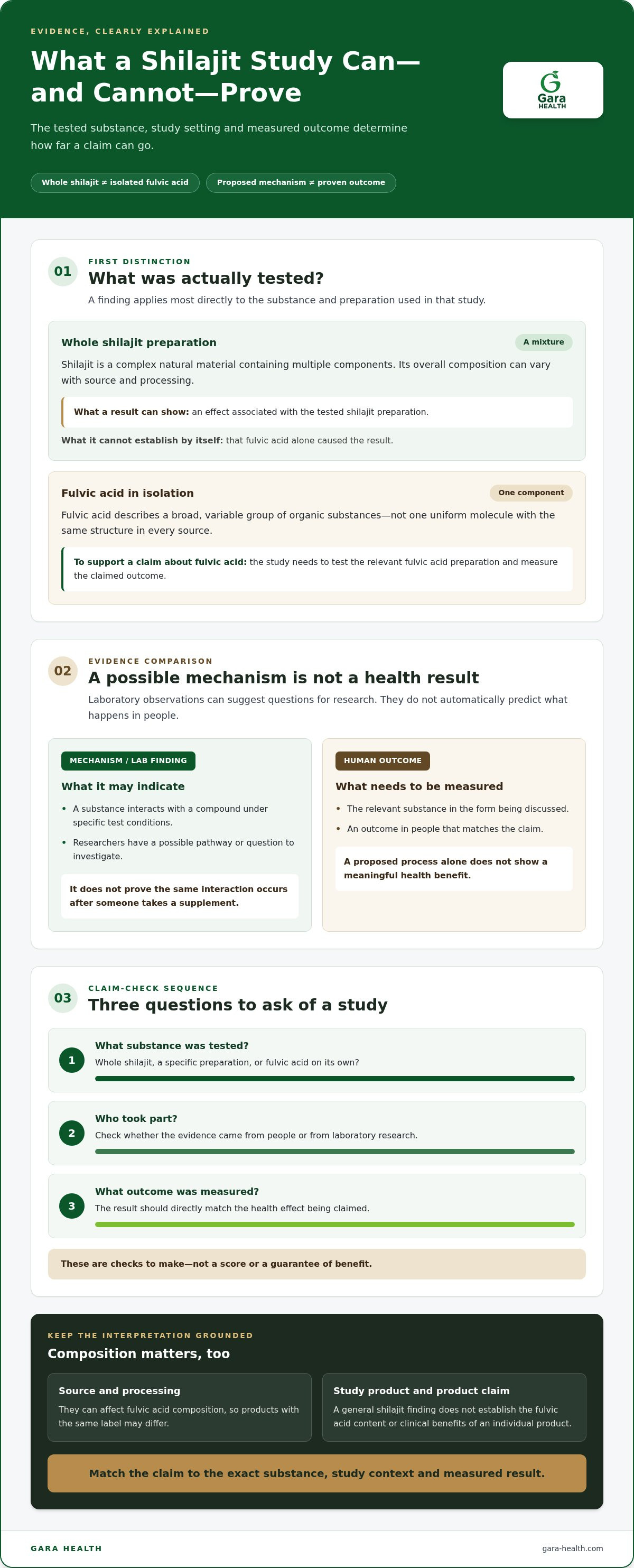
How to Evaluate Fulvic Acid Benefit Claims Before You Choose a Supplement
A clear benefit claim connects three things: the ingredient in the product, the research conducted, and the outcome promised. If any link is missing, treat the claim as a possibility to investigate, not a result to expect. This check helps you assess shilajit fulvic acid benefits without relying on confident wording or impressive-sounding science in place of evidence.
Which questions help test a benefit claim?
Start by identifying exactly what a study tested. Was it isolated fulvic acid, whole shilajit, or another material? Check whether participants were people and whether the measured outcome matches the advertised benefit. A study measuring a laboratory marker, for instance, doesn’t establish that a supplement improves how energetic someone feels.
- Match the ingredient. Compare the study material with the product claim. Evidence about a shilajit mixture can’t automatically be credited to fulvic acid alone, and research on one preparation may not apply to another.
- Match the outcome. Look at what researchers measured, such as a specific physical-performance test or a change in a health marker. Ask whether that measure supports the broader promise or whether the claim goes beyond the result.
- Check the study design. Consider whether participants were assigned a comparison treatment, how long the study lasted, and whether the sample was large enough to make the result persuasive. A small or short study may offer an early signal, but it can’t settle a broad health claim.
- Look for independent support. One study is a starting point, not a pattern. See whether separate research reaches similar conclusions and tests the same ingredient and outcome, rather than a loosely related mechanism.
How can readers keep expectations grounded?
Testimonials can describe someone’s experience, but they can’t show that an ingredient caused a change or that others are likely to have the same result. Mechanistic language, such as claims about cellular support or nutrient transport, doesn’t replace controlled human research. Treat both as context, not proof.
A supplement can be one choice within a broader wellness routine, not a guaranteed shortcut or substitute for care. Keep claims proportional to the evidence: a preliminary finding supports further study, while a well-designed human trial can offer stronger but still product- and outcome-specific information. Neither guarantees an individual result.
If you have a health condition, take medication, or are unsure whether a supplement is appropriate for you, discuss it with a qualified clinician. This section is about reading evidence, not choosing a dose or treating a health concern.
After weighing a claim against the evidence, explore Gara Health shilajit products, including shilajit in resin form. Evaluate any claim against the ingredient and outcome actually studied.
Exploring Shilajit Fulvic Acid Benefits With Gara Health
The most grounded conclusion is simple: fulvic acid is one part of shilajit, not a proven explanation for every effect attributed to it. Studies of shilajit may offer useful clues, but their findings don’t automatically show that isolated fulvic acid has the same effects or that every shilajit product will produce a particular result.
What should readers take away about fulvic acid?
Proposed mechanisms help researchers explore how a substance might interact with the body. Demonstrated human benefits require studies that measure meaningful outcomes in people. Keep those categories distinct, and look for the exact ingredient, preparation, participants, and outcome behind a claim. Evidence can be promising without being conclusive, and a study’s result applies most directly to what researchers tested.
This balanced view doesn’t mean every claim is false. It means the strength of a claim should match the strength of the evidence. Laboratory findings can point to questions worth asking, while human studies can begin to answer them. Limited studies leave uncertainty, and results from one preparation can’t automatically be generalized to another. Stay open to emerging research without treating a possible benefit as a personal guarantee.
The same approach applies to product descriptions. Separate general information about shilajit from claims about a specific product, and don’t assume that a discussion of fulvic acid establishes a product’s composition or clinical effect. If a claim refers to a study, consider whether the tested material and measured outcome match the wording. That comparison helps keep expectations clear.
How can a reader explore shilajit thoughtfully?
Gara Health offers Himalayan Shilajit Resin 30g as a resin-format shilajit product. Its inclusion here provides product context, not evidence of a particular fulvic acid content or health outcome. Research on an ingredient or another shilajit preparation shouldn’t be treated as proof of what this product will do.
Approach the product as an opportunity to learn about shilajit, rather than a promise of energy, performance, or another result. Review the product information with the same questions you’d use for any supplement claim: What exactly is being described? Does the evidence apply to that ingredient and product? Is the promised outcome what the research measured? These questions support informed choice rather than reliance on bold wording.
Health decisions are personal. If you have a health concern or are uncertain about using a supplement, a qualified clinician can help you consider your circumstances. This article offers an evidence-focused perspective, not individualized medical advice or treatment guidance.
Explore Himalayan Shilajit Resin at your own pace, with curiosity and realistic expectations.
Make Your Next Wellness Choice With Clarity
Let curiosity guide your next step, but let evidence set your expectations. Research can evolve, and staying open to new findings doesn’t mean treating a promising idea as a guaranteed result. For shilajit fulvic acid benefits, an informed choice begins by matching claims to the specific ingredient and evidence behind them.
If you’d like to explore shilajit as part of your wellness routine, Gara Health offers Himalayan Shilajit Resin 30g and Gara Shilajit Coffee Powder. Consider which format suits your preferences, and keep product information distinct from claims about clinical outcomes. A thoughtful approach leaves room for discovery without overpromising what a supplement can do.
Explore Himalayan Shilajit Resin and take your next step with confidence, curiosity, and realistic expectations.
Frequently Asked Questions
What is fulvic acid in shilajit?
Fulvic acid refers to a varied group of organic substances associated with humic materials and found among shilajit’s components. It isn’t a single, identical ingredient in every source. If a supplement label mentions fulvic acid, treat that as a description to examine, not proof of a specific amount or effect. The product’s exact composition and the research behind any related claim are separate questions.
What are the potential benefits of fulvic acid?
Researchers are exploring possible antioxidant activity and interactions with other compounds, but these proposed effects don’t establish a health benefit for people. A laboratory observation about how fulvic acid behaves in a test setting can suggest what to investigate next; it can’t show that taking it improves memory or reduces inflammation. Look for human research measuring the particular outcome a claim promises.
Does fulvic acid increase energy?
There isn’t enough evidence to say that fulvic acid on its own reliably increases energy in people. A study measuring physical performance after a whole-shilajit preparation wouldn’t show that isolated fulvic acid caused the result or that users will feel more energetic in daily life. If a product promises an energy boost, check whether research tested that exact ingredient and directly measured an outcome relevant to energy.
Is fulvic acid the same as humic acid?
No. Fulvic acid and humic acid are related categories of organic substances associated with decomposed natural material, but the terms aren’t interchangeable. They describe different fractions with different chemical characteristics, and products may have different compositions. A study or label referring to humic acid shouldn’t automatically be treated as evidence about fulvic acid. Check the named substance before applying a finding to a supplement.
Can fulvic acid help the body absorb nutrients?
It’s been proposed that fulvic acid may interact with minerals or other compounds, but that doesn’t prove it improves nutrient absorption in people. Evidence that substances interact in a laboratory isn’t the same as a human trial measuring how much of a nutrient the body absorbs or uses. Don’t assume a supplement will correct a deficiency or replace advice from a qualified clinician.
Does shilajit naturally contain fulvic acid?
Fulvic acid is commonly described as one component of shilajit, but shilajit is a complex natural material, and its composition can vary. Its presence doesn’t tell you how much is in a particular product. Don’t apply a reported composition from one sample or preparation to another. Product-specific content requires product-specific evidence, not a general statement about shilajit.
Is there scientific evidence for fulvic acid benefits?
There is scientific research into fulvic acid and shilajit, but the evidence varies by study type and substance tested. Laboratory findings can identify possibilities, but they don’t establish everyday health outcomes. Human studies of whole shilajit also can’t isolate fulvic acid’s contribution. To assess shilajit fulvic acid benefits, check whether research tested the same ingredient and measured the specific outcome being claimed. Stronger conclusions require relevant, well-designed human studies.


