


What if the answer to “is shilajit safe” depends less on its natural origins than on what’s actually in the product? Purity matters, and individual health factors matter too. That’s why confident claims online can be hard to reconcile.
It’s reasonable to want a clear answer before adding shilajit to your routine. Raw or poorly purified products may contain unwanted contaminants, while research on purified shilajit’s safety in people remains limited. Pregnancy, certain health conditions, and medicines may also affect the risk. Natural doesn’t automatically mean suitable for everyone.
This guide takes a balanced, safety-first look at what’s known. You’ll learn about potential side effects, who should avoid shilajit or speak with a healthcare professional first, and how to assess product information such as third-party testing and a Certificate of Analysis. We’ll also cover emerging purity concerns, including thallium, so you can make a more informed decision without alarm or exaggerated promises.
Key Takeaways
- “Is shilajit safe?” has no one-size-fits-all answer. Your health context and the specific product both matter.
- Understand which side effects and contamination concerns deserve attention without assuming every shilajit product carries the same risks.
- Use the checklist in this article to assess labels, batch-specific testing, and what a certificate of analysis can and cannot tell you.
- Consider health conditions and medicines before use, and know when it’s wise to seek medical guidance.
- Apply these checks as you research options, including Gara Health’s Himalayan Shilajit Resin 30g.
Is shilajit safe? The short answer depends on purity and personal risk
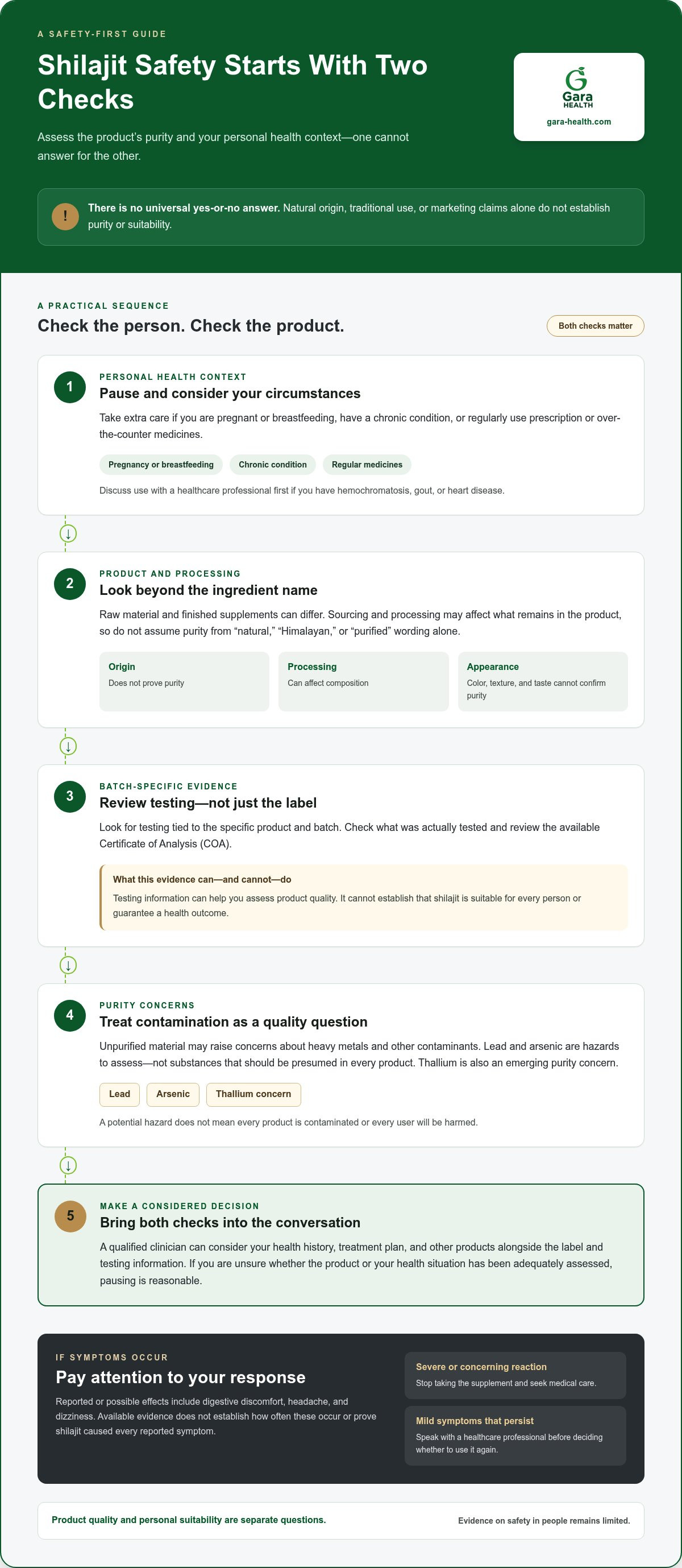
There isn’t a universal yes-or-no answer to “is shilajit safe?” Safety depends on what’s in the specific product, how it was processed, and who is considering taking it. Raw material and finished supplements can differ, so a product’s natural origin or traditional use alone can’t establish its purity or suitability.
Shilajit has a long history of traditional use, and modern products are often promoted with broad wellness claims. Neither history nor marketing is the same as clinical evidence about a supplement’s safety. Human research is limited and uneven. Some short-term research in healthy adults offers useful information, but it can’t show that every product is safe, that longer-term use is safe, or that the same findings apply to people with different health needs. The Shilajit Wikipedia article provides background on shilajit’s history and composition, but historical context isn’t proof of safety.
Shilajit safety rests on two checks: the quality of the product and the health context of the person using it. A product may pose a contamination risk because of its source or processing. Separately, an individual may experience a reaction or a medicine interaction. These are different questions, and a reassuring label alone can’t answer both.
What does safe shilajit use mean in practice?
Start by treating “natural” as a description of origin, not a purity guarantee. Consider the product’s ingredients, processing, and batch-specific testing, then weigh that information against your health history and medicines. Appearance, format, and traditional-use claims don’t establish quality. A qualified clinician can help put product information into context.
Who should pause and seek medical guidance?
Take extra care if you’re pregnant or breastfeeding, have a chronic condition, or regularly use prescription or over-the-counter medicines. People with conditions such as hemochromatosis, gout, or heart disease should discuss shilajit with a healthcare professional before use, rather than treating a general warning as a personal diagnosis. Evidence may not settle every individual risk, and supplements can matter alongside existing care.
A clinician can review factors that broad supplement guidance can’t fully account for, including your condition, treatment plan, and other products you take. Bring the label and any testing information to the conversation. If you’re unsure whether the product or your health situation has been adequately assessed, pausing is a reasonable next step.
Shilajit side effects and contamination: what can affect safety?
Safety questions aren’t limited to how a person responds after taking shilajit. The product’s composition matters too. Raw material can contain impurities, and sourcing and processing may affect what remains in a finished supplement. This doesn’t mean every shilajit product is contaminated. It does mean purity shouldn’t be assumed from the ingredient name alone.
What side effects have been reported?
Reported or possible side effects include digestive discomfort, headache, and dizziness. Available evidence doesn’t establish how often these occur or prove that shilajit caused every reported symptom. Individual reactions can differ, and limited human research can’t provide a complete picture of risk across different products and users.
If you experience a severe or concerning reaction, stop taking the supplement and seek medical care. Don’t try to push through symptoms or assume they’re harmless because the product is natural. If symptoms are mild but persist, speak with a healthcare professional before deciding whether to use it again.
Why do heavy metals and processing matter?
Contaminants such as lead and arsenic are quality hazards to assess, not ingredients that should be presumed in every product. The National Center for Biotechnology Information discusses concerns about unpurified shilajit, including potential exposure to heavy metals and other contaminants, in its overview of Potential risks of unpurified shilajit. A concern identified for unpurified material doesn’t establish that every processed product contains those substances.
A possible contamination hazard is a product-quality concern, not proof that every user will experience harm. Source material and processing can influence a finished product’s composition, which is why product-specific evidence is more useful than a broad claim about origin. A traditional source or a label that says “purified” doesn’t, by itself, show what’s in a particular batch.
Color, texture, and taste aren’t dependable proof of purity. A resin’s appearance can’t show whether it contains heavy metals, and a familiar sensory profile isn’t a substitute for reliable laboratory analysis. If you’re asking “is shilajit safe,” separate two questions: what contaminants might be present in this batch, and how might the supplement affect you personally?
As you compare options, apply the same evidence-focused approach to Gara Health’s Himalayan Shilajit Resin 30g. The product name or Himalayan origin alone shouldn’t replace reviewing product information and discussing personal concerns with a clinician.
How to assess shilajit purity: labels, testing, and claims
A useful purity check goes beyond the words on the front of the jar. Look for documentation tied to the specific product and batch, then check what was actually tested. This evidence can help you assess quality, but it can’t establish that shilajit is suitable for every person or guarantee a particular health outcome.
What should a shilajit test report show?
A certificate of analysis (COA) is more informative when it identifies the product or batch, gives a testing date, names the laboratory, and reports results rather than offering a general “passed” statement. Check the report’s scope: does it include relevant heavy metals, such as lead and arsenic, and microbial contaminants? A test tells you only about the substances and samples included in its analysis.
Pay attention to the analytes tested and the methods used. A missing result isn’t a passing result. It may mean that substance wasn’t tested or wasn’t reported. Thallium emerged as a concern in a 2025 study of shilajit samples, while thallium testing is not yet standard in the supplement industry as of October 2026. A conventional heavy-metal panel may not include it. For wider context, see the U.S. Department of Defense’s discussion of Shilajit heavy metal concerns and efficacy.
Which purity claims deserve a closer look?
“Natural,” “purified,” and “Himalayan” describe a product or its origin, but they aren’t substitutes for batch-specific results. Likewise, a reference to USP or NSF needs precise context. Verify the exact program, what it covers, and whether it applies to the product in question. A testing or certification reference shouldn’t be treated as proof of every quality attribute.
| Marketing claim | Evidence to look for | What it doesn’t prove |
|---|---|---|
| “Purified” | Batch-specific COA with named tests and results | That every possible contaminant was assessed |
| “Third-party tested” | Laboratory identity, date, batch, analytes, and methods | That the product is suitable for you |
| “Himalayan” or “natural” | Clear product information plus relevant test documentation | Purity or safety by origin alone |
| “USP” or “NSF” | The exact program and product-specific scope | That all safety questions are resolved |
If you’re still asking “is shilajit safe,” use documentation to assess product quality, not as a personal medical clearance. For a broader product-quality discussion, see the Himalayan Shilajit Resin 30g buying guide.
Before taking shilajit: safer-use questions to discuss
A careful decision starts with your health, not a generic dose recommendation. If you’re wondering “is shilajit safe” for you, work through this checklist before adding it to your routine:
- Review your health context. Consider pregnancy or breastfeeding, chronic conditions, and any history that could affect supplement use.
- List your medicines and other supplements. Potential interactions depend on the products you take and your individual health history. A clinician or pharmacist can help review the full picture.
- Read the product directions and documentation. Check the ingredients, serving instructions, warnings, and product-specific testing information. Don’t treat a general online dose or someone else’s routine as personal guidance.
- Discuss your next step with a qualified clinician. Ask whether shilajit is appropriate for you, and follow the product directions and professional advice rather than assuming one dose or duration suits everyone.
Professional guidance is especially important if you’re pregnant or breastfeeding, managing a chronic illness, or taking prescription medicines. These circumstances can change how a supplement fits with your care. Don’t stop or alter prescribed medication to accommodate a supplement unless your prescribing clinician advises you to.
What should you discuss with a clinician?
Bring the product label, a list of medicines and supplements, and any batch testing information. Mention relevant health conditions and what you hope to gain from taking shilajit. This gives your clinician a clearer basis for weighing potential risks and uncertainties, rather than relying on broad advice that may not fit your situation.
What should you do if you feel unwell?
Stop taking shilajit and contact a healthcare professional if you develop a concerning reaction. Seek urgent or emergency care for symptoms such as difficulty breathing, swelling of the face or throat, fainting, or severe chest pain. These can signal a serious medical problem and shouldn’t wait for a routine appointment.
Keep the container or a clear photo of its label. Note when you took it, how much the product directions indicated, when symptoms began, and any other medicines or supplements you used. That timeline can help a clinician assess what happened. It doesn’t prove the supplement caused the symptoms.
Once you’ve reviewed your health context and the product information, you can make a more informed choice. Explore Gara Health’s shilajit resin as part of your product research, and assess its details before deciding whether it’s right for you.
Choosing shilajit with care: apply the safety checklist to your next step
There’s no shortcut that makes a shilajit decision right for everyone. Consider your personal health risks, examine information for the specific product, and don’t rely on a Himalayan origin or “natural” label as proof of purity. If key details are unclear or you have health concerns, pause and discuss them with a qualified clinician.
A practical checklist before choosing a product
Before making a decision, review these points:
- Read the label. Confirm it identifies shilajit as an ingredient and gives clear directions, warnings, and other ingredient information.
- Review testing information. Look for documentation that identifies the product or batch, the date and laboratory, and the contaminants tested. Check the reported results and scope. A missing result doesn’t mean the product passed that test.
- Consider your health context. Pregnancy, breastfeeding, chronic conditions, and regular medicines are reasons to seek professional guidance before use. Don’t change prescribed treatment to make room for a supplement without advice from your clinician.
- Decide based on the whole picture. Product documentation can inform your quality assessment, but it can’t establish that shilajit is appropriate for your individual needs.
Asking “is shilajit safe” is only the beginning. A more useful next step is to ask what you know about the particular product, what remains uncertain, and whether your health history calls for medical advice. Clear directions and relevant documentation can help you make a more informed choice, but neither origin claims nor a general statement of purity should stand in for evidence about a specific batch.
Explore shilajit while keeping safety first
Gara Health offers Himalayan Shilajit Resin 30g as one shilajit product option. Its name is not a safety endorsement, so apply the same checklist you would use for any product: review its label and product-specific information, and consider your personal circumstances before deciding.
For another perspective on product selection, read the shilajit resin buying guide. Take the time you need, and explore Gara Health’s shilajit products when you’re ready to continue your research.
Make your next shilajit decision with clarity
So, is shilajit safe? There’s no answer that applies to everyone. Product purity and your personal health context both shape the decision, while limited human evidence can’t establish universal safety. Natural origin or traditional use alone isn’t proof of product quality.
Before choosing, review the label and directions, look for batch-specific testing that explains what was tested, and consider whether pregnancy, breastfeeding, a chronic condition, or regular medication makes professional guidance especially important. A test report can inform your view of product quality, but it can’t confirm that a supplement is right for you.
Gara Health offers Himalayan Shilajit Resin 30g as one option to include in your research. Consider it with the same careful questions you’d apply to any shilajit product, without treating its name or origin as a safety guarantee.
When you’re ready to explore, browse Gara Health’s shilajit products. Take a thoughtful, informed approach and choose the next step that feels right for your health and wellbeing.
Frequently Asked Questions
Is shilajit safe to take every day?
Daily use isn’t automatically safe for everyone. Some clinical trials suggest 200-500 mg of purified shilajit was relatively well-tolerated for up to 90 days in healthy adults, but that doesn’t establish long-term safety or apply to every person or product. Follow the product directions, don’t treat study amounts as personal dosing advice, and consult a healthcare professional if you have a health condition or take medication.
What are the side effects of shilajit?
Possible side effects include digestive discomfort, headache, and dizziness, but available evidence doesn’t establish how often they happen or prove shilajit caused every reported symptom. Reactions may differ between people and products. Stop taking it and contact a healthcare professional if you develop a concerning reaction. Seek urgent care for severe symptoms, such as difficulty breathing, facial or throat swelling, fainting, or severe chest pain.
Can shilajit interact with medications?
It’s possible that shilajit could be unsuitable alongside some medicines, but reliable information about specific interactions is limited. The answer depends on your medication, health history, and the product’s composition. Before use, show a doctor or pharmacist the product label and any testing information, along with a list of your medicines and other supplements. Don’t stop or change prescribed treatment without advice from your prescribing clinician.
Is shilajit safe during pregnancy or breastfeeding?
Safety during pregnancy and breastfeeding hasn’t been established well enough to assume use is safe. It’s prudent to avoid shilajit unless a qualified healthcare professional who knows your circumstances advises otherwise. If you’re pregnant, planning a pregnancy, or breastfeeding, discuss any supplement before taking it. Share the label and product information so your clinician can consider the specific ingredients and your health needs.
Can shilajit contain lead or other heavy metals?
Yes. Raw or poorly processed shilajit can contain contaminants such as lead, arsenic, cadmium, or mercury, though contamination shouldn’t be assumed in every product. Source material and processing can affect composition. A 2025 study also reported thallium in all 13 crude and 5 commercial samples it tested. This finding highlights a testing concern, but it doesn’t show that every shilajit product contains thallium.
How can you tell whether shilajit has been tested for purity?
Look for a batch-specific certificate of analysis that identifies the product or batch, testing date, laboratory, analytes, methods, and results. Check whether it covers heavy metals and relevant microbial contaminants. A missing result isn’t a passing result, and a standard panel may not include thallium. Third-party testing can inform product quality, but it doesn’t prove that shilajit is suitable for you. If you’re asking “is shilajit safe,” consider your health context too.


