


What if low motivation or difficulty focusing doesn’t mean your dopamine is low? It’s understandable to look for a natural fix, especially when online claims make supplements sound like a direct route to better drive and clarity. But natural supplements for dopamine increase don’t offer a guaranteed boost, and how you feel alone can’t reveal the cause.
This guide compares commonly discussed options, including L-tyrosine, Mucuna pruriens, ginkgo, and magnesium. You’ll learn what the evidence suggests, where it remains limited, and why results from animal or small studies don’t necessarily predict a clear benefit for people.
We’ll also cover practical safety considerations, from medication interactions and variable supplement quality to the value of checking for a deficiency rather than guessing. The goal isn’t to diagnose yourself or add another capsule by default. It’s to understand the options, make a more informed choice, and recognize when persistent changes in motivation or focus call for professional advice.
Key Takeaways
- Compare natural supplements for dopamine increase by the quality and relevance of human evidence, not by how convincing a proposed mechanism sounds.
- See why L-tyrosine may be more relevant in specific high-stress contexts than as a routine mood or focus enhancer.
- Separate better-supported findings from limited or unproven claims before deciding whether a supplement fits your goal.
- Use a practical safety sequence: clarify your goal, review medicines, consider diet and symptoms, and discuss possible testing with a qualified healthcare professional.
- Build a steady foundation with sleep, balanced nutrition, and movement. Treat supplements and wellness products as optional additions, not dopamine treatments.
What dopamine does, and what “natural dopamine increase” really means
Dopamine is more than a “happiness chemical.” This neurotransmitter helps nerve cells communicate and is involved in movement, motivation, learning, attention, and how the brain processes reward. Its effects depend on where and how signals travel, not simply on having “more” dopamine. Dopamine helps regulate movement, motivation, learning, and reward; a popular “dopamine boost” is not a measure of improved health.
That distinction matters if you’re searching for natural supplements for dopamine increase. Low motivation or difficulty focusing can feel frustrating, but neither symptom proves that dopamine is deficient. Mood, sleep, health conditions, medications, and everyday stress can all influence how you feel. A symptom or online quiz can’t identify the cause on its own.
Can a supplement directly increase dopamine in the brain?
Some ingredients are discussed as precursors or as nutrients involved in related pathways. But supplying a precursor doesn’t automatically mean the brain will produce more dopamine, release it differently, or change how its signals are received. The brain regulates these steps, and dopamine itself does not freely pass from the bloodstream into the brain. A blood nutrient result, meanwhile, is not a direct reading of brain dopamine. As this overview of dopamine’s role as a neurotransmitter helps illustrate, synthesis is only one part of a more complex signaling system.
Research varies by ingredient, population, outcome, and study quality. A biological rationale may justify further study, but it doesn’t establish a meaningful benefit for everyday motivation or focus. Consider the evidence for each supplement on its own.
When might low motivation deserve more than a supplement search?
Look beyond supplements if changes in mood, sleep, concentration, or movement persist, interfere with daily life, or are getting worse. These symptoms can have different causes. A qualified healthcare professional can help assess them and discuss whether testing is appropriate. Don’t use a checklist or online quiz to diagnose a dopamine deficiency or choose a treatment.
Seek urgent professional help for severe or rapidly worsening symptoms. A supplement shouldn’t delay assessment, especially when changes affect your ability to function or feel safe. A thoughtful next step starts with understanding the symptom, not assuming it points to one brain chemical.
Natural supplements for dopamine increase: comparing ingredients and evidence
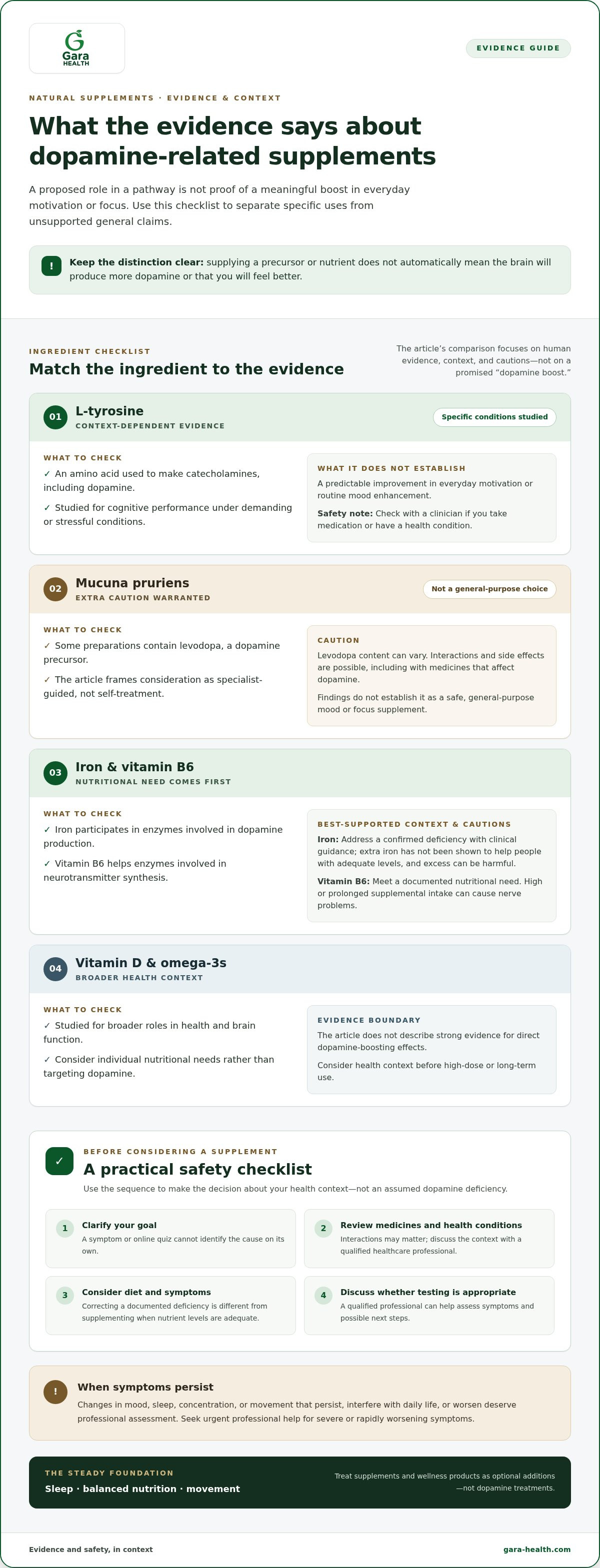
“Natural” doesn’t guarantee that a product is effective or risk-free. Evidence for natural supplements for dopamine increase depends on the ingredient, the person taking it, and the outcome a study measures. The comparison below distinguishes a plausible role in a pathway from demonstrated benefits in people.
| Ingredient | Proposed rationale | Human evidence | Best-supported context | Key cautions |
|---|---|---|---|---|
| L-tyrosine | Amino acid used to make catecholamines, including dopamine. | Context-dependent; not proof of routine mood enhancement. | Studied for cognitive performance under demanding or stressful conditions. | Check with a clinician if you take medication or have a health condition. |
| Mucuna pruriens | Some preparations contain levodopa, a dopamine precursor. | Findings don’t establish it as a safe, general-purpose mood or focus supplement. | Specialist-guided consideration, not self-treatment. | Levodopa content can vary; interactions and side effects are possible. |
| Iron | Iron participates in enzymes involved in dopamine production. | Doesn’t show that extra iron helps people with adequate levels. | Addressing a confirmed deficiency with clinical guidance. | Excess iron can be harmful; testing and professional advice matter. |
| Vitamin B6 | Helps enzymes involved in neurotransmitter synthesis. | Not established as a dopamine booster when intake is adequate. | Meeting a documented nutritional need. | High or prolonged supplemental intake can cause nerve problems. |
| Vitamin D and omega-3s | Studied for broader roles in health and brain function. | Not strong evidence of direct dopamine-boosting effects. | Addressing individual nutritional needs, not targeting dopamine. | Consider health context before high-dose or long-term use. |
L-tyrosine and mucuna pruriens: precursor does not mean guaranteed benefit
L-tyrosine contributes to catecholamine production, but the body regulates production and signaling. Research on it is situation-specific, including demanding conditions, and doesn’t establish predictable benefits for everyday motivation. Mucuna deserves extra caution: its levodopa content may vary, and it can interact with medications, including treatments that affect dopamine. Don’t use it casually or treat it as an established therapy.
Iron, vitamin B6, vitamin D, and omega-3s: focus on nutritional context
Correcting a documented deficiency is different from trying to boost dopamine in a well-nourished person. If low nutrient status is a concern, discuss assessment and suitable next steps with a qualified healthcare professional rather than guessing with supplements. Individual guidance is especially useful before high-dose or long-term use.
Gara Health offers wellness products, including Himalayan Shilajit Resin 30g and functional coffee products. They are optional additions to a broader routine, not proven dopamine supplements or substitutes for care. Visit Gara Health to explore the product range.
Do dopamine supplements work? Claims vs evidence
Some supplement claims begin with a real biological idea: a nutrient or compound may be involved in a pathway related to dopamine. But that alone doesn’t show that taking it will improve motivation, mood, or focus. Supplement evidence must be judged by human outcomes, not mechanism alone. “Natural” is not a synonym for proven, risk-free, or suitable for everyone.
What counts as meaningful evidence for a dopamine supplement?
Look for controlled human research that measures outcomes relevant to the claim, rather than relying mainly on animal studies, lab findings, or explanations of how an ingredient might work. Check who took part, how many people were studied, how long the study lasted, and whether the outcome was motivation or focus rather than a different health measure. Funding and conflicts of interest also matter. Preliminary results can guide further research, but they don’t establish a treatment recommendation.
How to sort claims from evidence
- Better-supported: Correcting a confirmed nutritional deficiency can address that nutritional need. It doesn’t prove that supplementation raises dopamine or benefits people whose nutrient levels are already adequate.
- Limited or context-specific: L-tyrosine has been studied in particular demanding or stressful situations. That doesn’t establish routine mood or focus benefits for everyone.
- Insufficiently supported: Claims that supplements reliably increase brain dopamine and improve everyday motivation are not established. For example, research on magnesium and berberine effects on dopamine is primarily based on animals, not proof of a meaningful human benefit.
These distinctions help put natural supplements for dopamine increase in perspective: a plausible pathway is a reason to investigate an ingredient, not a guarantee of a result.
Why a supplement may not help motivation, mood, or focus
Similar symptoms can have different causes. Sleep disruption, stress, medication effects, nutrition, and health conditions may all play a role, and each can call for a different response. If a supplement doesn’t seem to help, increasing the dose on your own isn’t a safe way to find out why. Higher intake may raise the chance of side effects or interactions without addressing the underlying issue.
Instead, take persistent or disruptive changes as a reason to review the broader picture with a qualified healthcare professional. They can help assess possible causes and whether a particular supplement or nutritional test makes sense. The most useful evidence is evidence that applies to your situation, not simply a claim that sounds biologically convincing.
How to choose and use a dopamine-related supplement more safely
A clear goal and a careful review are safer starting points than choosing a supplement based on a “dopamine boost” claim. Use this sequence before adding anything:
- Clarify your goal. Note what you hope to address, such as a change in focus or energy, and how long it has been happening. Symptoms alone can’t identify a dopamine problem.
- Review medicines and health conditions. Make a complete list of prescriptions, over-the-counter medicines, and supplements so a clinician or pharmacist can check for interactions.
- Assess diet and symptoms. Consider whether your eating patterns or ongoing symptoms suggest a nutritional concern. If you suspect a deficiency, discuss appropriate testing with a qualified healthcare professional rather than starting high-dose supplements by guesswork.
- Evaluate the evidence and label. Look for the exact ingredient and amount per serving, clear directions, and credible independent testing for identity and contaminants. Third-party testing can help assess product quality, but it doesn’t prove that a supplement works for dopamine or motivation.
Evidence for natural supplements for dopamine increase varies, so keep the claim, the studied ingredient, and the product label aligned. Follow label directions and professional advice. Don’t create a dose or increase one because you don’t notice an effect.
Check medications, health conditions, and supplement interactions
Take extra care with Mucuna pruriens products because they may contain levodopa, which can interact with medicines and cause unwanted effects. Psychiatric medicines and other prescriptions also deserve a careful interaction review before you combine them with supplements. Ask a clinician or pharmacist to review your full list first. If you’re pregnant, breastfeeding, or managing a chronic condition, seek individualized guidance before use.
Recognize when professional evaluation is the better next step
Persistent or worsening changes in mood, focus, sleep, or movement merit professional assessment, not just another supplement trial. Don’t stop or adjust a prescribed medicine in favor of a supplement without guidance. The guide to signs of low vitality may help you reflect on changes you’ve noticed, but it isn’t a diagnostic tool.
If you’re building a broader wellness routine, Gara Health offers wellness products you can explore as optional additions, not as proven dopamine treatments or substitutes for evaluation and care.
A realistic wellness routine: where Gara Health products may fit
A steady routine is a more reliable foundation for well-being than expecting a supplement to create a predictable dopamine change. Start with consistent sleep, balanced nutrition, and regular movement. These habits support overall health, while persistent or concerning symptoms deserve professional guidance. Supplements can be optional additions, but they aren’t replacements for evaluation, prescribed treatment, or the basics that help you feel your best.
- Prioritize rest: Give your body a consistent opportunity to recover.
- Build balanced meals: Aim for varied nourishment rather than relying on one ingredient or product.
- Make movement sustainable: Choose activity that fits your abilities and routine.
- Get support when needed: Discuss ongoing changes in mood, focus, sleep, or movement with a qualified healthcare professional.
Keep energy and focus goals separate from dopamine claims
A product marketed for vitality isn’t automatically a dopamine supplement, and a product name doesn’t establish a medical effect. Gara Health offers Himalayan Shilajit Resin 30g as a wellness product. This description doesn’t imply it raises dopamine or treats a condition. Read the Himalayan Shilajit Resin buying guide for product context, not as evidence of a dopamine benefit.
Explore functional beverages without expecting a dopamine shortcut
Gara Shilajit Coffee Powder and Gara Health Mushroom Coffee are also available from Gara Health. Their names alone don’t establish their exact ingredients, caffeine levels, or effects on dopamine, so don’t use them as a shortcut to a promised change in mood or focus. The mushroom coffee guide offers broader functional beverage context.
Keep expectations grounded: products can be part of a personal wellness routine without being proven dopamine interventions. If you’re curious about Gara Health’s offerings, explore the product range, and keep health concerns or treatment decisions between you and a qualified professional.
Choose a steadier, evidence-led path forward
The search for natural supplements for dopamine increase can start with a simple reminder: a proposed pathway isn’t a guaranteed benefit, and low motivation or focus doesn’t diagnose a dopamine deficiency. Compare ingredients by human evidence and safety, and speak with a qualified healthcare professional about persistent symptoms, possible deficiencies, or medication interactions before supplementing.
For a strong foundation, keep sleep, balanced nutrition, and movement in view. Supplements are optional, not replacements for evaluation, treatment, or those daily habits. Gara Health offers Himalayan Shilajit Resin 30g, Gara Shilajit Coffee Powder, and Gara Health Mushroom Coffee as wellness products, not established dopamine treatments.
To explore these options as part of your broader wellness routine, visit Gara Health’s product range. Make health decisions thoughtfully and avoid relying on promises of a quick dopamine boost.
Frequently Asked Questions
What natural supplements may support dopamine production?
L-tyrosine is a precursor used in dopamine production, while iron and vitamin B6 support processes involved in making neurotransmitters. Mucuna pruriens may contain levodopa, which the body can convert to dopamine. These roles don’t prove that supplements reliably improve mood or focus. Evidence for natural supplements for dopamine increase varies, and correcting a documented nutrient deficiency is different from supplementing when nutrient levels are adequate.
Can you increase dopamine naturally without supplements?
You can support overall well-being without taking a supplement by building consistent habits around sleep, balanced nutrition, and regular movement. These steps aren’t guaranteed to raise brain dopamine or resolve low motivation, but they support broader health. Stress management and discussing persistent symptoms with a healthcare professional may also help identify practical next steps. If changes in mood, focus, or sleep continue, don’t assume a dopamine issue is the cause.
Does L-tyrosine increase dopamine?
L-tyrosine contributes to the production of dopamine and other catecholamines, but taking it doesn’t guarantee a predictable rise in dopamine or better mood. Human research has examined it in particular conditions, including periods of stress or high demand, rather than establishing it as a routine focus or mood enhancer for everyone. Consider your health and medications before using it, and seek professional guidance if you’re unsure whether it’s appropriate.
Is mucuna pruriens safe to take for dopamine?
Mucuna pruriens isn’t risk-free, so don’t treat it as a casual dopamine supplement. Some products contain levodopa, a compound also used in prescription treatment, and levodopa content can vary between supplements. It may cause side effects or interact with medicines. Speak with a qualified healthcare professional or pharmacist before using it, especially if you take medication or have a health condition. Avoid self-prescribing it to manage symptoms.
Can low dopamine cause lack of motivation or brain fog?
Low dopamine may be associated with certain medical conditions, but lack of motivation or brain fog alone can’t confirm a dopamine deficiency. Similar experiences may relate to sleep disruption, stress, medication effects, nutrition, mood, or other health concerns. If symptoms persist, worsen, or interfere with daily life, discuss them with a qualified healthcare professional. An online quiz or symptom checklist can’t reliably identify the cause or guide treatment.
Should I get tested before taking supplements for dopamine?
There isn’t a simple blood test that directly measures dopamine levels in the brain. If you suspect a nutrient deficiency, discuss your diet, symptoms, and health history with a qualified healthcare professional, who can decide whether specific testing is appropriate. Testing and supplementation depend on the suspected issue. Avoid high-dose or long-term use based only on symptoms, and don’t assume that low motivation or difficulty focusing means you need a dopamine-related supplement.
Can dopamine supplements interact with antidepressants or other medications?
Yes. Some supplements can interact with prescriptions, and products containing levodopa deserve particular caution. Don’t combine a dopamine-related supplement with antidepressants, Parkinson’s medicines, or other prescriptions without first reviewing the combination with a clinician or pharmacist. Share the exact product label and a complete list of medicines and supplements. Never stop or change prescribed medication to try a supplement, and seek individualized advice if you’re pregnant, breastfeeding, or managing a chronic condition.


