


If you’re asking, “can you combine shilajit and creatine,” the short answer is that no well-established negative interaction between them is known. However, direct research on taking both together is limited, so that does not prove the combination is safe or more effective for everyone.
It makes sense to want a clear answer before adding another supplement, especially when dosing advice and safety claims can conflict. Creatine monohydrate has substantial research behind its use for high-intensity exercise. Shilajit is a separate option with less certain evidence for exercise benefits and important product-quality considerations.
This guide explains what each supplement may offer, what remains uncertain about combining them, and which health, medication, and product-quality questions to consider. The practical distinction is simple: creatine has a more established role in exercise research, while shilajit is a cautious, optional addition, not a proven way to enhance creatine.
Key Takeaways
- “Can you combine shilajit and creatine?” is different from asking whether taking them together improves results. Assess each supplement on its own evidence and purpose.
- Match your choice to your goal, whether that’s training performance, general wellness, or keeping your routine simple.
- Before adding shilajit, consider your health conditions and medications. Seek qualified healthcare guidance if you have safety concerns.
- Follow product-label directions, introduce one change at a time, and monitor your response rather than relying on generalized dosing claims.
- If you’re curious about shilajit, consider it separately from creatine, for example as a resin, without assuming the combination has proven added benefits.
Can you combine shilajit and creatine? The short answer
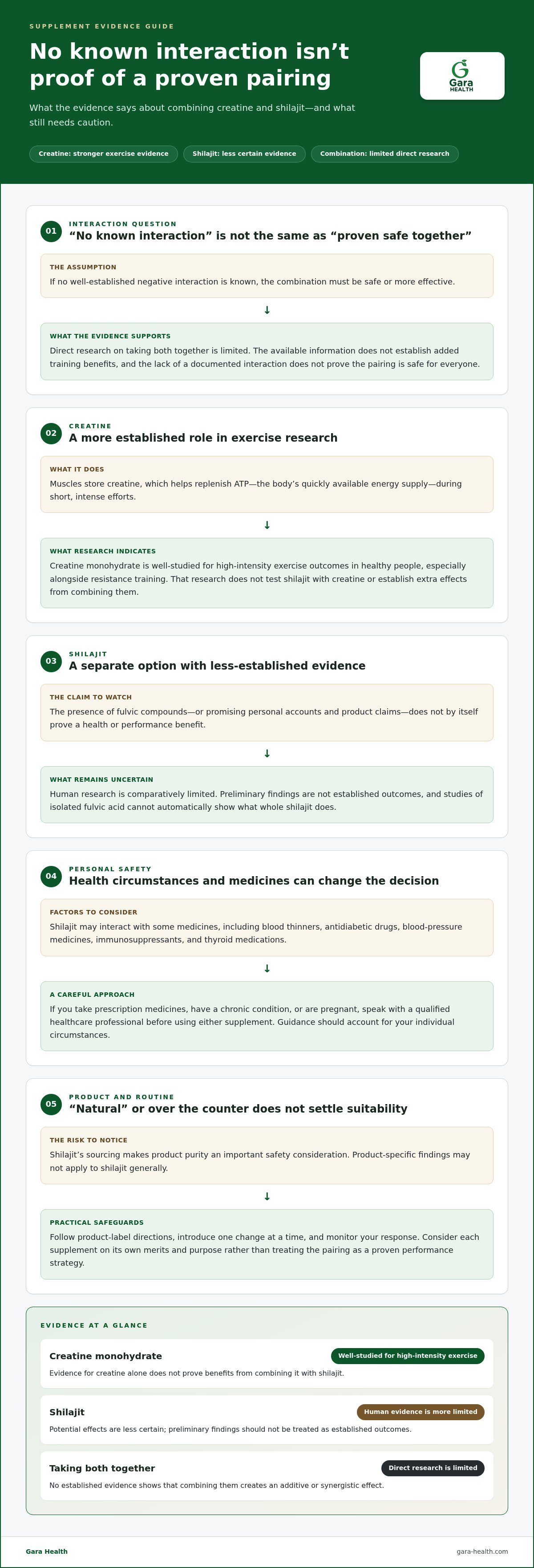
No well-established negative interaction between shilajit and creatine is known, but direct research on taking them together is limited. They may be used in the same routine, but that doesn’t mean the combination has been proven to work better or is right for everyone.
That distinction matters. Research on creatine alone or shilajit alone can’t establish the safety or benefits of using both together. Creatine has a well-studied role in the body’s energy system. Claims that shilajit improves creatine absorption, strength, or recovery remain unproven without direct evidence. For a general overview of creatine’s role and use, see Creatine.
What does the evidence say about taking both?
Research directly testing shilajit and creatine together in people appears sparse. Available information doesn’t establish that combining them produces added training benefits. Nor does the lack of a documented negative interaction prove that every combination is safe. Personal accounts and product marketing may describe promising effects, but they aren’t a substitute for clinical evidence. Consider each supplement on its own merits, not as a proven performance pairing.
What should readers understand before deciding?
Individual health, medications, and product quality can all affect the risks of adding a supplement. Shilajit may interact with some medicines, including blood thinners, antidiabetic drugs, blood-pressure medicines, immunosuppressants, and thyroid medications. Its sourcing also makes purity an important safety consideration. Don’t assume a supplement is suitable simply because it’s natural or sold over the counter.
If you take prescription medicines, have a chronic condition, or are pregnant, speak with a qualified healthcare professional before using either supplement. Supplements aren’t a substitute for medical care, and guidance should account for your health circumstances. Follow product-label directions rather than relying on generalized dosing advice.
No well-established negative interaction between shilajit and creatine has been documented, but it remains unknown whether taking them together is safe and more effective for a particular person. A measured approach starts with a clear reason for each supplement, attention to product quality, and professional guidance when health factors could affect your risk.
How Creatine and Shilajit Differ in Body and Research
These supplements aren’t interchangeable. Creatine monohydrate has a substantial body of research on exercise performance. Shilajit is a complex, mineral-rich substance containing fulvic compounds, with less-established evidence for specific benefits. Their different compositions and evidence bases matter when deciding whether either belongs in your routine.
| Ingredient | Commonly studied role | Evidence context | Key uncertainty |
|---|---|---|---|
| Creatine monohydrate | Supports muscle creatine stores used in rapid energy recycling | Well-studied for high-intensity exercise, particularly alongside training | Individual response varies; evidence for creatine alone doesn’t prove benefits from combining it with shilajit |
| Shilajit | Traditional wellness use; studied for a range of possible effects | Human evidence is more limited and findings shouldn’t be treated as established outcomes | Effects of a specific product or isolated compound may not apply to shilajit generally |
What creatine research can, and cannot, tell you
Muscles store creatine, which helps replenish ATP, the body’s quickly available energy supply, during short, intense efforts. Research on creatine monohydrate supports its use for high-intensity exercise outcomes in healthy people, especially alongside resistance training. The ISSN position stand on creatine reviews this evidence. It doesn’t test shilajit alongside creatine, so its findings can’t establish that the combination has added effects.
What shilajit research can, and cannot, tell you
Shilajit contains fulvic compounds, but the presence of a compound doesn’t by itself prove a health or performance benefit. Human research on shilajit is comparatively limited, and preliminary findings shouldn’t be confused with well-established clinical outcomes. Studies of isolated fulvic acid also can’t automatically show what whole shilajit does, since the substance contains multiple components.
Creatine monohydrate has stronger evidence for specific exercise outcomes. Shilajit’s potential effects are less certain, and research on either ingredient alone doesn’t prove that taking both is better. Use this distinction when evaluating claims about whether can you combine shilajit and creatine: established findings for one ingredient aren’t proof of benefits from the pairing.
If you’re interested in shilajit, consider it separately rather than as a proven creatine enhancer. Gara Health’s Himalayan Shilajit Resin 30g is one way to explore shilajit on its own merits.
Is combining shilajit and creatine worth it for your goal?
Start with the outcome you’re aiming for, not the number of supplements in your routine. Creatine has clearer relevance for people focused on high-intensity exercise. Shilajit is a separate wellness consideration with less-established evidence for specific outcomes. There’s no established evidence that combining them creates an additive or synergistic effect, so using both may add complexity without a proven extra benefit.
Use this simple decision framework:
- Training performance: Consider whether creatine’s researched role fits your training, health context, and expectations.
- General wellness: Assess shilajit independently rather than assuming it will enhance creatine or exercise results.
- Convenience: A simpler routine can make it easier to track what you’re taking and notice how you respond.
When creatine may be the more relevant choice
Creatine monohydrate is commonly studied in the context of repeated, high-intensity exercise, including resistance training. Its evidence is more directly relevant to someone focused on training performance than shilajit’s less-established exercise claims. It’s still not a universal recommendation: health conditions, medications, and individual circumstances matter. Set realistic expectations and consider the evidence for creatine on its own, rather than assuming another supplement will increase its effects.
When shilajit may be a separate wellness consideration
You might be curious about shilajit for reasons separate from training, such as exploring a traditional wellness ingredient. A scientific review of shilajit discusses its composition, traditional use, and potential effects. It doesn’t establish shilajit as a proven performance enhancer or creatine partner. For practical background on choosing a resin, see the Himalayan shilajit resin buying guide.
Shilajit doesn’t replace progressive training, adequate nutrition, sleep, or clinical advice. If you’re weighing it alongside creatine, identify what you want each supplement to contribute. If one has no clear purpose, keeping your routine simpler may make more sense than adding both at once. Those interested in exploring shilajit separately can view Himalayan shilajit resin, without treating it as a combined creatine product.
How to approach both supplements cautiously and practically
A thoughtful plan is more useful than adding both supplements at once. Before deciding whether can you combine shilajit and creatine, consider your health circumstances, why you’re considering each product, and how you’ll notice whether anything changes.
- Review your health context. List your medicines and health conditions, note any upcoming procedures, and consider whether pregnancy applies.
- Choose a clear goal. Decide what you want each supplement to contribute. If one has no clear purpose, you may not need to add it.
- Make one change at a time. Avoid starting both together. If an unwanted effect occurs, introducing supplements separately can make it easier to identify which change may be involved.
- Follow product directions and monitor your response. Use the label rather than generalized dosing or timing claims, and note any changes that concern you.
Seek individualized guidance from a qualified healthcare professional before using supplements if you take medicines, have a chronic condition, are pregnant, or have a planned procedure. This is especially relevant for shilajit, which may interact with some medicines, including blood thinners, antidiabetic drugs, blood-pressure medicines, immunosuppressants, and thyroid medications. Don’t change prescribed treatment to accommodate a supplement.
What safety questions matter before combining supplements?
People can respond differently, and a product’s safety depends partly on the individual and the product itself. If you develop concerning symptoms after starting a supplement, stop taking it and seek appropriate medical care. Bring the product label and a list of your medicines to a healthcare professional if you need advice. Supplements aren’t a substitute for diagnosis or treatment.
How to think about shilajit quality
Shilajit is a mineral-rich natural substance, so source transparency and credible testing for contaminants such as heavy metals are important considerations. A claim on a label alone doesn’t establish purity or safety. Look for clear information about the product’s composition and quality checks, and discuss concerns with a qualified professional. For more background, read about how shilajit safety and purity are assessed.
If you’ve considered the risks and want to explore shilajit as a separate choice, take a look at Gara Health’s Himalayan Shilajit Resin. It’s a shilajit option, not a creatine combination, and should be assessed on its own merits.
A thoughtful next step: assess shilajit on its own merits
Creatine and shilajit have different evidence profiles, and research hasn’t established that taking them together provides extra benefits. If you’re still asking, “can you combine shilajit and creatine,” keep the distinction in mind: using two supplements in the same routine isn’t the same as having evidence that the combination works better.
Before adding anything, assess each supplement separately. A clear goal can help you avoid broad claims and unnecessary changes to a routine that already works for you.
A simple decision checklist for readers
- Define the goal. Can you name what you hope each supplement will contribute, independently of the other?
- Consider your health context. Account for your health conditions, medicines, and any advice from a qualified healthcare professional.
- Look for ingredient transparency. Review the product label, ingredient information, and available details about quality.
- Keep track of your response. If you decide to try a supplement, changing one thing at a time can make it easier to identify what may be affecting you.
If the purpose or evidence for adding another supplement is unclear, keeping your routine simple is a reasonable choice. You can revisit the decision as your goals or circumstances change, with professional guidance if health questions are involved.
Explore shilajit as a separate wellness choice
Shilajit may interest you as a distinct wellness product, not as a proven creatine enhancer. For background before making a decision, read a guide to what shilajit is and how it is used. That context can help you consider the ingredient without confusing traditional use or preliminary research with established outcomes.
Gara Health offers Himalayan Shilajit Resin 30g as a separate shilajit product. It isn’t a creatine product or a combined formula, and choosing it doesn’t replace evidence-informed training, balanced nutrition, restorative sleep, or medical advice. If you’ve reviewed the evidence and safety considerations, consider Himalayan Shilajit Resin 30g as an optional addition at your own pace.
Make your next supplement choice with clarity
So, can you combine shilajit and creatine? No well-established negative interaction is known, but direct research on the combination is limited, and added benefits haven’t been established. Creatine and shilajit have different evidence profiles, so assess each according to its own purpose rather than assuming they work better together.
Before adding either supplement, consider your health, medications, product information, and ability to notice how you respond. If you have a chronic condition, take medication, or are pregnant, seek guidance from a qualified healthcare professional. A clear goal and a simple routine can make it easier to make a considered choice.
If you’re curious about shilajit as a separate wellness option, Gara Health offers Himalayan Shilajit Resin 30g and Shilajit-infused coffee powder. Neither is a creatine combination or a proven creatine enhancer. Explore Gara Health’s Himalayan Shilajit Resin after reviewing the evidence and safety considerations.
Frequently Asked Questions
Can you take shilajit and creatine at the same time?
No well-established negative interaction is known, but direct research on taking shilajit and creatine together is limited. Taking them at the same time hasn’t been shown to improve results, and the available information can’t confirm that every combination is suitable for every person. Consider your health, medicines, and the quality of each product. If you have a medical condition or take prescription medication, ask a qualified healthcare professional first.
Does shilajit make creatine work better?
There’s no established clinical evidence that shilajit improves creatine’s effects, such as exercise performance or recovery. The two supplements have different compositions and research backgrounds, and proposed explanations about how they might complement each other don’t prove a benefit in people. Evaluate creatine and shilajit separately, and be cautious of marketing or anecdotal claims promising extra results from combining them.
Should I take creatine or shilajit first?
There’s no established evidence that one needs to be taken before the other or that a particular order improves results. If you’re considering both, first identify why you want each one and review the product labels. Introducing only one new supplement at a time can make it easier to notice a response or unwanted effect. Ask a qualified healthcare professional about timing if you take medicines or have a health condition.
Can shilajit and creatine cause side effects when combined?
Direct research hasn’t established a specific side-effect pattern from combining them, so the risk of the combination isn’t well characterized. Each supplement has its own considerations, and shilajit product quality matters because contamination is a concern with mineral-rich substances. If you notice concerning symptoms after starting a supplement, stop using it and seek appropriate medical care. Consult a clinician before use if you take medicines or have a chronic condition.
Is shilajit safe to take with creatine every day?
There isn’t enough direct research to establish the long-term safety of taking the two together every day for everyone. Daily use should depend on the individual product labels and your health circumstances, not on a generalized online schedule. Shilajit may interact with some medications, so check with a qualified healthcare professional if you take prescriptions, have a chronic condition, or are pregnant. Don’t change prescribed treatment to accommodate supplements.
Does shilajit have the same evidence as creatine for exercise?
No. Creatine monohydrate has a substantially stronger research base for specific high-intensity exercise outcomes, while evidence for shilajit’s exercise benefits is more limited. Findings about creatine alone don’t prove that shilajit adds to its effects, and preliminary findings about shilajit shouldn’t be treated as established performance outcomes. Your training, nutrition, sleep, health, and goals remain important parts of any exercise plan.
How do I choose a shilajit supplement to combine with creatine?
Choose based on product transparency and safety, not claims that shilajit boosts creatine. Review the full label, ingredient information, and directions. Because shilajit is mineral-rich and may be vulnerable to contamination, look for credible independent testing information, such as a certificate of analysis that addresses contaminants. Don’t assume a product is tested or certified unless its documentation supports that claim. If medicines or health conditions are relevant, seek professional guidance before use.


