


What if shilajit is less a single “miracle ingredient” and more a complex substance shaped by nature over time? If you’ve wondered what is shilajit, the answer can be confusing: it isn’t simply a mineral or a plant, though both contribute to its story. It’s a dark, resin-like material found in mountain rock, with a variable mix of organic compounds and minerals.
Interest in shilajit spans traditional use and modern wellness, but confident claims about energy, focus, and other effects can go further than clinical research supports. It’s reasonable to want a clear explanation before deciding what to believe.
This guide explains how shilajit forms, what it may contain, and the common forms you’ll see, including resin and powders. We’ll also look at what studies suggest, where evidence remains limited, and why processing and product-specific testing information matter. By the end, you’ll have a grounded definition and realistic expectations, without confusing tradition, marketing, and scientific evidence.
Key Takeaways
- To answer “what is shilajit,” think of a naturally formed organic-mineral complex, not a single ingredient with a fixed formula.
- Its formation involves organic matter, microorganisms, and mountain conditions, but nature doesn’t follow a simple recipe.
- Fulvic acid and other reported components are discussed in research, but evidence still falls short of firm clinical conclusions.
- Compare resin, powder, capsules, and blends by convenience and ingredient transparency, not by format alone.
- Before considering a supplement, use the questions in this article to guide a conversation with a qualified healthcare professional.
What Is Shilajit? A Clear Definition of the Natural Substance
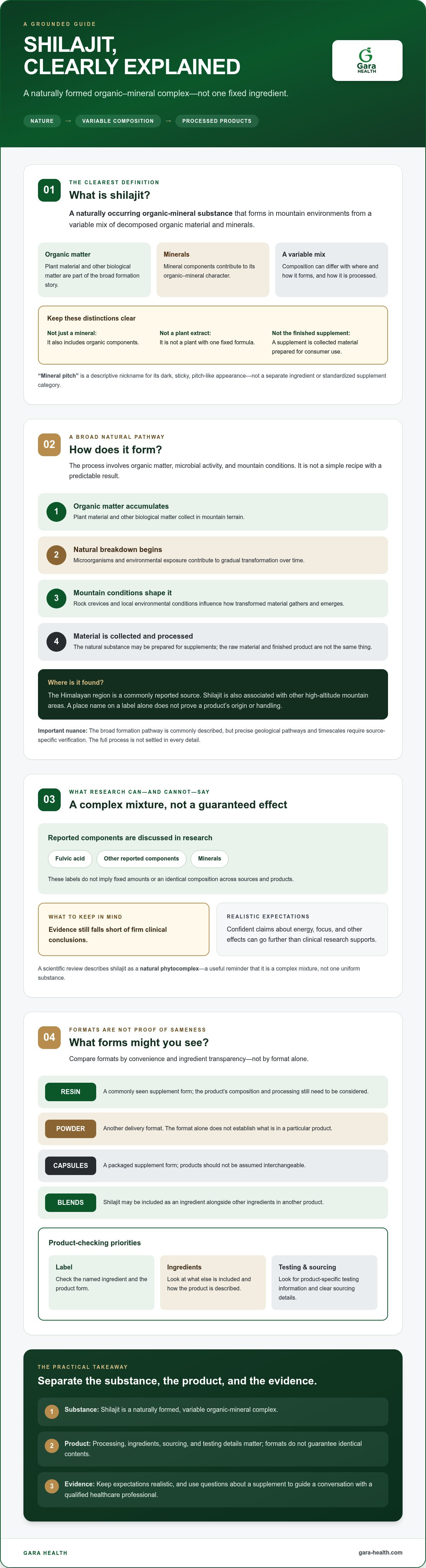
Shilajit is a naturally occurring organic-mineral substance that forms in mountain environments and contains a variable mix of decomposed organic material and minerals. It isn’t a single mineral, a plant, or a plant extract with one fixed chemical formula. That distinction is the clearest starting point for answering what is shilajit.
The natural material is commonly described as dark and resin-like, and it can seep from cracks in mountain rock. Its composition may vary according to where and how it forms, as well as how it’s processed. The Shilajit overview offers additional background on the substance’s history and traditional uses. However, the name alone doesn’t tell you exactly what’s in a particular supplement.
Products sold as shilajit supplements contain material collected and processed for consumer use. You may see it as resin, powder, capsules, or an ingredient blended into another product. These are different delivery formats, not proof that the contents are identical. Processing, ingredients, and product composition can differ, so check the label and any product-specific testing information rather than judging by format alone.
Is shilajit a mineral, plant, or supplement?
The natural substance has both organic and mineral components, so calling it only a mineral or only a plant extract misses part of the picture. A supplement, by contrast, is a finished product made from shilajit material, sometimes in a form designed for easier use. Keep those meanings separate: a naturally occurring substance and a packaged supplement aren’t the same thing, and products shouldn’t be assumed interchangeable.
Why is shilajit often called mineral pitch?
“Mineral pitch” is a descriptive nickname for shilajit’s dark, sticky, pitch-like appearance. It doesn’t refer to a separate ingredient or a standardized supplement category. You may encounter different names and descriptions in cultural, traditional, or scientific sources, so consider the context in which a term is used. In product listings, check the named ingredient and form rather than relying on a nickname to explain what’s inside.
How Does Shilajit Form in Mountain Rock Crevices?
Shilajit’s origin involves organic matter, microbial activity, and mountain conditions, rather than a simple recipe with a predictable result. The broad process is commonly described as transformation and accumulation over time. Precise geological pathways and timescales require source-specific verification.
What role do plants, microorganisms, and time play?
Researchers generally connect shilajit formation with plant material and other organic matter that accumulates in mountainous environments. Microorganisms are thought to contribute to its gradual transformation, while surrounding rock and environmental conditions shape how material develops and collects. The full process isn’t settled in every detail, so it’s more accurate to describe a broad natural pathway than to claim one complete mechanism.
This simplified sequence helps explain the idea, but it shouldn’t be mistaken for a fixed formula:
- Organic matter accumulates. Plant material and other biological matter collect in mountain terrain.
- Natural breakdown begins. Microorganisms and environmental exposure contribute to the material’s transformation over time.
- Mountain conditions influence it. Rock crevices and local conditions affect how transformed material gathers and emerges.
- Material is collected and processed. The naturally occurring substance may later be prepared for use in supplements, which are distinct from the raw material.
Environmental conditions vary, so collected material may differ in composition and characteristics. A scientific review describes shilajit as a natural phytocomplex, a useful reminder that it is a complex mixture rather than a single uniform substance. The review doesn’t mean that every source or finished product is identical.
Where is naturally occurring shilajit found?
The Himalayan region is a commonly reported source, and shilajit is also associated with other high-altitude mountain areas. Still, a geographic name on a label doesn’t, by itself, prove where a product’s material came from or how it was handled. If origin matters to you, look for clear sourcing details and ask the seller what documentation supports them.
Natural variability helps explain why shilajit supplements come in different formats. For example, Gara Health offers shilajit in resin and coffee powder formats. Explore shilajit supplement formats to see examples of the ingredient in finished products, not as evidence of a particular health outcome.
What Is in Shilajit, and What Does Research Actually Show?
Understanding what is shilajit also means recognizing that its contents aren’t perfectly uniform. Fulvic acid is one reported component, alongside other organic compounds and minerals. Proportions can vary with source and processing, so findings about one preparation may not apply to every supplement on the shelf.
What are fulvic acid and other reported components?
Fulvic acid is part of a broader group of naturally occurring organic substances called humic substances. Researchers have also reported compounds such as dibenzo-α-pyrones and minerals including potassium, calcium, and magnesium. A review discussing shilajit’s composition and traditional context uses the phrase wonder drug of Ayurveda. That historical description isn’t proof of a health effect. The presence of an ingredient doesn’t establish how much a product contains, how the body responds, or whether a claimed benefit follows.
Are shilajit’s claimed benefits proven in people?
Traditional use can guide research questions, but it isn’t the same as clinical evidence. Proposed explanations, such as effects related to antioxidant activity or nutrient transport, also don’t confirm improved energy, focus, or longevity in people. Early human studies have examined selected outcomes, but small or limited studies can’t establish broad benefits for everyone or every product.
The table distinguishes between different levels of evidence. A plausible mechanism or early signal is not the same as an established clinical conclusion.
| Evidence type | What it can tell us | What it can’t establish |
|---|---|---|
| Traditional use | How shilajit has been used in particular healing traditions. | That a use is effective or safe by modern clinical standards. |
| Proposed mechanisms | Possible ways reported compounds might interact with biological processes. | That those interactions produce a meaningful health benefit in people. |
| Early research | Preliminary findings that may help shape further study. | Reliable effects across larger, diverse populations or different formulations. |
| Established clinical conclusions | Conclusions supported by consistent, sufficiently robust human evidence. | At present, broad claims about shilajit’s benefits should not be treated as settled conclusions. |
Shilajit composition and research findings require careful interpretation because source, processing, and study design can all affect what a result means. When assessing a specific claimed benefit, look for evidence from human studies and check whether the preparation tested resembles the product being discussed.
How Do Shilajit Resin, Powder, and Other Supplement Forms Differ?
Once you know what is shilajit, the next question may be how to compare supplements online or in a store. Resin, powder, capsules, and blended products differ in texture, preparation, and convenience. But format alone doesn’t prove a product’s purity, potency, safety, or effectiveness.
What distinguishes resin from powders and capsules?
Resin is thick and sticky, and may need to be measured and mixed before use. Powders are dry and can be packaged alone or combined with other ingredients. Capsules contain material inside a shell, while blended products pair shilajit with another ingredient, such as coffee powder. Each format may suit a different routine, but manufacturers can use different processing and formulations. Resin isn’t automatically more authentic or effective, and a capsule isn’t necessarily less potent.
Compare product details rather than packaging:
- Resin: Check how the product identifies its ingredients and explains its processing.
- Powder: Look for a full ingredient list that distinguishes shilajit from any other components.
- Capsules: Review the amount and identity of the ingredients per serving, as stated on the label.
- Blends: Check which ingredients are included and whether the label clearly describes the blend.
What should a supplement label make clear?
A useful label should identify the ingredient and provide product-specific information rather than relying on broad claims like “premium,” “pure,” or “potent.” Look for the form, full ingredients, serving information, sourcing, processing, and testing details. If testing is mentioned, check what was tested and how to access the results. A claim on the front of a package isn’t a substitute for transparent product information.
Use this checklist when comparing products:
- Is shilajit clearly named as an ingredient?
- Does the label list other ingredients and identify the product’s form?
- Are sourcing and processing details specific enough to assess?
- Does the seller explain its testing and provide product-specific information?
Gara Health offers two examples of shilajit formats: Himalayan Shilajit Resin 30g and Gara Shilajit Coffee Powder. The format alone doesn’t establish health outcomes or make one option right for everyone. Explore shilajit product formats and review each product’s details before deciding what may fit your preferences. For focused information on safety and testing, consult a dedicated shilajit safety article and discuss supplement questions with a qualified healthcare professional.
What Should You Do With What You’ve Learned About Shilajit?
You can now answer “what is shilajit” with a grounded definition: it’s a naturally formed substance with a variable composition, not one uniform ingredient. Supplements may contain processed shilajit as resin, powder, capsules, or part of a blend. Those forms describe how a product is presented, not whether it’s pure, safe, effective, or supported by strong clinical evidence.
If you’re considering a supplement, bring specific questions to a qualified healthcare professional. For example:
- Could it interact with my medications, health conditions, or other supplements?
- What evidence supports the reason I’m considering it?
- What product information or testing details should I review?
- How can I tell whether a claim applies to the product I’m looking at?
Which shilajit topic should you explore next?
This guide has focused on definition, origins, composition, and what research can and can’t establish. For a closer look at choosing a particular format, continue with the Himalayan Shilajit Resin 30g buying guide or the shilajit infused coffee powder guide. These topics can help you assess product-specific details without treating format as proof of a health benefit.
How can you explore Gara Health’s shilajit products?
Gara Health offers two examples of shilajit formats: Himalayan Shilajit Resin 30g and Gara Shilajit Coffee Powder. They’re product options, not medical solutions, and their format alone doesn’t establish an outcome. If you’re curious, review the product information and compare it with the questions above before deciding whether either format fits your preferences.
Keep the bigger picture in view: shilajit’s natural origin makes it an intriguing subject, while its variable composition and developing evidence call for careful expectations. Learning what a product contains and discussing your plans with a healthcare professional can help you make a more informed choice.
Make Your Next Shilajit Choice an Informed One
Now you have a clearer answer to “what is shilajit”: a naturally formed organic-mineral substance with a variable composition, not a single standardized ingredient. It can be sold as resin, powder, capsules, or part of a blend, but a product’s format alone doesn’t establish its quality or effects.
Research into shilajit is still developing. Traditional use and promising early findings may raise questions worth exploring, but they shouldn’t be mistaken for proven benefits. If you’re considering a supplement, review its product-specific information and discuss your plans with a qualified healthcare professional, especially if you have health concerns or take medication.
For readers curious about available formats, Gara Health offers Himalayan Shilajit Resin 30g and Gara Shilajit Coffee Powder. These are product options, not promises of a health outcome. Explore Gara Health’s shilajit products and review the details that matter to you before deciding. A thoughtful, informed approach is a strong place to begin.
Frequently Asked Questions
What is shilajit made of?
Shilajit is a naturally occurring mixture of organic substances and minerals, not a single compound with a fixed recipe. Reported components include humic substances, fulvic acid, other organic compounds, and minerals such as potassium, calcium, and magnesium. The exact profile can vary with the material’s source and processing. A supplement label or product-specific testing information can help you understand what a particular product contains.
Is shilajit a plant or a mineral?
Shilajit is neither a plant nor a single mineral. It’s an organic-mineral substance associated with transformed plant matter and other natural material in mountain environments. Calling it only a plant extract or only a mineral leaves out part of its makeup. A shilajit supplement is a processed product made from this material, and different products may vary in ingredients and composition.
Where does shilajit come from?
Shilajit is found in high-altitude mountain regions, with the Himalayas among its commonly reported sources. It’s also associated with other mountain ranges, including the Altai. The natural material is linked to organic matter and microorganisms gradually changing in mountain environments, then collecting or emerging around rock crevices. A place name on a product label alone doesn’t verify its specific origin or establish its quality.
What is fulvic acid in shilajit?
Fulvic acid is an organic component within the broader group of substances known as humic substances, which are reported in shilajit. It’s often discussed in research on shilajit’s composition, but its presence doesn’t prove a health benefit. The amount can differ among source materials and finished products, so don’t assume every supplement has the same fulvic acid content unless product-specific information supports that claim.
Does shilajit have proven health benefits?
Shilajit’s potential benefits are still being studied, and broad health claims aren’t established by strong clinical evidence. A 2016 human trial examined testosterone in healthy men aged 45 to 55, while a 2026 open-label pilot studied physical performance in healthy men. These findings are preliminary and apply to the study groups and preparations tested. They don’t prove that every product will produce the same effects.
What forms of shilajit are available?
Shilajit supplements are sold in forms such as resin, powder, and capsules. It can also appear as an ingredient in blended products, including coffee powder. The formats differ in preparation and convenience, but appearance alone doesn’t establish purity, potency, safety, or effectiveness. Review the full ingredient list and product-specific information to understand what you’re considering rather than assuming that one form is universally superior.
Is shilajit the same as shilajit resin?
Shilajit is the naturally occurring substance; shilajit resin is one supplement form made from processed shilajit material. The terms are related, but they don’t mean exactly the same thing. Resin describes a thick, sticky format, while shilajit products may also come as powder, capsules, or blends. The resin format alone doesn’t establish a product’s composition, quality, or expected effects.


