


Shilajit may have a place in a wellness routine, but it isn’t a proven immune treatment. If you’re exploring shilajit for immune support, you may wonder whether traditional use and claims about fulvic acid and minerals translate into real benefits for immune health. The evidence is more nuanced than many online promises suggest.
This guide separates what researchers are investigating from what human studies have demonstrated. You’ll learn how to assess proposed links between shilajit and immune function, why “immune boosting” claims deserve caution, and what to check when reviewing a product’s ingredients and available quality information. Use these points to weigh the evidence and prepare practical questions before deciding whether shilajit is right for you. A more informed choice starts with clear expectations.
Key Takeaways
- Learn why “immune support” is a broad wellness phrase, not proof that shilajit prevents or treats illness.
- Explore why fulvic acid and trace minerals interest researchers without assuming they produce immune benefits in people.
- See how to distinguish human research from laboratory findings and traditional-use context when judging shilajit for immune support.
- Use a simple checklist to assess health claims, product details, and when to seek advice from a qualified healthcare professional.
- Discover how Himalayan Shilajit Resin 30g and Gara Shilajit Coffee Powder may be options to explore, not proven immune solutions.
What does shilajit for immune support mean?
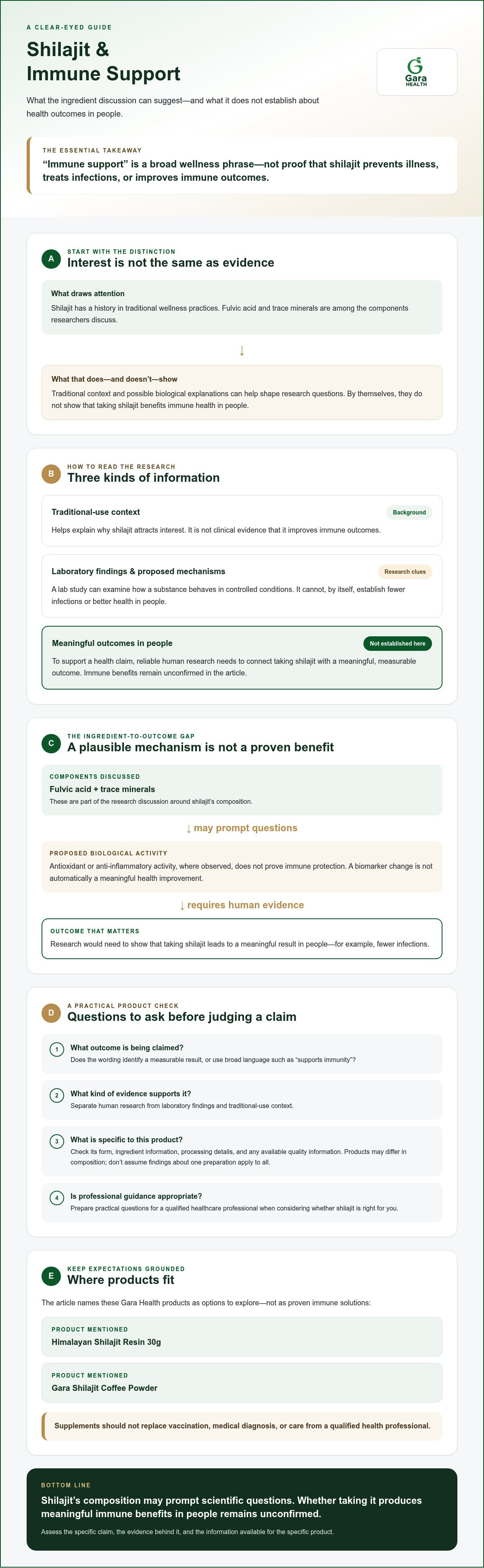
The phrase shilajit for immune support combines two ideas, but the wording doesn’t show that shilajit improves immune health. Shilajit is a naturally occurring substance associated with mountainous regions and traditional wellness practices. “Immune support” is a broad wellness phrase, not a specific clinical result. To establish a health effect, research would need to show that taking shilajit leads to a meaningful outcome in people, such as fewer infections.
In brief: “Shilajit for immune support” is a supplement claim or area of interest, not proof that shilajit prevents illness, treats infections, or improves immune outcomes in humans.
What is shilajit, in plain language?
Shilajit is a naturally occurring material associated with mountainous environments. Its history in traditional wellness practices helps explain why it attracts modern interest. A general overview of Shilajit describes its history and traditional use. That background is useful context, but it isn’t clinical evidence of an immune benefit.
Products can differ in form and processing, so don’t assume every supplement has the same composition or quality. When considering a resin, review the specific product details rather than relying on general descriptions. For a closer look at evaluating resin products, see the Himalayan shilajit resin buying guide.
What does immune support mean?
Your immune system is a network of cells, tissues, and processes that helps the body respond to potential threats. It isn’t a simple switch that can be turned up for better health. A phrase like “supports immunity” may sound reassuring, but it doesn’t tell you whether a product has been shown to reduce infections, change a defined immune measure, or improve another health outcome.
Claims about shilajit often draw on traditional use and interest in components such as fulvic acid and trace minerals. These points can help researchers form questions, but they don’t establish that taking a supplement changes immune function in people. A plausible explanation is not the same as a demonstrated benefit.
Keep the distinction clear: general wellness language describes a hoped-for role, while a proven clinical effect requires reliable evidence tied to a measurable outcome. Supplements shouldn’t replace vaccination, medical diagnosis, or care from a qualified health professional. If you’re considering shilajit, assess the specific claim and product rather than relying on the phrase “immune support” alone.
How might shilajit relate to immune function?
Interest in shilajit and immunity often starts with its complex composition. Fulvic acid and trace minerals are commonly discussed as possible reasons the substance could interact with biological processes. That’s a starting point for research, not evidence that taking shilajit strengthens immune defenses or helps prevent illness.
What role do fulvic acid and trace minerals play in the discussion?
Fulvic acid is a group of organic compounds discussed in research on shilajit. Trace minerals are minerals present in small amounts. A review indexed by the U.S. National Library of Medicine discusses shilajit as a natural phytocomplex and describes its composition and traditional use. This context can help explain scientific interest, but it doesn’t confirm an immune benefit.
Shilajit products shouldn’t be assumed to share identical composition or concentrations. The starting material and processing can affect what’s present in a finished product. Check the specific product’s ingredient information and any available quality details. Don’t assume that findings about one preparation apply to all supplements.
Why don’t proposed mechanisms prove an immune benefit?
A laboratory study can show how a substance behaves in cells or under controlled conditions. It can’t establish that people who take a supplement experience fewer infections or better health. Human studies are needed to assess those outcomes, and results depend on the preparation, participants, and measures used.
Even a change in a biomarker, such as a measurement related to inflammation or oxidative stress, isn’t automatically a meaningful health improvement. Researchers must determine whether that change leads to an outcome that matters to people. Antioxidant or anti-inflammatory activity, where observed, shouldn’t be presented as proof of immune protection.
In short, shilajit’s fulvic acid and mineral content may prompt hypotheses about biological activity, but whether taking it produces meaningful immune benefits in people remains unconfirmed. This distinction matters when assessing claims about shilajit for immune support: ingredient-level research doesn’t prove that a particular finished product works for that purpose.
If you’re considering shilajit, review the details for the specific product rather than relying on broad mechanism claims. You can explore Gara Health’s shilajit options and assess the product information with the same careful, evidence-minded approach.
Does research show that shilajit improves immune health?
The most relevant question is whether people taking shilajit experience measurable immune-health benefits. As of 2026, human evidence for shilajit’s role in immunity is weak and speculative. A major review noted the lack of well-established clinical trials testing its immunomodulatory effects in people. The evidence therefore doesn’t support claims that shilajit prevents infections, shortens illness, or treats immune conditions. That doesn’t prove shilajit has no effect; it means the answer remains uncertain.
A review of support for immunity can help you see how proposed biological activity differs from established clinical benefits. When assessing a claim, check what kind of evidence supports it and whether that evidence measures the result being promised.
What kinds of evidence should readers look for?
Controlled human studies that measure relevant health outcomes are more directly useful than cell or animal experiments. Human research also needs careful reading: check who took part, what preparation was tested, how many participants were included, and whether the outcomes measured actual health effects or only biomarkers. Study design and publication date matter, too.
Here’s how to distinguish the evidence categories:
Human research: No well-established clinical trials demonstrate that shilajit improves immune outcomes in people. Available human evidence doesn’t establish fewer infections or other clinical benefits.
Preclinical research: Laboratory or animal findings may explore immune-related activity, but they can’t show that a supplement produces the same effect in people.
Traditional-use context: Longstanding use can explain why shilajit is of interest, but it isn’t a controlled test of effectiveness.
What can current evidence reasonably support?
At present, research supports interest in possible mechanisms, not a confirmed immune-health benefit. A change in a laboratory measure would still need to be connected to a meaningful outcome, such as a demonstrated change in infection rates, before it could support a stronger claim. Results from one preparation also can’t automatically be applied to every shilajit product.
Bottom line: Human evidence for shilajit for immune support is limited, and no well-established clinical trials show that it improves immune outcomes or prevents illness.
When you see a confident claim, look for human research that tested the same preparation and measured the outcome being promised. If that connection is missing, treat the claim as unproven. Shilajit shouldn’t replace vaccination, diagnosis, or medical care.
How can you assess shilajit immune-support claims?
A clear claim should be possible to evaluate. “Immune boosting” sounds appealing, but without a defined outcome, such as a measured change in infection rates, it’s difficult to know what the promise means or what evidence could support it. Use this sequence to look beyond the wording:
- Identify the exact claim. Is it about general wellness, a change in a biomarker, fewer infections, or another specific outcome?
- Look for relevant human research. Check whether a study tested people, measured the outcome being claimed, and used the same form or preparation of shilajit. Lab findings and animal studies offer context, not proof of a human benefit.
- Review the product details. Read the ingredient list, directions, and warnings. Don’t assume evidence about one preparation applies to another, or that a product has been tested unless its information clearly says so.
- Ask a qualified healthcare professional. They can help you consider personal health factors and possible interactions before you decide whether to use a supplement.
Which questions help separate evidence from marketing?
Ask what was measured, who participated, and whether the research studied the same preparation as the product being promoted. A general wellness phrase isn’t a substitute for a defined result. Testimonials may describe someone’s personal experience, but they can’t establish that shilajit caused the outcome or that others should expect it.
For claims about shilajit for immune support, look for a direct connection between the promise and reliable human evidence. If a claim relies only on traditional use, a proposed mechanism, or a laboratory result, treat it as preliminary rather than established.
When should you speak with a healthcare professional?
Get professional advice before using a supplement if you have a health condition, take medicines, are pregnant or breastfeeding, or have another personal concern. A clinician or pharmacist can help you consider whether a supplement is appropriate for your circumstances. This section offers general information, not individualized medical advice or a safety guarantee.
Don’t delay seeking care for symptoms or replace prescribed treatment with shilajit. If you’re interested in exploring product options after reviewing the evidence and your own considerations, explore Gara Health’s shilajit offerings.
How can Gara Health's shilajit products fit into an informed choice?
Once you’ve weighed the evidence, choosing a product is a separate decision. Gara Health offers Himalayan Shilajit Resin 30g and Gara Shilajit Coffee Powder for people interested in shilajit. Their availability doesn’t establish that either product improves immune health, and neither should be treated as a substitute for medical care. If you’re considering shilajit for immune support, base your decision on the evidence, the specific product information, and your own circumstances.
What should you check before considering a shilajit product?
Start with the current product page. Read the ingredient information, directions, and warnings, and look for clear, verifiable quality details. If independent testing information or a Certificate of Analysis is available, review what it covers rather than assuming testing has taken place. Product information can change, so check the page directly before deciding. Don’t infer ingredients, testing, or health effects from a product name or from claims about shilajit generally.
Your personal situation matters, too. If you have a health condition, take medicines, are pregnant or breastfeeding, or have another safety concern, ask a qualified healthcare professional before using a supplement. They can help you consider whether it’s appropriate for you without relying on broad marketing language.
Where can you learn more before deciding?
For broader context on supplements and immune health, explore this immune support supplements guide. Use it as a starting point for questions, not as proof that a particular supplement prevents illness or improves immune outcomes.
Shilajit may interest you as part of a wellness routine, but choosing a product is optional. It isn’t a proven immune solution, and product information shouldn’t be confused with clinical evidence. Immune health involves broader care, including appropriate medical advice and recommended preventive care, not one supplement alone.
If you’d like to review the available options and their current details, explore Gara Health's shilajit products.
Make your next wellness choice with clarity
Shilajit has a long history of traditional use, and its components continue to interest researchers. But shilajit for immune support remains an area with limited human evidence: proposed mechanisms and early findings don’t establish that it prevents infections or improves immune health.
As you weigh your options, look for research that tests people and measures meaningful outcomes. Review the current details of any product you’re considering, and speak with a qualified healthcare professional if you have health concerns, take medicines, or are unsure whether a supplement is suitable for you.
Gara Health offers Himalayan Shilajit Resin 30g and Gara Shilajit Coffee Powder as options to explore, not proven immune solutions or replacements for medical care. Review their current product information and make a choice that feels informed and right for you. Explore Gara Health's shilajit products.
Steady, thoughtful decisions are a strong foundation for your wellness journey.
Frequently Asked Questions
Can shilajit support the immune system?
It’s possible that shilajit has biological effects worth studying, but current human evidence doesn’t establish that taking it improves immune health. Researchers have proposed links involving its components, yet a plausible mechanism isn’t proof of a benefit in people. If you’re considering shilajit for immune support, look for controlled human research that measures meaningful outcomes rather than relying on traditional use or broad wellness claims alone.
Is shilajit proven to boost immunity?
No. As of 2026, human evidence for shilajit’s immune effects is weak, and well-established clinical trials demonstrating improved immune outcomes are lacking. “Boost immunity” is also imprecise: it doesn’t specify what changed or how that change benefits health. Laboratory or animal findings can guide further research, but they can’t establish that a supplement helps people resist infection or improves immune function.
What does fulvic acid in shilajit have to do with immune support?
Fulvic acid is one component discussed in research on shilajit, and proposed biological activity has contributed to interest in possible immune effects. That interest doesn’t confirm that fulvic acid in a supplement improves immunity. Products can differ in composition and concentration, so findings about an ingredient or preparation may not apply to every product. Check the specific product information, and treat mechanism-based claims as unproven unless supported by relevant human outcomes.
Can shilajit prevent colds or infections?
There’s no well-established human evidence showing that shilajit prevents colds or other infections. Claims about antioxidant or anti-inflammatory activity don’t demonstrate protection from illness. Don’t rely on shilajit to prevent infection, delay medical advice, or replace recommended preventive care. If you’re unwell or concerned about symptoms, seek appropriate guidance from a qualified healthcare professional rather than treating a supplement as an infection remedy.
Is shilajit safe for everyone to take?
No supplement can be assumed safe for everyone. Shilajit products may differ, and raw or unpurified material can carry contamination risks, including heavy metals. If you have a health condition, take medicines, are pregnant or breastfeeding, or have other safety concerns, ask a qualified healthcare professional before use. Review the product’s current ingredient and quality information, and don’t treat general safety claims as a substitute for advice suited to your circumstances.
How can I tell whether a shilajit immune-support claim is credible?
Look for a clearly defined outcome and human research that tests the same form of shilajit and measures that outcome. Check the study design, participants, and whether it assessed a meaningful health result rather than only a laboratory marker. Read the product’s current ingredients and quality information, too. Testimonials and traditional use may offer context, but they don’t prove effectiveness. Ask a healthcare professional if you’re unsure whether the evidence applies to you.


