


A mountain name can tell you where a shilajit story begins, but it can’t prove what’s in the jar. If you’ve seen claims about Himalayan peaks, extreme altitude, and authenticity, it’s fair to ask: where does the best shilajit come from, and what does its origin really tell you?
Shilajit forms over long periods as organic material decomposes among rock layers, and its composition can vary with local geology. The Himalayas are a widely recognized source, but they aren’t the only mountain range associated with shilajit. The Altai, Caucasus, and Pamir are also reported sources. A place name or an impressive altitude claim does not, on its own, establish a product’s quality.
This guide explains where shilajit naturally forms, how Himalayan origin compares with other source regions, and what to look for when assessing sourcing claims. You’ll also learn why clear provenance and relevant product evidence matter more than mountain-name marketing. Gara Health Himalayan Shilajit Resin is identified as Himalayan, without a more specific collection site or altitude claim.
Key Takeaways
- Shilajit forms over long periods in mountain rock environments, and its composition can vary with local geology.
- When asking where does the best shilajit come from, compare Himalayan, Altai, Caucasus, and Pamir origins without treating any region as an automatic quality guarantee.
- Distinguish a broad region label from product-specific sourcing details that make an origin claim easier to trace.
- Assess a source claim in order: identify the named region, look for consistent sourcing information, and consider what relevant product evidence can establish.
- Keep origin in perspective. A compelling mountain story matters less than evidence that supports claims about the finished product.
Where does the best shilajit come from? Start with how it forms
The best shilajit is not defined by a mountain name alone. It naturally occurs in high mountain environments, including the Himalayas, and is associated with the interaction of organic material, rock, climate, and time. In brief, shilajit is a naturally occurring material found in some mountain regions, formed through long-running natural processes involving organic matter and rock.
That distinction separates two questions: where the raw material originates and how the finished supplement is handled. A natural source gives geographic context, but it cannot by itself establish the purity or quality of what ends up in a jar.
How does shilajit form in mountain environments?
Accounts of shilajit formation commonly describe plant material accumulating in mountain settings and becoming trapped among rock layers. Over time, environmental and geological processes can transform or concentrate this material, which may later emerge through cracks in the rock. Descriptions of the precise sequence vary, so it is more accurate to treat this as a broad account than as one definitive process.
The setting helps explain why geography is relevant. Organic material is the starting matter described in formation accounts. Rock provides the surrounding environment, while temperature, moisture, and seasonal changes can influence how material weathers and moves. These processes unfold over time, but a general description of formation does not reveal the exact history of a particular batch.
Shilajit on Wikipedia provides an overview of reported distribution and formation descriptions across mountain regions. Use geographic references like this to understand the broader natural context, not as proof of where a specific commercial product was collected.
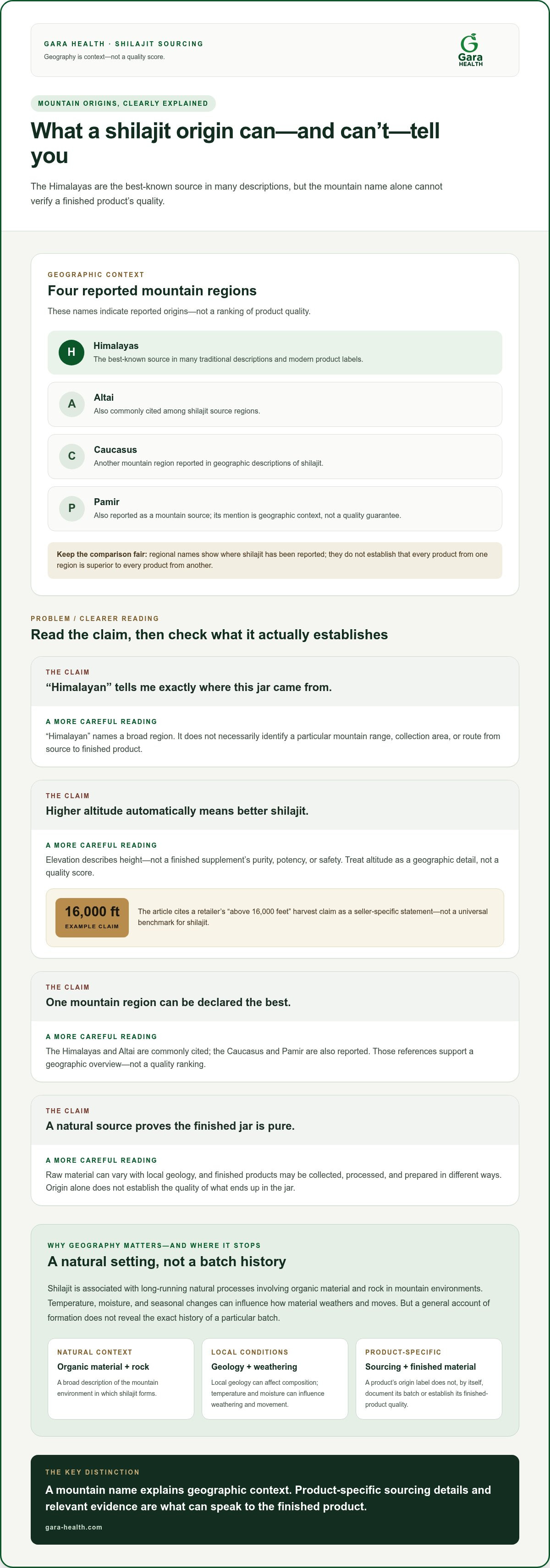
Natural formation and finished-product quality are separate matters. Raw material can differ, and the final product may be collected, processed, and prepared in different ways. A label that says “natural” or names a mountain region does not independently show how the material was processed or establish that the finished supplement is pure. Those questions require evidence about the product itself.
Why are the Himalayas so closely associated with shilajit?
The Himalayas feature prominently in traditional descriptions and modern commercial claims about shilajit. The region’s high mountain environment fits common accounts of how shilajit forms, and “Himalayan” has become a familiar origin label. It is a useful starting point, but not a complete sourcing record.
A regional label gives context by naming a broad part of the world associated with shilajit. It does not necessarily identify a particular mountain range, collection area, or the route from source to finished product. Nor does “Himalayan” alone show that one product is better than another. Treat altitude claims as geographic details, not shortcuts to quality, especially when they lack clear product-specific context.
So, where does the best shilajit come from? Start with a credible natural origin, then consider what the product’s sourcing information and quality evidence can actually establish. Geography explains the setting, but it does not tell the whole story.
Himalayan shilajit and other mountain origins: what geography can tell you
The Himalayas are the best-known source in many traditional descriptions and modern product labels, but they are not the only mountain region associated with shilajit. Geographic references also include the Altai, Caucasus, and Pamir ranges. These names help show where shilajit has been reported; they do not establish that every product from one region is superior to every product from another.
Geography alone cannot verify a finished product’s quality. A region provides useful context about origin, but a label is not the same as batch-specific sourcing records or evidence about the final material. Keep that distinction in mind when a familiar mountain name appears alongside claims about altitude or potency.
Does higher altitude automatically mean better shilajit?
Altitude describes elevation, not a finished supplement’s purity, potency, or safety. A retailer’s claim that its product is harvested above 16,000 feet is a claim about that seller’s product, not a universal benchmark for shilajit. Without comparable, product-specific evidence, the figure does not establish superiority. Treat altitude as one geographic detail, not a quality score.
Elevation may be part of a sourcing description, but it does not tell you how a particular batch was collected, handled, or processed. Nor can it substitute for evidence about the finished product. If an altitude figure appears, identify what it describes: a broad region, a collection site, or a documented source for the product. The wording matters.
Can shilajit from different mountain regions be compared fairly?
Only with care. Britannica on Shilajit discusses mountain origins and formation, providing context for why several regions appear in descriptions of the substance. The Himalayas and Altai are commonly cited source regions, while the Caucasus and Pamir are also reported. This supports a geographic overview, not a quality ranking.
Regional names also differ in precision. “Himalayan” covers a broad area, while naming a country or collection location narrows the claim. More detail on a label is still not proof by itself. A meaningful comparison needs consistent, reliable information about the source material and the finished products being compared. Broad marketing terms rarely provide enough detail to conclude that one region produces stronger or cleaner shilajit.
For a practical comparison, separate three things: the named mountain region, how specific the sourcing description is, and the evidence about the product itself. If two labels name different ranges but offer no comparable sourcing details or product evidence, geography alone cannot settle which is better. Available regional descriptions do not support a simple “best range” ranking.
Gara Health Himalayan Shilajit Resin is identified as Himalayan shilajit, a broad regional origin description without a specific altitude claim. Explore the Gara Health Himalayan Shilajit Resin as one example of a product labeled by its Himalayan origin.
What makes a shilajit origin claim credible beyond the place name?
A country or mountain-region label answers a broad question: where does the seller say the raw material comes from? It does not necessarily show which source supplied a particular product or how the material moved from collection to finished supplement. To understand an origin claim, look for detail and consistency, not just an evocative place name.
Useful sourcing information connects the geographic description to the product as specifically as possible. For example, a clear region paired with records identifying the relevant batch provides more context than “mountain-sourced” on its own. Such information makes the claim easier to follow, but does not automatically prove quality. Documentation practices can vary, and these examples are not a statement of legal requirements.
What sourcing details help substantiate a geographic claim?
Start by noting exactly what the label says: a country, a mountain region, or a more specific collection area. Then look for consistent, product-specific information connecting that description to the batch being sold. A broad label can be accurate while leaving the precise source unclear. Specific, traceable details make the claim easier to interpret; dramatic language without context tells you little.
Consistency matters. If a product page names one region while other materials use a different description, the sourcing story is harder to follow. Clear explanations of what the region label means, and what records support it, help distinguish a geographic statement from a fuller provenance account. No single phrase or document is automatic proof. Consider how the details fit together.
How should you interpret testing and purity language?
Testing and provenance answer different questions. A laboratory result may provide information about what was tested in a sample, depending on the test and the details reported. It does not, by itself, establish where the raw material originated. Geographic records can support a sourcing story, but do not demonstrate the finished product’s measured characteristics. Evaluate these evidence types separately.
Be just as precise with purity language. A competing product page, for example, claims lab testing above 78% fulvic acid. That is a seller-specific claim, not a universal benchmark for shilajit or proof of a particular geographic source. To interpret a numerical result, you would need to know what was analyzed and whether the result relates to the product in question. Do not turn one seller’s figure into a general rule.
The NIH Review of Shilajit discusses shilajit’s reported origins and composition, including fulvic acid. It offers scientific context, but a general review is not documentation for an individual product’s provenance. Keep that distinction in view as you compare labels and testing claims.
For a separate look at consumer-level checks, the shilajit resin purity test guide can help explain what simple observations may and may not tell you. Such checks cannot replace laboratory evidence, and neither a home test nor a lab result establishes geographic origin on its own. A clearer assessment combines a specific sourcing account with relevant product-level evidence, while recognizing what each can actually show.
How to assess a shilajit source claim without falling for origin hype
A place name is a starting point, not a complete quality check. To assess a shilajit source claim, move from the broad label to the details behind it, then consider processing and finished-product evidence separately. This approach makes it easier to see what a seller supports and what remains a marketing phrase.
Treat origin as one useful clue, not a quality verdict. Asking “where does the best shilajit come from” can help you explore geography, but the answer will not establish what is in a specific product or how it was prepared.
A practical checklist for reading origin labels
Read the claim in sequence. Each step clarifies what the label tells you without treating one detail as proof of everything else.
- Find the place named. Does the description identify a country or mountain region, or rely only on mountain imagery and phrases such as “remote peaks”? Note how specific the claim is.
- Look for a sourcing explanation. See whether the product description explains the stated origin and whether supporting materials use the same description. Consistent wording is easier to interpret than vague or shifting place names.
- Separate sourcing from processing. Origin describes where the raw material is said to come from. Processing describes what happens afterward. A clear account of one does not automatically explain the other.
- Read precise numbers in context. Altitude or purity figures may sound persuasive, but they are claims to understand, not automatic proof. Identify what the number refers to and whether the evidence relates to the product being described.
- Check what product testing addresses. Testing information may speak to measured properties of a sample. It does not, by itself, verify where the raw material originated. Keep those evidence types distinct.
Which questions does an origin label leave unanswered?
A country or mountain-region name alone cannot establish a product’s composition, purity, or safety. Those questions call for evidence about the finished material, not just its geographic story. Even a precise-sounding origin statement may leave the collection location, sourcing path, and handling details unexplained.
Origin also cannot promise a particular personal result. People’s experiences vary, and a location claim is not evidence that an individual will feel a specific effect. For a grounded starting point, a foundational guide to what shilajit is can help clarify the substance before you weigh product descriptions or wellness claims.
Keep the evaluation practical: note the named region, record what the seller says about sourcing and processing, then look separately at any evidence about the finished product. If a claim blurs those categories, do not assume it proves more than it says.
If you’re exploring a clearly labeled Himalayan-origin option, take a look at Gara Health Himalayan Shilajit Resin.
Gara Health Himalayan Shilajit: a clear origin description, without overclaiming
A useful way to read any shilajit label is to separate three kinds of information: stated origin, described ingredients, and evidence about the finished material. A regional name tells you how the product is presented geographically. Ingredients describe what the product contains. Neither detail alone verifies the other, and neither guarantees a particular personal result.
That framework keeps the question “where does the best shilajit come from” grounded. A Himalayan origin provides context, but it does not establish a specific collection site, altitude, or sourcing process. Those details should not be inferred from the word “Himalayan.”
What Gara Health's Himalayan Shilajit product description says
Gara Health Himalayan Shilajit Resin is pure Himalayan Shilajit infused with Ashwagandha, Turmeric, and Tribulus. It contains 75+ trace minerals and fulvic acid. These details describe the product’s stated origin and composition; the ingredient description is not independent verification of where the shilajit was collected.
The geographic wording identifies a broad region. It does not name a particular Himalayan range, collection site, or altitude, so understand it at that level rather than expanding it into a more detailed sourcing story. This is a useful distinction for evaluating any origin-labeled product: repeat what the description says, but do not add specificity it does not provide.
Composition and origin statements answer different questions. One describes the product’s contents; the other communicates its regional origin. Neither, on its own, establishes every aspect of sourcing, processing, purity, or safety. Keeping those categories separate helps you make a balanced assessment without relying on geographic prestige as a shortcut.
Explore Gara Health's shilajit products
Readers comparing formats can explore the existing Himalayan Shilajit Resin buying guide for product-specific context. For another format, the shilajit-infused coffee powder guide can explain how that option is presented. Gara Shilajit Coffee Powder combines medium-roast Brazilian Arabica with Himalayan Shilajit. Each serving provides 200 mg of Shilajit, and the coffee has 80% less caffeine than regular coffee. The blend description identifies both components without specifying a more exact shilajit source location.
These distinctions keep the origin story clear and proportionate. A broad Himalayan description is useful context, while claims about exact sourcing or finished-product quality should be assessed using relevant details. The goal is not to dismiss geographic origin, but to understand what it tells you and what it does not.
To explore the resin’s Himalayan origin and product details, Explore Gara Health's Himalayan Shilajit.
Choose your next step with clarity
Let the question “where does the best shilajit come from” guide your research, not decide it for you. As you compare options, focus on what each claim actually says and whether the available information supports it. A thoughtful choice does not require the boldest altitude story; it starts with clear expectations about what you can and cannot verify.
Gara Health Himalayan Shilajit Resin is pure Himalayan Shilajit infused with Ashwagandha, Turmeric, and Tribulus. Consider the product description on its own terms, without treating a regional label or ingredient list as proof of geographic superiority. A grounded approach leaves room for curiosity while keeping your standards clear.
Ready to explore a Himalayan-origin option? Explore Gara Health's Himalayan Shilajit and take your next step with confidence and care.
Frequently Asked Questions
Where does shilajit naturally come from?
Shilajit is associated with high mountain environments, including the Himalayas, and is described as forming where organic material and rock interact over time. For a product, distinguish this general natural history from its own sourcing story. For example, “Himalayan” identifies a broad region, while a product-specific account may provide more detail about its stated source. Neither description, by itself, tells you everything about the finished supplement.
Is Himalayan shilajit better than shilajit from other regions?
Not automatically. A Himalayan label may be a relevant point of origin, but it does not rank the product above shilajit associated with another region. When comparing options, consider what each description says about sourcing and what evidence relates to the product itself. The question “where does the best shilajit come from” is best answered by considering the full evidence, rather than choosing by mountain name alone.
Can shilajit come from outside the Himalayas?
Yes. Shilajit is also associated with other mountain regions, including the Altai, Caucasus, and Pamir. Those names offer broad geographic context, not a complete map of every source or proof about a particular supplement. If a product names one of these regions, consider what the regional label refers to. Do not assume that a broad place name identifies an exact collection location.
Does higher-altitude shilajit mean higher quality?
No. An elevation figure tells you something about a claimed location, not whether a finished supplement has a particular composition or is safe. If a label gives an altitude, read it as a sourcing detail and consider whether the claim is explained clearly. Evaluate product testing and processing information separately. A dramatic elevation figure should not replace evidence about the product you are considering.
How can I tell where a shilajit supplement comes from?
Look for a country or region in the product description, then compare that wording with any supporting sourcing materials. If a label says “Himalayan” but another description names a different region, the inconsistency makes the claim harder to interpret. Product-specific records may add context, but testing results answer a separate question. Read each piece of information for what it can establish rather than treating one as proof of everything.
Is Himalayan origin enough to prove shilajit is authentic?
No. A Himalayan label states a claimed origin; it does not independently authenticate the material. Check whether the product’s sourcing description is clear and consistent, then review what any product-specific evidence actually covers. For instance, a test report may relate to the sample tested, while a regional label relates to origin. Neither should be stretched beyond its stated purpose.
What is the difference between shilajit origin and shilajit purity?
Origin refers to the geographic source associated with the raw material; purity concerns the product’s composition or condition. The two require different kinds of evidence. A test result may describe measured properties of a sample, but it does not necessarily trace the sample to a mountain region. Conversely, an origin description cannot establish composition. Keeping those questions separate helps you interpret product claims without confusing location with quality.


