


Shilajit may be taken in the morning, including before breakfast, but individual tolerance can vary. If you’re wondering whether you can take shilajit on an empty stomach comfortably, start with a small amount and pay attention to how your stomach responds. Nausea or mild discomfort can happen, especially with higher doses.
It makes sense to want a clear routine before adding a supplement to your morning. This guide covers taking shilajit on an empty stomach, what to consider about timing and possible effects, and which medication interactions warrant caution. You’ll also learn what to do if taking it before breakfast doesn’t suit you, so you can make an informed choice that fits your day.
Key Takeaways
- A morning, empty-stomach routine may suit you, but notice how your digestion responds and adjust the timing if needed.
- Learn how to begin with a measured amount and increase gradually rather than assuming one dose fits everyone.
- Set realistic expectations: changes in energy or focus may take consistent use over several weeks.
- Review possible interactions carefully, especially if you take medication for blood sugar or blood pressure.
- Build a breakfast routine that gives shilajit time before your first meal, while keeping comfort and consistency in mind.
1. Is it Safe to Take Shilajit with Your Morning Coffee or on an Empty Stomach?
Yes, taking shilajit on an empty stomach is a common morning approach. A practical routine is to take it 30–60 minutes before breakfast, then wait another 30–60 minutes before eating. Some guidance suggests taking it 15–30 minutes before breakfast for faster absorption. These timings vary, so choose a consistent window that fits your morning and follow the product’s directions.
Taking shilajit before breakfast may affect absorption: estimates suggest absorption can be up to 30% higher on an empty stomach than with meals. That doesn’t mean everyone will feel better using it this way. Shilajit may cause mild nausea or stomach discomfort, particularly at higher doses. If your stomach is sensitive, take it with a small meal instead of forcing an empty-stomach routine.
Water is a straightforward option for taking shilajit, while warm water or milk can help dissolve resin or powder. Don’t boil the resin. If you prefer morning coffee, allow 30–45 minutes between coffee and shilajit; if mixing shilajit into coffee, let the drink cool to about 140–150°F first. If you take shilajit with coffee or food, follow the product directions and choose a routine you can maintain.
For morning use, take it before 11am–12pm and keep the timing steady. Record the time, whether you took it with food, and any stomach response. That simple log can help you decide whether to continue before breakfast or switch to taking it with food. Capsules may be convenient, but the label’s serving instructions matter because forms and concentrations can differ.
To assess whether a product is purified and independently tested, look for clear labeling that identifies purification and third-party laboratory testing. ConsumerLab.com, US Pharmacopeia (USP), and NSF International are examples of testing organizations cited in guidance. Check the package or product information for testing details, since poor-quality shilajit can contain lead or arsenic.
Some people should avoid shilajit or seek medical guidance before use. It isn’t recommended during pregnancy or breastfeeding, for children, or for people with iron overload or autoimmune disorders. People with hemochromatosis or other iron-related conditions should consult a physician before taking it. If an empty-stomach dose causes nausea, try taking it with a small meal rather than increasing the amount.
2. Starting dosage and gradual increases
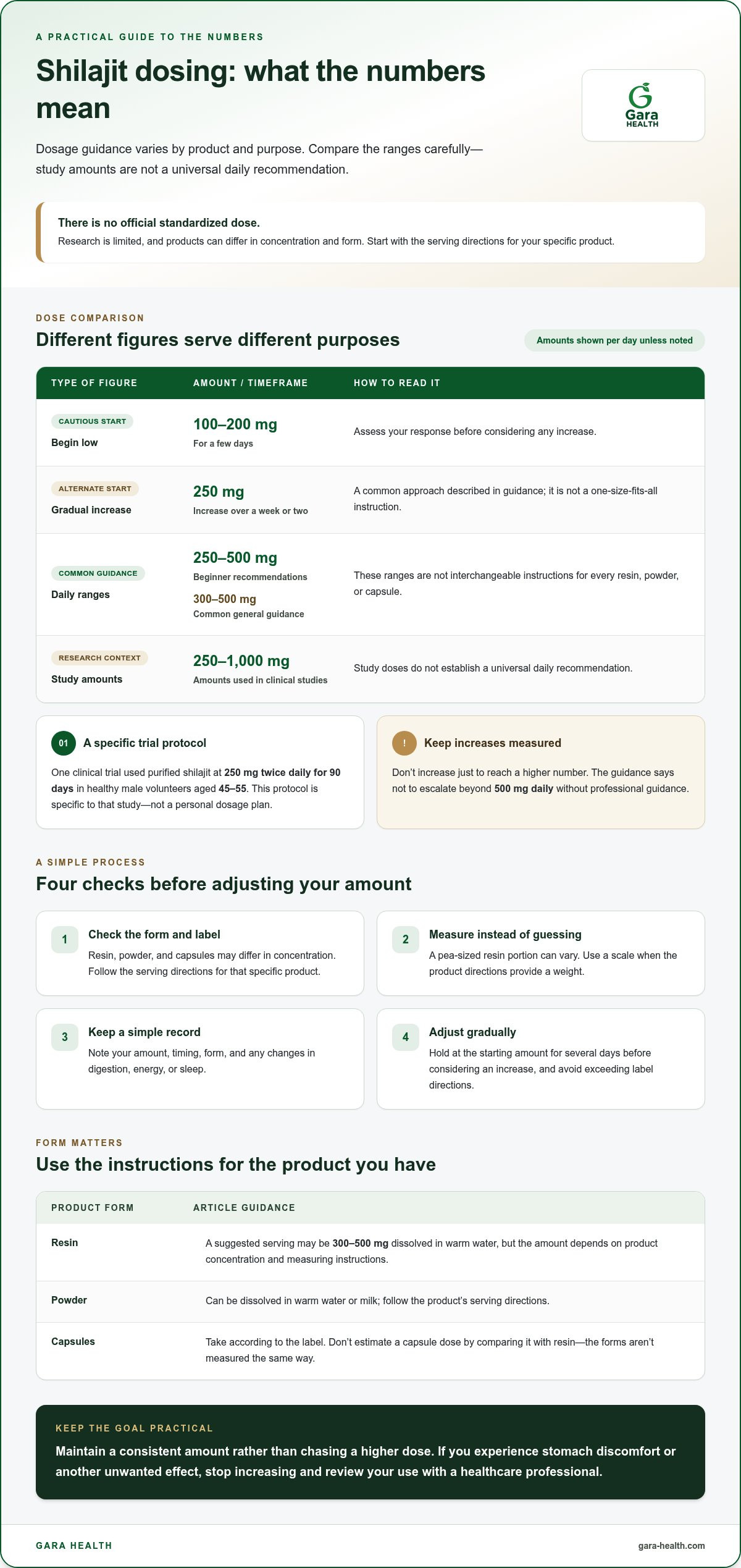
Shilajit has no official standardized dosage because research remains limited and products vary in concentration and form. Guidance commonly places a daily amount around 300–500 mg, while beginner recommendations range from 250–500 mg daily. Those ranges are not interchangeable instructions for every resin, powder, or capsule. Start with the product’s serving directions and consider the amount of actual shilajit in each serving.
A cautious approach is to begin at 100–200 mg for a few days, then assess your response. Another common approach starts at 250 mg and increases gradually over a week or two. Don’t increase simply to reach a higher number. If you experience stomach discomfort or another unwanted effect, stop increasing and review your use with a healthcare professional.
For a practical routine, follow these steps:
- Check the form and label. Resin, powder, and capsules may differ in concentration, so use the serving directions for that specific product.
- Measure rather than guess. A resin portion that looks pea-sized can vary, so use a scale when the product directions provide a weight.
- Keep a simple record. Note your daily amount, timing, form, and any changes in digestion, energy, or sleep.
- Adjust gradually. Hold at the starting amount for several days before considering an increase, and avoid exceeding the label directions.
Clinical studies have used 250 to 1,000 mg per day, but study doses don’t establish a universal daily recommendation. Ayurvedic guidance commonly uses 300–500 mg daily for general well-being. Some experienced users take up to 1,000 mg under professional guidance; that is not a reason to increase your own dose without appropriate advice.
Resin and powder can be dissolved in warm water or milk, while capsules are taken according to their label. A suggested resin serving may be 300–500 mg dissolved in warm water, but the actual amount depends on the product’s concentration and measuring instructions. Avoid estimating a capsule dose by comparing it with resin; the forms aren’t measured the same way.
Fulvic acid is one compound associated with shilajit, but a higher percentage alone doesn’t determine the right serving. Check the product’s labeling and consider its fulvic acid content alongside the serving size and purification details. A clinical trial used purified shilajit at 250 mg twice daily for 90 days in healthy male volunteers aged 45–55. That study protocol is specific, not a personal dosage plan.
Keep the goal practical: maintain a consistent amount rather than chasing a dose to enhance function or reduce fatigue. Track your response over time, and don’t escalate beyond 500 mg daily without professional guidance.
3. Potential benefits and expected time to notice effects
Shilajit is often used to support energy, focus, and physical stamina, but effects aren’t immediate for everyone. Market guidance reports that users may notice changes within 2–4 weeks of consistent use. Treat that as a possible timeframe, not a reason to increase your dose if you feel no change after a few days.
Another trial involved 63 recreationally active men over 8 weeks. These findings give context, but a study result doesn’t establish what every person will experience or prove that shilajit replaces sleep, balanced meals, or training recovery.
To get a clearer picture of your experience, track your routine for several weeks. Record the amount, timing, sleep, exercise, and any changes in energy or focus. Keep other habits steady where possible. Starting shilajit alongside a new exercise plan or caffeine routine makes it harder to tell which change may be related to an observed effect.
Digestive discomfort, including nausea or mild stomach upset, is a possible side effect. If it occurs after taking shilajit on an empty stomach, try taking it with a small meal, and don’t increase the amount while symptoms continue. Note the timing and severity. Stop taking it and seek medical advice if the reaction is severe or persistent.
Review your medications before starting shilajit. It may amplify the effects of blood thinners or anti-diabetic drugs, and may interact with some cancer treatments and aspirin. People taking blood pressure or diabetes medication shouldn’t use shilajit without supervision. Those with low blood sugar should also use caution because shilajit may lower blood sugar levels.
Pregnant or breastfeeding people, children, and people with iron overload should avoid shilajit. People with hemochromatosis or another iron-related condition should consult a physician before use. Those with autoimmune disorders or conditions worsened by increased testosterone should also avoid it. If you have surgery scheduled, stop taking shilajit at least two weeks beforehand.
Track changes in a simple daily record: amount, meals, medication timing, physical activity, and symptoms. For example, note whether nausea follows an empty-stomach dose or unusual fatigue occurs after exercise. Share the record with a healthcare professional when discussing medication or an ongoing reaction. Don’t treat increased vitality as proof that a medication dose should change.
4. Possible medication interactions
Before adding shilajit to a medication routine, review the combination with a healthcare professional. Shilajit may amplify the effects of blood thinners or anti-diabetic drugs, so don’t assume it is free of interactions because it is an Ayurvedic supplement. Be ready to share the medication name, amount, reason for use, and any recent changes.
Blood sugar needs particular attention. Shilajit may lower blood sugar levels, so people taking diabetes medication or living with low blood sugar should use caution. Keep taking prescribed medication as directed, and discuss shilajit with a healthcare professional before combining it with treatment. A supplement should not replace prescribed care or prompt you to change medication on your own.
Blood pressure medication also calls for supervision before using shilajit. Guidance advises people taking blood pressure or diabetes medication not to use it without supervision. Make a complete list of prescriptions, over-the-counter medicines, and supplements to discuss with a healthcare professional. Include aspirin and any blood thinner by name.
Shilajit may also interact with some cancer treatments and aspirin. If either is on your medication list, don’t assume that taking them at different times removes the concern. Share the exact product label and serving directions with a healthcare professional, since preparation and amount are relevant when assessing combined use.
Product purity matters as well as medication review. Poor-quality shilajit can contain heavy metals such as lead or arsenic, creating a separate safety concern. Look for independent testing information; ConsumerLab.com, US Pharmacopeia (USP), and NSF International are examples of testing organizations cited in guidance. A purity claim alone doesn’t establish whether a product is compatible with medication.
Use a short preparation checklist before starting:
- Write down each medicine. Include prescriptions, aspirin, blood thinners, diabetes drugs, and other supplements.
- Identify relevant conditions. Mention low blood sugar, blood pressure treatment, cancer treatment, and iron-related conditions.
- Show the product details. Bring its ingredient panel, serving directions, and independent testing information.
- Track your routine. Record shilajit use, medication timing, meals, and exercise, especially if monitoring blood sugar.
A record can help you connect changes with a particular routine, but it can’t diagnose an interaction. If you notice a concerning change after combining shilajit with medication, stop taking the supplement and seek medical advice promptly. Sharing details about the product and all medications supports a more informed safety decision.
5. Timing shilajit before breakfast
For an empty-stomach morning routine, take shilajit 30–60 minutes before breakfast. Then wait another 30–60 minutes after taking it before eating. This schedule gives you a repeatable window to observe comfort and routine, rather than changing timing from day to day. Some guidance instead suggests taking it 15–30 minutes before breakfast for faster absorption. Follow the serving directions for your product, and keep your chosen schedule consistent.
Timing also matters if coffee is part of your morning. Guidance recommends leaving 30–45 minutes between shilajit and tea or coffee. Other recommendations advise a 2-hour gap between shilajit and caffeine, dairy, or high-fiber foods. These intervals differ, so don’t combine every timing rule into one rigid routine. Use the product directions, consider your stomach response, and avoid taking shilajit alongside coffee if the combination causes discomfort.
A practical example is to take shilajit after waking, drink water, and have breakfast later. If you drink coffee first, allow a suitable gap before taking shilajit, rather than swallowing both together. If you prefer to add shilajit to coffee, let the coffee cool to about 140–150°F first. Don’t boil resin when dissolving it in a warm drink. These steps help make the routine clear without turning breakfast into a complicated schedule.
Morning use is generally recommended before 11am–12pm. The most useful time is one you can maintain consistently and tolerate comfortably. If taking shilajit before breakfast brings nausea or stomach discomfort, have it with a small meal instead. People with sensitive stomachs may find food helps prevent digestive discomfort. A consistent food-and-timing record can help you identify whether an empty stomach or coffee changes how you feel.
Fulvic acid is associated with shilajit’s nutrient profile. Guidance states that fulvic acid can increase nutrient absorption by up to 60% when taken on an empty stomach. Shilajit is also described as containing more than 84 minerals, but that figure doesn’t tell you how much your body absorbs. Don’t treat a stated absorption percentage as a personal result or a reason to exceed the serving directions.
Build a straightforward schedule:
- Choose a morning time: Take the serving before 11am–12pm, following its label directions.
- Plan breakfast: Allow 30–60 minutes after taking shilajit before eating.
- Separate coffee: Keep the recommended gap, or avoid combining them if discomfort occurs.
- Adjust for comfort: If an empty stomach causes nausea, take it with a small meal.
Gara Health: Himalayan Shilajit Resin 30g
Gara Health’s Himalayan Shilajit Resin 30g offers a resin option for readers building a simple shilajit routine. If you prefer a coffee format, Gara Shilajit Coffee Powder is another shilajit offering. Choose a format that fits how you plan to take it, and follow the serving directions provided with the product.
For a morning routine, decide whether to take shilajit before breakfast or with food, then track the timing and how your stomach responds. If you take medication or have a health condition, discuss shilajit with a healthcare professional before starting. A product may fit into a consistent routine, but it doesn’t replace individualized medical advice.
Visit Gara Health online to explore its shilajit offerings.
Make Your Morning Routine Work for You
A useful routine is one you can follow without turning each morning into a test of willpower. When deciding whether to take shilajit on an empty stomach, consider more than timing: notice how it fits your appetite, medication routine, and daily habits. A supplement should fit into your broader wellbeing routine, not compete with practices that already help you feel steady.
Give yourself room to refine your routine. Consistency can make it easier to notice what suits you, while a brief record of your experience can support a more informed conversation about supplement use. If you take medication or have a health condition, speak with a qualified health professional before starting.
For questions about Gara Health’s shilajit offerings, contact Gara Health for guidance. Take the next step at your own pace, with a routine built around thoughtful choices and everyday consistency.
Frequently Asked Questions
How Much Shilajit Should I Take?
There isn’t an official standardized dose for shilajit, so use the product’s serving directions rather than guessing from another form. Common guidance suggests 300–500 mg daily, while beginners may start at 250 mg and increase gradually. Resin, powder, and capsules can differ in concentration. Keep a note of the form and amount you use, and don’t treat a higher dose as a shortcut to results.
Is it Safe to Take Shilajit with Your Morning Coffee or on an Empty Stomach?
Taking shilajit before breakfast is a common option, but taking it alongside coffee may not suit every routine. Leave a gap between coffee and shilajit, and follow the product’s preparation directions. If you prefer coffee first, make that part of a consistent schedule rather than taking both together. If an empty stomach causes discomfort, taking shilajit with a small meal is another practical option.
What foods should I avoid when taking shilajit?
Guidance recommends leaving a 2-hour gap between shilajit and dairy products, caffeine, or high-fiber foods. That includes planning around a milky coffee, tea, or a fiber-rich breakfast rather than taking them together. Recommendations also mention a 30–45-minute gap around tea or coffee, so use the product directions and choose a routine that avoids combining them. If food helps prevent stomach discomfort, take shilajit with a small meal.
Is it safe to take shilajit on an empty stomach?
Yes, you can take shilajit on an empty stomach, often in the morning before breakfast. Some people experience nausea or mild stomach discomfort, particularly with higher amounts. If that happens, take it with a small meal rather than pushing through symptoms. Avoid use during pregnancy or breastfeeding and for children. People with iron overload or autoimmune disorders should also avoid it.
What is the recommended shilajit dose for adults?
Common guidance for adults places a typical daily amount at 300–500 mg, but shilajit doesn’t have an official standardized dose. The right serving depends on the product’s form and concentration, so follow its label rather than translating a capsule amount into a resin serving. People taking medication or managing a health condition should discuss use with a healthcare professional before adding this supplement.
What are the common side effects of shilajit?
Mild nausea or stomach discomfort can occur, especially when taking a higher amount without food. If symptoms begin, don’t increase the amount; note when you took it, what you ate, and how you felt. Taking it with a small meal may help reduce digestive discomfort. Poor-quality shilajit can contain lead or arsenic, so product quality and independent testing are important considerations.
Can shilajit interact with medications or supplements?
Yes. Shilajit may amplify the effects of blood thinners or anti-diabetic drugs and may interact with aspirin or some cancer treatments. People taking blood pressure or diabetes medication shouldn’t use it without supervision; those with low blood sugar should also use caution. Before starting, list your prescriptions, over-the-counter medicines, and supplements. Include the shilajit product and its serving directions when discussing possible interactions.
Is there evidence that shilajit provides health benefits?
Human studies have examined possible effects, including fatigue and exercise-related muscle strength, but results from a study don’t establish what every person will experience. One trial described in the research used purified shilajit for 90 days in healthy male volunteers aged 45–55. Treat study findings as evidence under specific conditions, not proof that shilajit replaces medical care, balanced nutrition, or recovery habits.


