


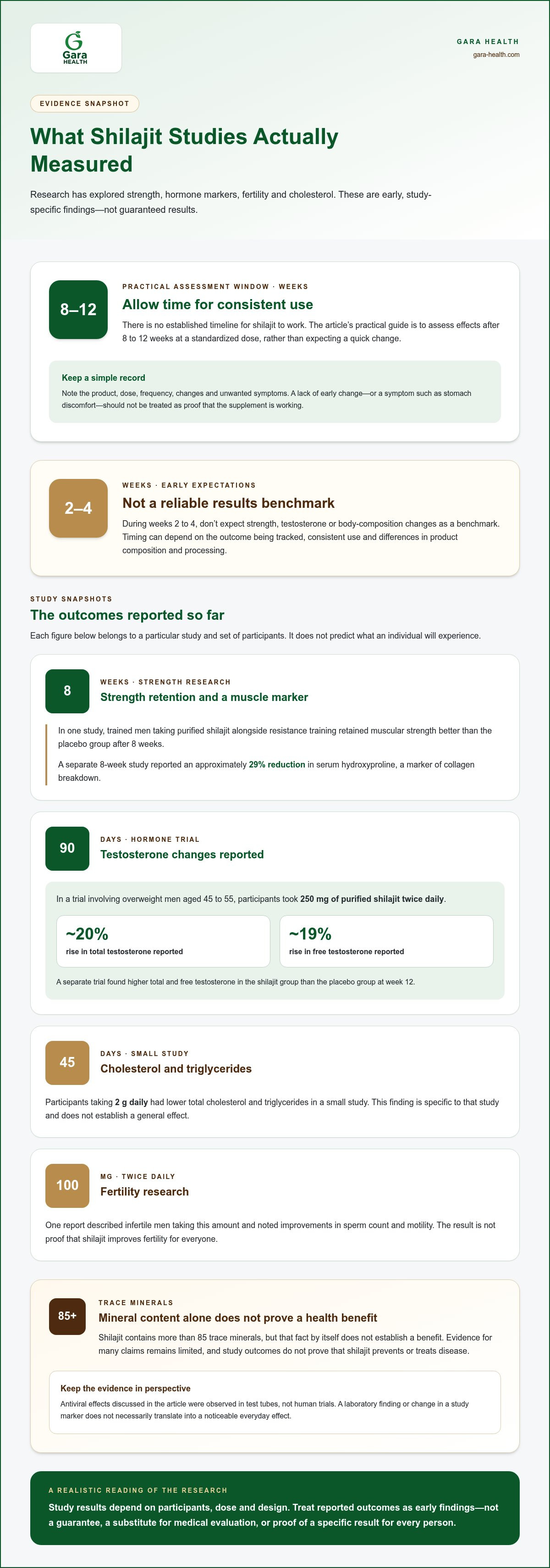
There’s no established timeline for how long it takes for shilajit to work, and its effects aren’t clearly defined. A practical guide is to assess it after 8 to 12 weeks of consistent use at a standardized dose, rather than expecting a quick change.
It’s natural to want more energy or focus from a supplement, but timing is only part of the decision. Safety matters just as much: raw or unpurified shilajit may contain contaminants, and its side effects aren’t well documented.
This guide explains what may affect how quickly shilajit works, which potential benefits have been studied, and why results need to be considered in light of the evidence. You’ll also learn what to look for when assessing supplement purity, who should be cautious about using shilajit, and how to approach safe use. The goal is to help you decide more clearly and realistically whether it belongs in your wellness routine.
Key Takeaways
- Allow a consistent 8 to 12 weeks before assessing effects, and track changes rather than expecting an immediate result.
- Shilajit is associated with possible benefits such as energy, strength, and testosterone support, but evidence for many claims remains limited.
- Raw or unpurified shilajit may contain contaminants, including heavy metals; prioritize products with third-party testing and a certificate of analysis.
- Nausea, upset stomach, and digestive discomfort have been reported, while overall side effects are not well documented.
- Review medications and health conditions with a healthcare professional before use, especially if pregnant, breastfeeding, or taking prescription medicines.
Possible side effects
Shilajit’s side effects aren’t well documented, so there’s no complete picture of how different people respond. Reported issues include nausea, an upset stomach, and mild digestive discomfort. Raw or unpurified shilajit can contain heavy metals, including lead, arsenic, and mercury, as well as fungus. The source and processing therefore matter to safety, not just the supplement’s advertised benefits.
What are the side effects and risks of taking shilajit? Some users report nausea or digestive discomfort, while contaminated material can expose people to toxic substances. Allergic reactions are another concern: anyone allergic to shilajit, mineral pitch, mumio, or an ingredient in a particular product should avoid it. Pregnancy and breastfeeding are also reasons to avoid shilajit, and people trying to become pregnant may be advised to avoid it.
Timing can be hard to judge because shilajit’s effects aren’t well defined. The answer to how long it takes for shilajit to work depends partly on what someone means by “work,” such as energy, muscle performance, or a hormonal marker. A practical assessment period is 8 to 12 weeks at a standardized dose. Trials reporting positive findings ran for a minimum of 8 weeks before measurements changed, so an early impression may not reflect a measurable effect.
In weeks 2 to 4, don’t use strength, testosterone, or body-composition changes as an expected benchmark. A lack of noticeable effects can reflect the outcome being tracked, inconsistent use, or differences in shilajit’s composition across mountain sources. Dosage and processing also matter when comparing products, while the evidence for many claimed benefits remains limited. An ayurvedic tradition of use does not establish that a supplement will produce a specific result for every person.
Keep a simple record during an 8-to-12-week trial: note the product, dose, frequency, and any changes or unwanted symptoms. For example, record stomach discomfort after a serving rather than treating it as a sign of the supplement working. Stop taking shilajit if an allergic reaction or concerning side effect occurs. Don’t continue solely to reach a target timeline when symptoms begin.
- Digestive effects: Nausea, an upset stomach, and mild discomfort have been reported.
- Contamination: Raw material can contain lead, arsenic, mercury, or fungus.
- Allergy and pregnancy: Avoid use with a relevant allergy, during pregnancy or breastfeeding, or when trying to become pregnant.
What are the claimed benefits of shilajit?
Shilajit is used traditionally in Ayurvedic practice, and modern claims often focus on energy, fatigue, strength, and hormonal health. It contains more than 85 trace minerals, but that mineral content alone doesn’t prove a health benefit. The evidence is still limited, and results from a particular study don’t establish that shilajit can prevent or treat disease.
Some research has examined physical performance. In a study by Keller and colleagues, trained men taking purified shilajit alongside resistance training retained muscular strength better than the placebo group after 8 weeks. Das and colleagues reported changes in muscle transcriptome markers linked to extracellular matrix after 8 weeks. The same study associated shilajit with an approximately 29% reduction in serum hydroxyproline, a marker of collagen breakdown. These findings are specific to the study conditions, not a guarantee of stronger muscles or faster recovery.
Hormonal effects have also been studied. In a trial involving overweight men aged 45 to 55, participants took 250 mg of purified shilajit twice daily for 90 days. The study reported an approximately 20% rise in total testosterone and an approximately 19% rise in free testosterone. A separate trial found higher total and free testosterone in the shilajit group than the placebo group at week 12. Those outcomes don’t show that shilajit will enhance testosterone for everyone, or that it replaces medical evaluation for hormonal symptoms.
Other reported uses include fertility and cholesterol support. One report described infertile men taking 100 mg twice daily, with improvements in sperm count and motility. A small study reported lower total cholesterol and triglycerides after participants took 2 g daily for 45 days. A separate study in postmenopausal women examined doses of 250-500 mg in relation to bone loss and inflammation-related outcomes. Differences in participants, doses, and study design make these findings difficult to apply broadly.
Fatigue relief and antiviral activity are also discussed, but the evidence has limits. Reported antiviral effects were observed in test tubes, not human trials. A claimed benefit in a laboratory setting doesn’t show that shilajit treats infections in people. Likewise, a change in a study marker doesn’t always translate into a noticeable everyday effect.
- Strength: One 8-week study examined trained men using purified shilajit with resistance training.
- Hormones: Trials reported testosterone changes at week 12 or after 90 days.
- Evidence: Treat study outcomes as early findings, not proof of disease prevention or treatment.
Choosing and using shilajit supplements safely
Start with the product form and its label. Shilajit is sold as resin, capsules, or powder, but the amount of active material can differ across products. Clinical-trial doses have ranged from 200 to 2000 mg daily, and optimal dosing for particular outcomes hasn’t been established. Don’t assume that a larger serving will work better or faster.
Published dosing guidance also varies. One recommendation gives 200 to 500 mg of purified shilajit extract daily, split into two servings and taken with food. Another describes 300-500 mg per day, or as advised by a physician. Clinical trials most commonly used 500 mg daily, split into two doses. These figures describe different guidance and study regimens, not one proven dose for every person.
Before taking a supplement, compare its serving size with the amount of shilajit per serving. Check whether the label identifies the material as purified and whether testing documentation is available. Third-party testing and a certificate of analysis can help assess purity. This matters because raw shilajit may contain heavy metals, and the U.S. Food and Drug Administration does not regulate dietary supplements.
Use a cautious routine rather than combining multiple products. If a health care provider approves shilajit, start with the lowest recommended dose and follow the product directions. Resin or powder can be mixed with warm water or milk. Guidance differs on timing: some recommendations suggest taking it early in the morning or before exercise on an empty stomach, while others suggest taking it with food. Follow the directions for the specific supplement, and don’t add extra servings to make up for a missed dose.
Consistency makes it easier to assess effects. Keep a brief log of the product, dose, timing, exercise, and any changes you notice. For example, record energy or stomach discomfort at the same point in your daily routine. If you’re assessing a testosterone-related outcome, the evidence commonly involves a longer trial: one study used 250 mg twice daily for 90 days. That study schedule isn’t a universal dosing instruction.
- Check the label: Identify the form, serving size, and amount of shilajit.
- Review purity: Look for third-party testing and a certificate of analysis.
- Keep the routine clear: Track dose, timing, exercise, and effects without exceeding directions.
Safety, purity, and medical advice
Shilajit’s composition can vary by geographical region and mountain source, which may affect its biological effects. The substance forms naturally over hundreds of years, but a natural origin doesn’t establish purity. Raw material can contain heavy metals, and some supplements may contain more thallium than raw shilajit. Purification and independent testing matter because appearance alone can’t reveal contamination.
Look for purified shilajit with third-party testing and a certificate of analysis. These documents can help show whether a product was tested for purity and contaminants. The U.S. Food and Drug Administration has not reviewed shilajit for safety and effectiveness, and it has not tested products to confirm their labeled ingredients. Dietary supplements aren’t regulated in the same way as medicine, so product quality can vary.
Clinical research doesn’t settle every safety question. Shilajit is described as generally well tolerated by most adults at daily doses up to 2,000 mg, but it may not be safe for everyone. Side effects are not well documented, and possible interactions with medicines aren’t fully understood. Shilajit may interfere with blood sugar-lowering drugs, thyroid medications, and other prescriptions.
Some health conditions call for extra caution. People with kidney or liver problems, prostate problems, heart disease, or hemochromatosis should tell their health care provider before using shilajit. People taking blood sugar-lowering medicines, diuretics, or hypertension medications should also discuss it before starting. Anyone using testosterone replacement therapy or medicine containing testosterone should raise it with their provider, since shilajit has been studied for hormonal effects.
Avoid shilajit during pregnancy or breastfeeding, and don’t give it to children. People trying to become pregnant may also be advised to avoid it. Anyone allergic to shilajit, mineral pitch, mumio, or an ingredient in a product should not take that supplement. These cautions apply even when a product is labeled purified.
- For a side effect: In the United States, report shilajit supplement side effects to the FDA by calling 888-SAFEFOOD (888-723-3366).
- After taking too much: Call Poison Control at 800-222-1222 for help in the United States.
- Before use: Review your medicines and health conditions, then use third-party testing and a certificate of analysis to assess product purity.
These steps help distinguish a product’s natural origin from evidence of its quality. A mountain source, traditional use, or “purified” label alone doesn’t show that every batch has been tested for contaminants or that the product is suitable alongside a particular medicine.
Does purified shilajit work faster than raw shilajit?
Purification doesn’t establish that shilajit works faster. It describes how the substance is processed, while the time it may take to notice an effect depends on the outcome being tracked, the product’s composition, and consistent use. Shilajit is usually processed into powder or taken as purified resin. Neither form guarantees a quicker response.
Raw material can vary in composition because shilajit differs by geographical source. This variability makes comparisons difficult: two products labeled shilajit may not contain identical material. Processing may help address purity concerns, but a purified label alone doesn’t show how quickly someone will notice energy, strength, or another change. These are separate questions.
Evidence from studies also points to a gradual assessment, not an immediate speed advantage. Trials reporting positive findings ran for at least 8 weeks before measurements changed. One exercise study assessed men after 8 weeks of supplementation, while a testosterone trial reported a change at its 90-day measurement. Those study timelines describe particular outcomes and participants, not a universal clock for every purified product.
Claims about fulvic acid can also complicate comparisons. Purified resin usually contains about 6-7% fulvic acid, while extracts can contain about 60-70%. Those concentrations describe different preparations; they don’t prove that the higher percentage produces faster effects. A product’s serving size, formulation, and the measure being observed all affect what a comparison can tell you.
For a fair comparison, start with the label and testing record. Check whether the product identifies its form, serving size, and purified status. Third-party testing and a certificate of analysis can help assess purity, but they don’t predict how quickly you’ll respond. Avoid comparing raw material with an extract as though equal amounts represent the same preparation.
Then track one outcome consistently. For example, note energy or exercise performance alongside the product and dose, and assess the pattern over 8 to 12 weeks. Don’t treat an early sensation as proof of a lasting benefit, or a lack of immediate change as evidence that a product is ineffective. Strength and hormonal measures may follow different timelines.
- Speed: Purified shilajit hasn’t been shown here to work faster than raw material.
- Comparison: Form, composition, serving size, and outcome make product comparisons more meaningful.
- Assessment: Use consistent tracking over 8 to 12 weeks rather than judging by an immediate sensation.
Gara Health: Himalayan Shilajit Resin 30g
Himalayan Shilajit Resin 30g is Gara Health’s resin offering for readers considering shilajit in this form. It provides a clear next step if you’ve weighed the evidence, reviewed the safety considerations, and want to explore a resin supplement as part of your routine.
Choose based on the form that suits your preferences, and keep purity, personal health factors, and consistent use in mind. The product name identifies its resin format and 30g size; it doesn’t guarantee a particular effect or timeline. If you’re considering shilajit alongside medication or a health condition, discuss use with your health care provider first.
For details about the offering, contact Gara Health.
Make Your Next Wellness Choice With Confidence
A useful next step is to decide what you want a supplement to support, then choose a routine you can follow consistently. If you’re wondering how long it takes for shilajit to work, keep expectations grounded and pay attention to your own experience rather than chasing someone else’s results. Your response can depend on your health, the product, and how consistently you use it.
Gara Health offers Himalayan Shilajit Resin 30g and Gara Shilajit Coffee Powder for those exploring shilajit in different formats. Gara Health Mushroom Coffee is another option in its range. Choose the format that best fits your preferences, and keep safety considerations part of the decision. If you’d like to explore the offerings, contact Gara Health for guidance.
Thoughtful choices can help you build a sustainable wellness routine. Stay curious, listen to your body, and move at a pace that suits you.
Frequently Asked Questions
Is shilajit safe?
Shilajit may be tolerated by many adults, but it isn’t appropriate for everyone. Product quality matters because contaminated material can introduce harmful substances. When comparing supplements, look beyond the word “natural” and consider purification and independent testing. Pregnancy, breastfeeding, allergies, and certain health conditions are important reasons to avoid use or seek medical advice before considering it.
But does it actually work?
Some trials have found changes in specific measures, including muscle strength retention or testosterone levels. Those findings don’t establish broad benefits for every user, and claimed outcomes such as energy or focus are harder to assess consistently. To evaluate a claim, ask what was measured, in whom, and for how long. A change in a study marker doesn’t automatically mean a noticeable improvement in everyday life.
Are there safety concerns?
Yes. Shilajit may interact with medicines, and its interactions aren’t fully understood. People taking thyroid medication, blood sugar-lowering drugs, diuretics, or hypertension medication should discuss use with a health care provider. The same applies to people using testosterone medication or managing kidney, liver, or prostate problems. Keep the product label available so its ingredients and serving directions can be reviewed.
How long does shilajit take to work for energy and fatigue?
There’s no established timeline for energy or fatigue. Some reports describe subjective energy changes within 2-4 weeks, but that isn’t a reliable prediction for every person. Sleep, daily activity, and the cause of fatigue can shape what someone notices. Track a specific change, such as energy during a usual afternoon routine, rather than relying on a general impression from one day.
How long does shilajit take to affect testosterone levels?
In one trial, a testosterone change was observed at the 90-day measurement point, not at 4 or 8 weeks. That finding came from a specific study, so it doesn’t define an individual response. If you’re monitoring testosterone, use a health care provider’s testing plan and compare results taken under consistent conditions. Don’t use a supplement as a substitute for evaluating symptoms or prescribed treatment.
What does clinical research say about how quickly shilajit works?
Clinical timelines depend on the outcome being measured. In one exercise study, participants used shilajit for 8 weeks before follow-up testing. Other research assessed testosterone after a longer period. These studies examine defined groups and measures, not every form of shilajit or every possible benefit. Their timelines can help set expectations, but they don’t establish an immediate effect or a universal schedule.
What factors affect how quickly shilajit works?
The outcome you’re watching is one key factor: a subjective sense of energy differs from a measured hormone or strength marker. Dose consistency, product composition, and processing also affect comparisons between supplements. Daily routines matter, too. Changes in sleep or exercise, for example, can influence energy and recovery, making it harder to attribute a shift to shilajit alone. Track those habits alongside supplement use.
How long should you take shilajit before deciding whether it works?
Assess a consistent, standardized routine over 8 to 12 weeks, unless a health concern means you should stop sooner. Choose one outcome to track, such as energy during a familiar daily task, and note the product and dose. If a properly dosed 12-week trial brings no change, the guidance is to stop rather than continue indefinitely. A health care provider can help assess ongoing symptoms.


