


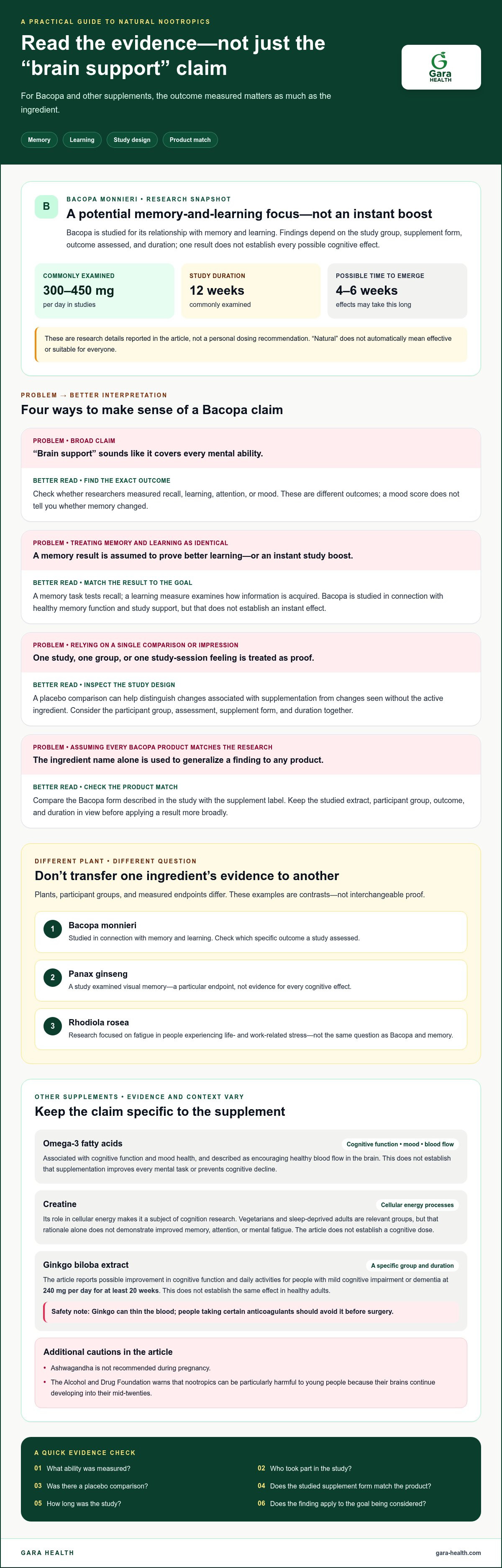
Natural nootropics for cognitive enhancement are plant-based or naturally occurring substances studied for potential effects on memory, attention, or other aspects of thinking. Bacopa monnieri is a leading example: studies commonly examine 300-450 mg per day for 12 weeks, and its effects may take 4-6 weeks to emerge. The evidence varies by supplement and cognitive outcome, so “natural” doesn’t automatically mean effective or suitable for everyone.
If you’re curious about natural nootropics for cognitive enhancement, you’re likely looking for a clearer way to support focus or memory without confusing supplements with prescription drugs. This guide explains what nootropics are, what research suggests about Bacopa and other natural options, and how their evidence and uses compare with prescription stimulants. It also shows why the kind of cognitive support you’re seeking matters when weighing your options.
Key Takeaways
- Understand what qualifies as a nootropic and why supplements can differ in their effects on memory, focus, and attention.
- Learn why Bacopa is studied for memory and why its potential benefits are considered over time rather than as an instant boost.
- Compare the evidence and considerations for other natural supplements, including ginseng, before deciding what may suit your goals.
- Recognize that prescription smart drugs differ from supplements in purpose and use, and aren’t interchangeable with natural options.
- See how Himalayan Shilajit Resin 30g fits into a broader natural wellness routine without treating it as a proven cognitive enhancer.
Bacopa monnieri for memory and cognition
Bacopa monnieri is studied as a potential cognitive enhancer, particularly for its relationship with memory and learning. When comparing natural nootropics for cognitive enhancement, the useful question isn’t whether nootropics work as a single category. It’s whether the evidence for Bacopa matches a specific goal, such as remembering information or supporting study. That distinction helps separate appealing claims from measured outcomes.
Research on Bacopa examines cognitive performance and mood, but those measures aren’t interchangeable. A memory task tests recall; a learning measure examines how information is acquired. A mood score captures something different. When reading about Bacopa, identify the exact outcome researchers assessed and consider whether it reflects your goal. The phrase “brain support” alone doesn’t reveal which ability was tested.
Placebo comparisons matter, too. A study comparing Bacopa with a placebo can help distinguish changes associated with supplementation from changes seen without the active ingredient. Consider the participant group, supplement form, assessment, and duration together. These details show what a finding can reasonably tell you. Results from one group or test don’t establish every potential cognitive effect.
Bacopa is studied in connection with healthy memory function and study support. That makes it relevant to people interested in learning, but it doesn’t establish an instant study boost. A careful interpretation connects the proposed use with the measured outcome. Compare the extract studied with the product format, and don’t judge cognitive performance from one isolated feeling or study session.
Evidence for natural nootropics for cognitive enhancement depends on the ingredient. Use these comparisons to keep the outcomes clear:
- Memory: Check whether a Bacopa study measured recall or another memory outcome.
- Learning: Separate learning measures from attention, mood, and general study support.
- Study design: Note whether researchers included a placebo comparison and who participated.
- Product match: Compare the Bacopa form described in research with the supplement label.
Ginseng offers a useful contrast, not a substitute for Bacopa evidence. A Panax ginseng study examined visual memory, while research on Rhodiola rosea focused on fatigue in people experiencing life- and work-related stress. Different plants, groups, and endpoints produce different evidence. When considering Bacopa, keep memory and learning at the center rather than applying conclusions from ginseng or fatigue studies.
For readers exploring natural wellness products alongside evidence-based research, explore natural wellness options while keeping product claims distinct from Bacopa findings.
What are other brain health supplements?
Omega-3 fatty acids, creatine, and ginkgo are examples of supplements discussed for brain health. Their evidence and safety considerations differ, especially for healthy adults seeking sharper mental performance.
Omega-3 Fatty Acids and Cognitive Health
Omega-3 fatty acids are nutrients associated with cognitive function and mood health. They matter because brain health involves more than memory scores alone. Omega-3s are also described as encouraging healthy blood flow in the brain, linking circulation with cognitive health. That relationship doesn’t establish that supplementation improves every mental task or prevents cognitive decline.
Consider the specific goal: mood support, general cognitive health, or a diagnosed concern. Those are different outcomes, and evidence for one doesn’t automatically establish benefits for another. A supplement’s role also depends on the person’s diet and health context. Keeping the outcome specific makes claims about omega-3s easier to assess.
Creatine and Cognition
Creatine is involved in cellular energy processes, which makes it a subject of interest in cognition research. Vegetarians and sleep-deprived adults are relevant groups because diet and sleep can shape the starting conditions for mental performance. That rationale alone doesn’t demonstrate that creatine improves memory, attention, or mental fatigue in either group.
For a useful comparison, separate a proposed mechanism from measured outcomes. Ask whether a study assessed memory, attention, or fatigue, and whether it included vegetarians or sleep-deprived participants. A result in one group or on one task can’t automatically be applied to other adults. The evidence presented here doesn’t establish a cognitive dose for creatine.
Evidence Limits in Healthy People
Evidence limits show how far findings can be applied beyond the participants and outcomes studied. This matters because a supplement examined for one task may not improve other mental abilities in healthy people. Check the study group, supplement, measured outcome, and duration before treating a finding as broadly relevant.
Healthy adults also differ from people with mild cognitive impairment or dementia. For example, ginkgo biloba extract may improve cognitive function and daily activities in people with mild cognitive impairment or dementia at 240 mg per day for at least 20 weeks. That finding doesn’t establish the same effect in healthy adults.
Safety is part of the comparison. Ginkgo can thin the blood, and people taking certain anticoagulants should avoid it before surgery. Ashwagandha isn’t recommended during pregnancy. The Alcohol and Drug Foundation warns that nootropics can be particularly harmful to young people because their brains continue developing into their mid-twenties.
Before adding supplements, discuss the specific ingredient and your health circumstances with a healthcare professional. Bring the product label and a list of medications so they have concrete details to consider when assessing interactions and suitability. Don’t treat a stack of ingredients as a single intervention, since each compound has its own evidence and potential risks.
For a coffee-based option within a wellness routine, Gara Health Mushroom Coffee is a beverage choice, not an established cognitive treatment. Keep that distinction clear when weighing supplements for mental performance.
Do nootropics actually work for Cognitive Performance?
Some nootropic studies report changes in specific cognitive outcomes, but findings depend on the substance, group, and task. Ginseng and ginkgo illustrate why proposed effects and study results need to be considered separately.
Nootropic Definitions and Intended Effects
Nootropics are substances intended to support brain functions such as thinking, memory, and learning. The term matters because it describes an aim, not proof that every product improves cognitive function.
Dr. Corneliu E. Giurgea coined “nootropics” in 1972. Their proposed actions include supporting circulation and oxygen delivery in the brain, encouraging neurotransmitter production, and protecting against free radicals. Some are also proposed to support proteins involved in neuroplasticity, learning, and memory. These mechanisms describe possible pathways, not a guaranteed improvement in everyday performance.
Proposed Effects of Plant-Derived Compounds
Plant-derived compounds are natural substances studied for possible effects on particular cognitive tasks. Comparing evidence by outcome helps avoid treating every supplement as a general brain booster.
Rhodiola rosea, for example, has been studied for fatigue in people experiencing life- and work-related stress. In a study of 101 people, 400 mg daily was associated with improvements in fatigue and exhaustion within four weeks; benefits were observed as early as three days. Sage is also identified for attention, recall, and cognitive performance. These findings concern specific ingredients and outcomes.
Ginseng’s Proposed Actions
Ginseng is studied for possible cognitive effects, including visual memory. Adaptogenic and antioxidant actions are proposed explanations, but a proposed mechanism and a measured test result answer different questions.
A study of 90 volunteers found improvements in visual memory tests after six months of Panax ginseng supplementation. The treatment used an individual dose of 200 mg. That result identifies a specific group, duration, and outcome; it doesn’t establish that every ginseng extract produces the same effects. When comparing products, note whether the study tested the same ginseng form and cognitive task.
Ginkgo’s Proposed Neuroprotective Effects
Ginkgo biloba is studied for memory and cognition, including possible neuroprotective effects. It’s important to distinguish evidence in people with cognitive impairment from evidence in healthy adults.
Ginkgo is described as potentially supporting brain health by helping address free radicals. Extract may improve cognitive function and daily activities in people with mild cognitive impairment or dementia at doses such as 240 mg per day for at least 20 weeks. This evidence concerns those groups and outcomes, not general cognitive enhancement in every person. Ginkgo can also thin the blood, so people taking certain anticoagulants should avoid it before surgery.
Methylphenidate is a prescription stimulant, unlike plant-derived supplements. Its side effects and long-term risks are relevant to decisions about its use, but they aren’t interchangeable with supplement findings. Prescription treatment and self-directed cognitive enhancement are different contexts. A healthcare professional can consider intended use, current medicines, health history, and possible side effects when discussing methylphenidate. Comparing it with an herb means comparing evidence and risks, not assuming they work alike.
Natural supplements versus prescription smart drugs
Natural supplements and prescription smart drugs differ in purpose, evidence, and use. Sleep and exercise support the foundations of cognition; supplements don’t replace either routine.
Matching Supplements to Cognitive Goals
To match a supplement to a cognitive goal, compare the outcome studied with the ability you want to support. This matters because memory, calm focus, and attention are distinct targets.
Bacopa is studied for memory, while citicoline is associated with memory, attention, and focus. L-theanine is an option for relaxation and calming focus during work or study. Ashwagandha research describes root doses of 6 to 10 g per day, or extract doses of 750 mg to 1250 mg per day. These amounts differ by form, so compare like with like.
Students seeking study support, for example, should distinguish an ingredient studied for memory from one associated with calm focus. A supplement label’s stated purpose doesn’t establish that it improves every task. The intended outcome and the studied ingredient should match.
Herbal and Nutritional Supplement Types
Herbal supplements come from plants, while nutritional supplements provide compounds such as minerals or fatty acids. Knowing the category helps explain why ingredients may work through different proposed pathways.
Ashwagandha and Bacopa are herbal examples; magnesium and omega-3 fatty acids are nutritional examples. Magnesium is involved in more than 300 reactions in the body, while omega-3s are associated with cognitive function and mood health. Caffeine is another naturally occurring compound with stimulant effects. These categories don’t make ingredients interchangeable, since their targets and evidence differ.
Choline is another useful comparison point because it supports the production of acetylcholine, a chemical involved in brain-cell communication. Lecithin is estimated to contain about 13% choline. That figure describes lecithin’s composition, not a supplement dose or proof of improved cognition.
Supplement Quality and Standardized Extracts
A standardized extract is prepared to contain a defined amount of selected compounds. The plant name alone doesn’t describe an extract’s strength or composition.
Compare the botanical name, plant part, extract amount, and stated standardization on labels. Bacopa extract and whole-plant powder, for example, aren’t automatically equivalent. Study findings apply most directly to the form researchers examined, so matching the product format makes comparisons more relevant.
Also distinguish an ingredient’s total amount from its active-compound content. A label that names an herb without explaining its extract or standardization gives you less to compare. Clear labeling makes it easier to assess whether a supplement resembles the preparation used in relevant studies.
Supplements and Other Evidence-Based Approaches
Sleep and exercise are daily health practices; supplements add specific ingredients to a routine. A capsule doesn’t make up for missed sleep or replace physical activity.
For students facing demanding study periods, adequate sleep supports readiness to learn, while regular exercise contributes to overall health. Consider supplements separately, with a specific goal in mind, such as memory or calm focus. Prescription smart drugs are medicines, not stronger versions of herbal supplements; their purpose and use differ.
A practical comparison starts with the underlying need: disrupted sleep, low activity, or a specific cognitive goal. Improving sleep habits and regular movement builds a foundation. Evidence about ingredients can then help you assess whether a supplement fits that goal, keeping natural options in perspective alongside established daily practices.
Bacopa monnieri as a proposed cognitive enhancer
Bacopa monnieri is studied as a potential cognitive enhancer, particularly for its relationship with memory and learning. The useful question isn’t whether “nootropics” work as a single category. It’s whether the evidence for Bacopa matches the specific outcome you care about, such as remembering information or supporting study. That distinction separates an appealing claim from a measured result.
Research on Bacopa examines cognitive performance and mood, but those measures don’t mean the same thing. A memory task tests recall; a learning measure examines how information is acquired. A mood score captures a different experience. When reading about Bacopa, identify the exact outcome researchers assessed and consider whether it reflects your goal. A broad phrase such as “brain support” doesn’t reveal which ability was tested.
Placebo comparisons matter, too. A study comparing Bacopa with a placebo helps distinguish changes associated with supplementation from changes seen without the active ingredient. Consider the participant group, supplement form, assessment, and duration together. These details explain what a finding can reasonably tell you. Results from one group or test shouldn’t be treated as proof of every potential cognitive effect.
Bacopa is described as a supplement for healthy memory function and study support. That makes it relevant to people interested in learning, but it doesn’t establish an instant study boost. A careful interpretation connects the proposed use with the measured outcome. Compare the extract studied with the product format, and avoid judging cognitive performance from one isolated feeling or study session.
- Memory: Check whether a Bacopa study measured recall or another memory outcome.
- Learning: Separate learning measures from attention, mood, and general study support.
- Study design: Note whether researchers included a placebo comparison and who participated.
- Product match: Compare the Bacopa form described in research with the supplement label.
Ginseng offers a useful contrast, not a substitute for Bacopa evidence. A Panax ginseng study reported visual-memory findings, while research on Rhodiola rosea focused on fatigue in people experiencing life- and work-related stress. Different plants, groups, and endpoints produce different evidence. When considering Bacopa, keep memory and learning at the center rather than applying conclusions from ginseng or fatigue studies.
For readers exploring natural wellness products alongside evidence-based research, explore natural wellness options while keeping product claims distinct from Bacopa findings.
Gara Health: Himalayan Shilajit Resin 30g
Himalayan Shilajit Resin 30g is a Gara Health option for readers exploring shilajit as part of a natural wellness routine. The research discussed above focuses on ingredients such as Bacopa, ginseng, and ginkgo; it doesn’t establish shilajit as a proven cognitive enhancer. Keep that distinction in mind when choosing a supplement for a specific memory or focus goal.
If you prefer a different format, Gara Health also offers Gara Shilajit Coffee Powder and Gara Health Mushroom Coffee. Choose based on the kind of product that fits your routine, rather than assuming coffee or resin will reproduce findings from studies of other ingredients. Explore Gara Health’s products to find an option that aligns with your wellness interests.
Choose Your Next Step With Clarity
Your next step is simple: decide what you want to support, then choose products with claims that match the evidence. Natural nootropics for cognitive enhancement aren’t interchangeable, and a supplement should not replace prescribed medicine or the everyday habits that support wellbeing.
If you’re exploring a natural wellness routine, Gara Health’s options include Himalayan Shilajit Resin 30g, Gara Shilajit Coffee Powder, and Gara Health Mushroom Coffee. These offerings provide different formats to consider, but they shouldn’t be treated as proven Bacopa alternatives or established cognitive treatments. For persistent memory or focus concerns, start with a healthcare professional rather than relying on a supplement alone.
Keep your goal specific, take time to assess what fits your routine, and stay grounded in what each product is intended to offer. Contact Gara Health to discuss your options and take a thoughtful next step toward your wellness goals.
Frequently Asked Questions
What Are Nootropics?
Nootropics are substances intended to support brain functions such as memory, thinking, or learning. The term describes their intended purpose, not proof that a particular supplement improves those abilities. Bacopa, for example, is studied for memory, while L-theanine is associated with relaxation and calm focus. Knowing the intended outcome helps distinguish a specific cognitive goal from broad “brain boost” language on a label.
How do they work?
Nootropics are proposed to affect processes involved in brain function, including circulation, neurotransmitter activity, and neuroplasticity. These mechanisms offer possible explanations, but they don’t all point to the same outcome. A compound associated with neurotransmitter production, for example, isn’t automatically a memory aid. To evaluate a claim, connect the ingredient’s proposed action with the specific cognitive task measured.
What Are the 15 Best Nootropic Supplements for Mental Clarity?
There’s no established universal ranking of the “best” supplements, since ingredients target different outcomes. Options discussed for cognitive or brain health include Bacopa, citicoline, guarana, ginkgo biloba, sage, Panax ginseng, Rhodiola rosea, L-theanine, GABA, spearmint extract, omega-3 fatty acids, ashwagandha, magnesium, PQQ, and maca. Treat this as a comparison list, not a recommendation to combine them. Start by matching one ingredient to a clearly defined goal.
Which natural nootropics have the strongest clinical evidence for cognitive enhancement?
Evidence depends on the outcome and group studied, so no single natural nootropic is strongest for every person or task. Bacopa has been studied for memory, while research on Panax ginseng has examined visual memory. Ginkgo findings related to cognitive function involve people with mild cognitive impairment or dementia. Before applying a result to your own goal, compare the participant group, measured outcome, extract, and study duration.
How do caffeine and L-theanine affect focus, memory, and alertness?
Caffeine can affect alertness, while L-theanine is used for relaxation and calming focus during work or study. A trial found that 50 mg of caffeine delivered as coffee improved executive function, planning, and reaction time in habitual users. That result concerns those specific tasks and participants. It doesn’t establish the same effect on memory, or show that combining caffeine and L-theanine produces identical outcomes.
Can bacopa monnieri improve memory, and what dose and duration have studies used?
Bacopa monnieri is studied for memory, with research commonly using 300-450 mg per day for 12 weeks. A 2024 study included 80 healthy adults. These study details help you compare the ingredient and timeframe described in research with a supplement label. They aren’t interchangeable with an individual recommendation. Keep the goal specific: evidence about memory doesn’t automatically show better attention, learning, or performance on every mental task.
What side effects, interactions, and contraindications are associated with natural nootropics?
Risks vary by ingredient and personal circumstances. Ginkgo can thin the blood, and people taking certain anticoagulants should avoid it before surgery. Ashwagandha isn’t recommended during pregnancy. These examples show why a plant-based label doesn’t remove the need to consider interactions or contraindications. Before adding a supplement, review its ingredient list alongside your medications and health conditions with a healthcare professional.
Are natural nootropic supplements regulated or tested for quality and safety in the United States?
Regulation, independent quality testing, and evidence of cognitive benefit are separate considerations. A supplement label can identify ingredients and serving information, but that alone doesn’t demonstrate independent testing or prove a cognitive effect. Compare the full ingredient list, extract details, serving directions, and manufacturer information. If a product provides batch-testing documentation, assess what it covers. These details support a more informed comparison, but they don’t establish that an ingredient will improve mental performance.


