


What if the boldest immune supplement claim is the one to question first? Product labels can promise broad protection, while ingredient forms and amounts vary. Choosing an immune support supplement can feel more confusing than empowering, especially if you take medication or already use other supplements. It’s reasonable to look for clear evidence and a product that fits your needs.
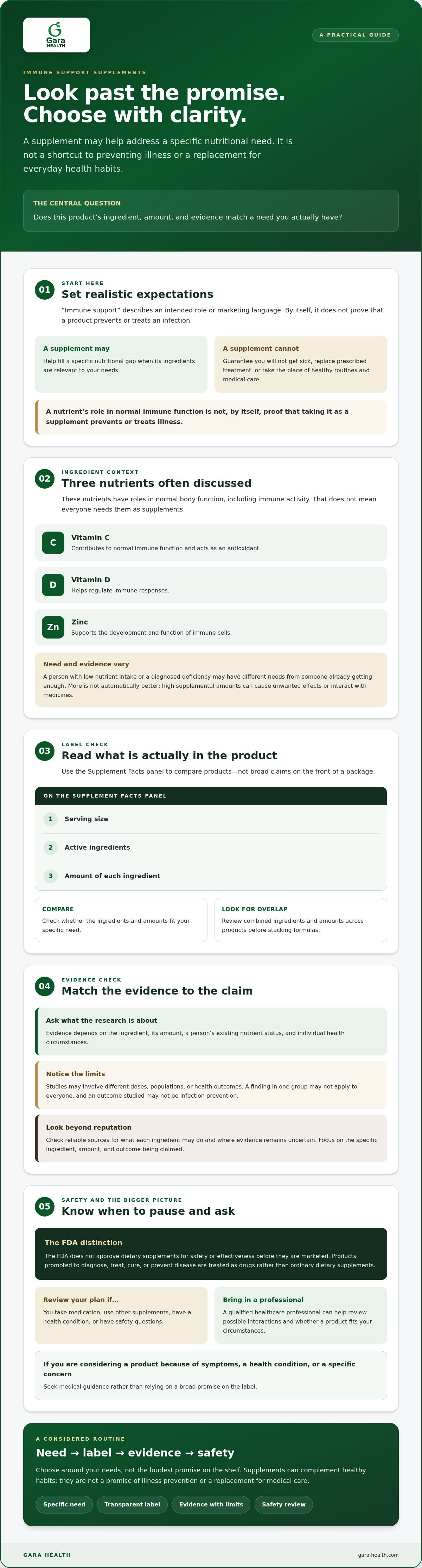
Supplements may help address a specific nutritional need, but they aren’t a shortcut to preventing illness or a replacement for everyday health habits. A smarter choice starts with realistic expectations, a transparent label, and a closer look at the evidence for each ingredient.
This guide explains how to weigh evidence against marketing, compare ingredients and amounts, spot overlapping formulas, and recognize when a healthcare professional should review your plans. The goal is a considered routine built around your needs, not the loudest promise on the shelf.
Key Takeaways
- Start with a specific health need, then check whether an immune support supplement’s ingredients and evidence match it.
- Read the Supplement Facts panel for the serving size, active ingredients, and amounts so you can compare products.
- Look beyond broad marketing claims and check reliable sources for what each ingredient may do and where evidence has limits.
- Review possible interactions and overlapping ingredients. Consult a qualified healthcare professional when you have safety questions.
- Use supplements to complement healthy habits, not as a promise of illness prevention or a replacement for medical care.
What Does an Immune Support Supplement Actually Do?
You want to feel well and support your body through everyday life. A supplement may help fill a specific nutritional gap, but it can’t switch your immune system into “extra protection” mode or guarantee you won’t get sick.
Dietary supplements are products intended to add nutrients or other ingredients to the diet. For a neutral overview of their forms and general purpose, see What is a dietary supplement? “Immune support” describes a product’s intended role or marketing language. By itself, it doesn’t prove that the product prevents or treats an infection.
What “immune support” means in everyday health
Your immune system is a network of cells, tissues, organs, and chemical signals that work together to recognize and respond to potential threats. It isn’t a single organ or a switch controlled by one vitamin. Nutrients contribute to normal body functions, including immune function, but taking more doesn’t make a healthy person immune to infection.
Think of a supplement as one possible part of a broader wellness routine, not the routine itself. Its relevance depends on its ingredients, the evidence for them, and whether they address an individual need.
Can supplements replace food, sleep, or medical care?
No. Supplements add to a balanced diet and healthy routines; they don’t replace them. They also don’t take the place of prescribed treatment, vaccination, or advice from a qualified healthcare professional. If you’re considering a product because of symptoms, a health condition, or a specific concern, seek medical guidance rather than relying on a broad promise on the label.
The FDA does not approve dietary supplements for safety or effectiveness before they’re marketed, and products promoted to diagnose, treat, cure, or prevent disease are treated as drugs rather than ordinary dietary supplements. Keep this distinction in mind: a general claim of “support” isn’t proof of disease protection. Look for transparent ingredient information and evidence that fits the claim, and be wary of promises that sound like prevention or treatment.
How Immune Support Supplements Work: Nutrients, Evidence, and Limits
Knowing that a nutrient plays a role in immune function is not the same as knowing a supplement will prevent illness. Evidence depends on the ingredient, its amount, a person’s existing nutrient status, and individual health circumstances. That distinction helps separate a plausible nutritional benefit from an overreaching product promise.
Which ingredients appear in immune supplement discussions?
Vitamin C, vitamin D, and zinc are often discussed because each has recognized roles in normal body function, including immune activity. Vitamin C contributes to normal immune function and acts as an antioxidant. Vitamin D helps regulate immune responses, while zinc supports the development and function of immune cells. The NIH Office of Dietary Supplements explains the evidence for immune-supporting nutrients, including what is known and where research remains uncertain.
These roles don’t make the nutrients interchangeable or mean everyone needs them as supplements. Someone with low nutrient intake or a diagnosed deficiency may have different needs from someone already getting enough. More isn’t automatically better: high supplemental amounts can cause unwanted effects or interact with medicines. The appropriate amount depends on the person and product, so check combined ingredients and amounts before stacking formulas.
What does the research actually show?
Correcting a confirmed deficiency can help restore normal body functions that depend on that nutrient. That is different from claiming that routine supplementation gives every healthy person extra protection. Research may involve different doses, populations, and health outcomes, so a finding in one group may not apply to everyone. Studies may also measure outcomes other than whether a product prevents infection.
A nutrient’s established role in normal immune function does not, by itself, prove that taking it as a supplement prevents or treats an illness. When evaluating an immune support supplement, look for evidence about the specific ingredient, amount, and outcome being claimed rather than relying on the ingredient’s general reputation.
Before choosing a product, identify its ingredients and amounts on the current label, then compare those details with reliable guidance and your own needs. If you’re exploring Gara Health’s wellness products, assess each product by its label and stated use. Don’t assume it offers immune protection.
How to Compare Immune Support Supplements Without Falling for Hype
A clear label is more useful for comparison than a bold claim on the front of a bottle. Start with the Supplement Facts panel to identify the serving size and amount of each listed ingredient per serving. Check the suggested use, too. Compare products based on the serving you would actually take, not just the amount that sounds most impressive.
What to check on the Supplement Facts label
Use this quick comparison for nutrients often discussed in connection with immune function. Amounts vary by product, so rely on the current label rather than assuming a standard dose.
| Ingredient | Stated amount | Evidence question | Safety consideration |
|---|---|---|---|
| Vitamin C | Check amount per serving | Does the evidence match the product’s specific claim? | Count amounts from other supplements, too. |
| Vitamin D | Check amount per serving | Is the product addressing a relevant need? | Ask a professional about personal dosing or medication concerns. |
| Zinc | Check amount per serving | Does the evidence apply to this use and group? | Look for overlapping sources in other products. |
Check every supplement you already take for duplicate nutrients. A multivitamin plus a separate formula can add up, even if each label looks reasonable on its own. Be cautious with proprietary blends: if a label gives only a combined amount for several ingredients, you may not be able to tell how much of each ingredient you’re getting. For practical consumer guidance, see NCCIH’s advice on how to choose supplements safely.
How to judge claims and quality signals
Promises to prevent, treat, or cure disease, or guarantees of protection, deserve extra scrutiny. Marketing terms such as “pure,” “premium,” or “clinically tested” don’t verify quality on their own. If a company claims independent testing, look for details you can confirm: who conducted the testing, what was tested, and whether the results apply to the product or batch in question.
Label checklist: Confirm ingredient names, amounts per serving, serving size, suggested use, overlapping ingredients, and evidence for the specific claim. Verify any testing statement before relying on it. These habits help you assess a product without treating it as evidence of immune benefits. For example, Gara Health’s Himalayan Shilajit Resin buying guide is a product-evaluation resource, not proof of immune benefits.
How to Use Immune Support Supplements More Safely
A safer routine starts with a clear reason for taking something, not a crowded supplement shelf. Before adding an immune support supplement, move through four steps: identify a possible need, review the label, check for interactions or overlapping ingredients, then reassess whether continued use still makes sense.
When should you ask a healthcare professional first?
Check with a qualified healthcare professional before starting a supplement if you take prescription medicine, have a chronic condition, are pregnant or breastfeeding, or have a procedure planned. These circumstances can affect what’s appropriate. Supplements may affect how medicines work, and combining products can unintentionally duplicate nutrients or other ingredients. Bring the labels, or a list of ingredients and amounts, so the professional can review the products you’re considering.
Don’t use a supplement to manage symptoms that need medical attention. Seek professional care for symptoms that are persistent, severe, or concerning, especially if they’re getting worse. A supplement is not a substitute for diagnosis, prescribed treatment, or timely care.
How to keep a supplement routine simple
Once you’ve established a reason for taking a supplement and checked its safety, keep the routine easy to review:
- Start with one product. Introducing one change at a time makes it easier to notice unwanted effects and understand what you’ve added.
- Follow the current label. Use the product as directed. Don’t combine several formulas on the assumption that more ingredients will provide more support. If the instructions or ingredients are unclear, ask a pharmacist or healthcare professional before use.
- Reassess as life changes. Review your routine if you begin or stop medication, develop a health condition, become pregnant, or have a procedure planned. Ask whether the supplement remains suitable and how long it makes sense to continue.
A simple record can help: note the product, when you started it, and any changes you notice. Share that information with your healthcare professional, particularly if you experience a possible side effect. Don’t change prescribed treatment or delay care based on how you feel after starting a supplement.
Careful label review and realistic expectations are useful starting points. If you’re exploring options, browse Gara Health wellness products, then assess each one for its stated ingredients and fit with your routine. Product information isn’t a substitute for individualized medical advice.
Choosing a Wellness Product That Fits Your Immune Support Goals
A useful choice begins with a verified need, not a broad promise. Before adding an immune support supplement or wellness product, ask what you want it to do, whether the label clearly identifies its ingredients and amounts, and whether credible evidence supports that intended use. If you can’t connect the product to a specific need or reliable information, pause rather than buying on the strength of an “immune” claim.
How to decide whether a supplement belongs in your routine
Consider the whole picture: your usual diet, sleep, movement, current supplements, and health circumstances. A product may be relevant if a qualified professional identifies a dietary need or if its documented use fits your goals. Check the label and available evidence for that specific product and purpose. Don’t assume a general wellness claim means it prevents illness. If medication or a health condition is part of the picture, ask a healthcare professional about personal safety.
Gara Health sells wellness products, not personalized health coaching or medical care. Its confirmed offerings include supplements and functional beverages, but they shouldn’t be treated as immune treatments. Match any choice to its label, realistic intended use, and your circumstances. Healthy routines and appropriate medical guidance remain part of the decision, whether or not you choose a product.
Where functional beverages fit, and where they do not
A functional beverage may suit someone looking for a particular kind of drink as part of a daily routine. Gara Health Mushroom Coffee is one of Gara Health’s beverage offerings. The category alone doesn’t establish that it supports immune function or prevents illness. Review product-specific ingredients, amounts, and evidence before drawing health conclusions. For background on the beverage category and brewing context, see this mushroom coffee guide. It offers product context, not medical advice or proof of an immune benefit.
The clearest path is a considered one: verify the need, read the label, weigh the evidence, and check safety with a qualified professional when relevant. Choose for a well-supported fit with your routine, not the biggest promise.
Build a Wellness Routine Around What You Know
A smarter supplement choice begins with a clear need, credible evidence, and a careful look at the label. An immune support supplement may be relevant in some circumstances, but it isn’t a guarantee of protection or a substitute for healthy routines and professional care. If medication, a health condition, pregnancy, or a planned procedure could affect your choice, ask a qualified healthcare professional before starting.
Keep your approach simple: check what’s in the product, consider how it fits with what you already take, and reassess if your needs change. Choose based on a transparent, evidence-informed fit, not the boldest promise.
Gara Health’s catalog includes Himalayan Shilajit Resin 30g, Gara Shilajit Coffee Powder, and Gara Health Mushroom Coffee. These are wellness products, not proven immune treatments. Explore Gara Health wellness products and review product information to see what fits your interests.
Small, informed choices can make your routine feel more intentional. Keep asking good questions, and let your wellbeing lead.
Frequently Asked Questions
Do immune support supplements actually work?
Some supplements can help address a nutrient shortfall, but that doesn’t mean they prevent infections or improve protection for everyone. Effects depend on the ingredient, amount, a person’s existing nutrient status, and the outcome studied. An immune support supplement is most worth considering when there’s a specific, evidence-informed reason to use it. Be cautious of claims promising guaranteed protection or results for everyone.
What is the best supplement for immune support?
There isn’t one best supplement for everyone. The right choice depends on your diet, health needs, current medications, and whether a particular nutrient is lacking. Vitamin C, vitamin D, and zinc have roles in normal immune function, but those roles don’t establish that everyone needs a supplement. Ask a healthcare professional if you’re unsure what’s appropriate, especially if you have a health condition or take prescription medicine.
Can vitamin C supplements prevent colds?
For most people, taking vitamin C regularly doesn’t appear to prevent colds. Research summarized by the National Institutes of Health Office of Dietary Supplements suggests regular use may modestly shorten cold duration, but taking vitamin C after symptoms begin hasn’t consistently shown the same benefit. These findings don’t mean vitamin C prevents illness or works equally for everyone. Check your total intake and ask a professional if you’re considering high supplemental amounts.
Is it safe to take immune support supplements every day?
Daily use may be suitable for some people, but it depends on the ingredient, amount, length of use, and your health circumstances. Some nutrients can cause harm in excessive amounts or interact with medicines. Follow the current product label, and review daily supplements with a healthcare professional if you take medication, have a chronic condition, are pregnant or breastfeeding, or have a procedure planned. Don’t assume “natural” means risk-free.
How much zinc should I take for immune support?
There isn’t a single supplemental dose that’s right for everyone. The NIH’s recommended dietary allowance for adults is 11 mg daily for men and 8 mg daily for women, counting zinc from food and supplements. Those figures are general nutrient intake recommendations, not a personal supplement prescription. Check other products for zinc, and ask a healthcare professional before taking extra, particularly if you use medication or plan long-term supplementation.
Can I take more than one immune support supplement at once?
You may be able to, but combining products can duplicate ingredients and raise total intake beyond what you intended. Compare the Supplement Facts panels for overlapping nutrients such as vitamin C, vitamin D, or zinc, and include multivitamins and fortified products in your review. Ask a pharmacist or healthcare professional to check for interactions if you take medication or have a health condition. Adding one product at a time makes changes easier to track.
What should I look for on an immune supplement label?
Check the ingredient names, amount per serving, serving size, and suggested use. Compare those details with the product’s specific claims and look for amounts hidden inside proprietary blends, which can make individual ingredients difficult to assess. Review the label alongside your other supplements to spot duplicates. Treat promises to prevent or treat disease as a reason to scrutinize the claim, and don’t take marketing terms alone as proof of quality or testing.


