


What if deeper focus starts with fewer interruptions, not a stronger supplement? When attention slips before important work is done, it’s tempting to look for a quick boost. But supplements to improve deep work aren’t a guaranteed shortcut, and caffeine or other stimulants can feel too intense or interfere with sleep.
It makes sense to want something that helps you stay with a demanding task. The challenge is separating promising ingredients from confident marketing, then weighing potential benefits against limitations and personal suitability.
This guide explains what deep work depends on beyond supplements, what evidence to look for in common ingredients, and how to choose with realistic expectations. It also covers label transparency, possible drawbacks, and practical ways to protect sleep and sustained attention. The aim isn’t to build the biggest supplement stack. It’s to create a steady routine where any supplement is an optional, carefully considered addition to the habits that support focused work.
Key Takeaways
- Build deep work around clear tasks, restorative sleep, planned breaks, and fewer distractions before considering supplements.
- Assess supplements to improve deep work by checking human evidence, realistic outcomes, and potential drawbacks, not just persuasive marketing.
- Compare ingredients by their intended use, strength of evidence, limitations, and safety questions before choosing a product.
- If you decide to test a supplement, change one variable at a time and track focus, task completion, sleep, and unwanted effects.
- Gara Shilajit Coffee Powder and Gara Health Mushroom Coffee may be optional routine formats, but check current labels and personal suitability rather than assuming deep-work benefits.
What does deep work require, and where might supplements fit?
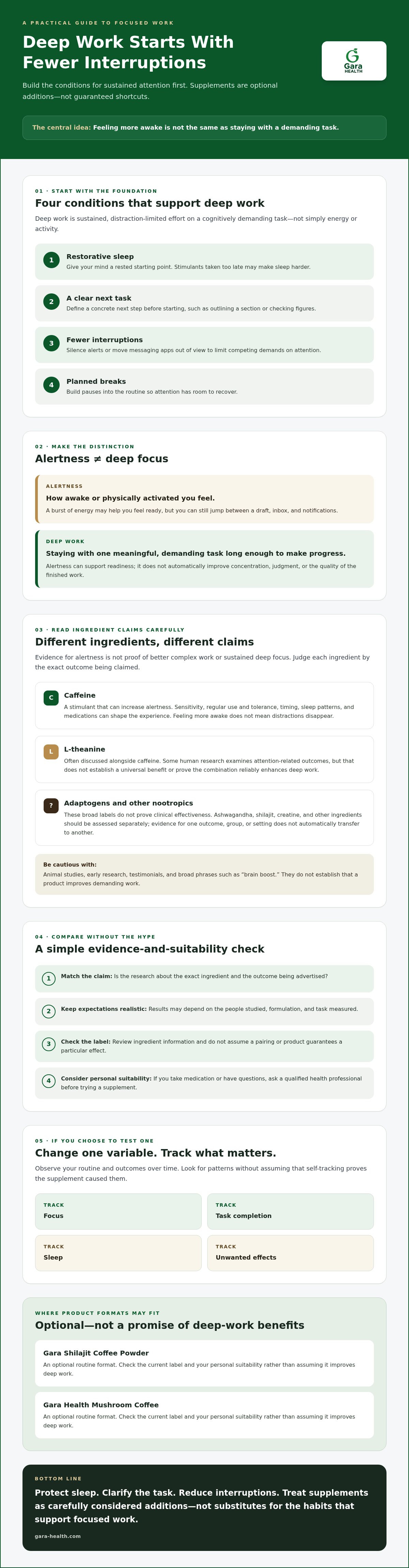
Deep work is sustained, distraction-limited effort on a cognitively demanding task, not simply feeling awake or getting more things done. Writing a report, solving a complex problem, or learning a challenging skill can call for this kind of concentration. A burst of energy may help you feel ready, but deep work also asks you to stay with one meaningful task long enough to make progress.
That distinction matters when evaluating supplements to improve deep work. Products marketed as nootropics are often framed around cognitive performance, but the category covers different substances and claims. Nootropics is a useful starting point for understanding the term; it doesn’t establish that a particular ingredient or product will help you concentrate during demanding work.
Start with the conditions you can shape:
- Sleep: Give your mind a rested starting point.
- Task clarity: Before you begin, define the next concrete step, such as outlining a section or checking a specific set of figures.
- Distraction control: Silence alerts or move messaging apps out of view.
- Breaks: Plan pauses so attention has room to recover.
These habits don’t guarantee effortless focus, but they make it easier to tell whether a supplement appears useful or whether the work setup itself needs attention.
How is deep work different from feeling energized?
Energy describes how awake or physically activated you feel. Deep work describes what your attention is doing. You might feel lively after a strong coffee and still jump between a draft, your inbox, and chat notifications. By contrast, focused writing means staying with the draft, working through ideas, and resisting the urge to check messages between sentences. Alertness can support readiness, but it doesn’t automatically improve concentration, judgment, or the quality of the finished work.
Can supplements create the conditions for focused work?
Some ingredients may affect alertness or a person’s perceived focus, but responses vary with individual sensitivity, routine, and other factors. A benefit someone describes online may not transfer to your experience, and feeling stimulated isn’t proof that you’re producing stronger work. Treat a supplement as a possible support, not a replacement for sleep, planning, or fewer interruptions. If you choose to try one, observe your routine and outcomes over time, including sleep and unwanted effects. Look for patterns without assuming that self-tracking proves the supplement caused them.
How can ingredients affect alertness, attention, and focus?
Ingredients discussed for mental performance don’t all aim to do the same thing. Caffeine is a stimulant that can increase alertness; other compounds are studied for specific cognitive outcomes, such as attention or memory. Those are different measures. Evidence that an ingredient can affect alertness isn’t proof that it improves complex work performance or helps someone sustain deep focus.
To assess claims behind supplements to improve deep work, look for reputable human research on the exact ingredient and outcome being advertised. Animal studies, early research, testimonials, and broad phrases like “brain boost” don’t establish that a product improves demanding work. Results may also depend on the people studied, the formulation, and the task measured.
What should readers know about caffeine and L-theanine?
Caffeine is a familiar alertness aid, but its effects aren’t identical for everyone. Sensitivity, regular use and tolerance, timing, sleep patterns, and medications can all shape the experience. You may feel more awake yet remain distracted, or find that caffeine taken too late makes it harder to sleep.
L-theanine is often discussed alongside caffeine. Some human research examines attention-related outcomes, but that doesn’t establish a universal benefit or prove that the combination reliably enhances deep work. Check the specific evidence and product label rather than assuming that an ingredient pairing guarantees a particular effect. If you take medication or have questions about suitability, ask a qualified health professional before trying a supplement.
Are adaptogens or other nootropics proven for deep work?
“Adaptogen” is a broad label for substances promoted as helping the body respond to stress, while “nootropic” commonly refers to substances discussed for cognitive effects. Neither label proves clinical effectiveness. Ashwagandha, shilajit, creatine, and other ingredients need to be judged separately: evidence for one outcome, group, or setting doesn’t automatically apply to sustained attention during complex work.
Creatine research, for example, may explore particular cognitive outcomes, but that alone can’t show it improves focused writing or problem-solving for everyone. The same caution applies to shilajit: general energy or wellness positioning isn’t evidence of a deep-work effect. For any ingredient, ask what human studies actually measured, who participated, and whether the result matches the claim.
If a coffee format is already part of your routine, treat it as a preference, not a proven focus strategy. You can review Gara Shilajit Coffee Powder as one optional format, then check its current label, ingredients, and amounts before deciding whether it suits you. Avoid adding several new ingredients at once; a simpler routine makes your own response easier to observe, without turning that observation into proof.
How to Compare Deep Work Supplements Without the Hype
A useful comparison starts with the exact outcome being claimed. Evidence for feeling more alert, recalling information, or improving a measure in an animal study doesn’t automatically show that a supplement helps people sustain complex work. The table is a starting point, not a ranking: evidence confidence describes the kind of research noted in the available evidence, not a guarantee of benefit.
| Ingredient | Intended outcome | Evidence confidence | Common limitation and safety question |
|---|---|---|---|
| Caffeine | Alertness | Established as a stimulant, not proof of better deep-work performance | Could it affect your sleep, sensitivity, or tolerance? |
| L-theanine | Attention or working memory | Human research, with results that may depend on the study and combination | Does the product match the ingredient and combination studied? |
| Citicoline | Attention or memory | Studies suggest possible cognitive effects; check the specific outcome | Does the evidence apply to your goal and the product’s form? |
| DHA omega-3 | Support for cognitive performance | Research includes older adults; don’t assume the same relevance for every population | Is the claim about the population and outcome actually studied? |
| Bacopa monnieri | Memory | Clinical research shows promise; effects may take weeks | Is memory the outcome you want, and is the ingredient suitable for you? |
| Magnesium L-threonate | Memory-related effects | Preclinical findings do not establish a human benefit | Is the marketing moving beyond the evidence? |
What evidence should you look for on a supplement claim?
Look for relevant human studies and check what researchers measured: alertness, attention, memory, or something else. Consider who took part, how long the study lasted, which ingredient form was used, and whether the product you’re considering matches it. Animal findings, early research, testimonials, and marketing phrases are not interchangeable with human clinical evidence. The NIH Office of Dietary Supplements guide offers a useful starting point for evaluating supplements and checking current references.
How can you assess safety and product transparency?
“Natural” doesn’t mean safe or effective for everyone. Read the full Supplement Facts panel, serving instructions, warnings, and ingredient amounts. Ask a qualified healthcare professional about possible interactions or suitability if you take medication, have a health condition, are pregnant, or have other personal concerns. Look for product-specific documentation before relying on claims about independent quality testing or certification.
For supplements to improve deep work, the best choice may be none at all if the evidence doesn’t match your goal or the safety information is unclear. A transparent label and relevant human research are more useful than a bold promise.
How should you test a supplement as part of a deep-work routine?
A careful trial is less about chasing a noticeable buzz and more about seeing whether a product fits your workday without creating unwanted trade-offs. Before starting, check the label and ingredient evidence, and ask a qualified healthcare professional about suitability if you take medication, have a health condition, are pregnant, or have other personal concerns.
Change one variable at a time, track a few relevant outcomes, and treat any pattern as a personal observation, not proof that the supplement caused it. Starting several supplements together makes it difficult to tell which one may be linked to a benefit or side effect.
- Define the work goal. Choose a clear priority, such as finishing a draft section or reviewing a set of notes, rather than aiming to “focus better” in general.
- Set up the work block first. Choose a realistic period for the task, silence likely interruptions, and decide what a useful break will look like.
- Check personal suitability. Review the product’s current label, directions, warnings, and ingredient amounts. Get professional advice when personal health factors or medications could matter.
- Keep the rest of your routine steady. Avoid changing your sleep schedule, meal pattern, caffeine timing, and other supplements at the same time. Prioritize consistent sleep, hydration, regular meals, and planned breaks as foundations for the workday.
- Observe and review. Follow label directions without increasing the amount to chase an effect. Choose a review point that makes sense for the product and your routine, then decide whether to continue, stop, or seek advice.
How can you monitor benefits and unwanted effects?
Before the trial, note a few simple measures: whether you completed the priority task, how focused you felt, how well you slept, and any unwanted effects. A brief daily record can help you notice patterns, but it can’t control for changing workloads, expectations, sleep quality, or other influences. Don’t interpret a better work session as evidence of a reliable effect.
If you experience concerning effects, stop using the supplement and seek appropriate professional advice. Don’t push through symptoms or increase the amount. If sleep worsens or task completion doesn’t change, that matters too. The goal is a routine that supports focused work without sacrificing rest or wellbeing.
If you’re considering a coffee format as one optional part of your routine, explore Gara Health’s coffee options and check current product labels for ingredients, amounts, and directions before deciding whether either suits you.
Where might Gara Health products fit into a deep-work routine?
A familiar beverage can be a convenient part of a work ritual: prepare it, settle into your workspace, and begin a clearly defined task. That routine may help mark the transition into focused work, but convenience and enjoyment aren’t evidence of improved attention. Gara Shilajit Coffee Powder and Gara Health Mushroom Coffee are optional formats to consider, not validated treatments for deep work.
They may appeal if you already enjoy coffee-style drinks and want a familiar format in your routine. Personal fit matters, though. Check the current label for ingredients, amounts, directions, and warnings, including whether it contains caffeine or other ingredients you may need to consider. If caffeine affects your sleep or makes you feel overstimulated, account for that before choosing a drink for a work session. Don’t infer a product’s formula, serving guidance, or quality testing from its name or category.
Could functional coffee suit a focused work ritual?
Think of taste, convenience, and how a drink fits your existing habits as practical considerations, not cognitive benefits. For more background, look for a mushroom coffee guide or an adaptogenic coffee guide that explains the ingredients and evidence behind these beverage categories. Use those resources to inform your questions, not as proof that a coffee format improves concentration.
How can you explore Gara Health products thoughtfully?
Gara Shilajit Coffee Powder is a confirmed Gara Health product, but its name alone doesn’t establish its ingredients or likely effect on focused work. The same principle applies to Gara Health Mushroom Coffee. Before making either part of a routine, review current product information and consider the evidence for each listed ingredient, your personal suitability, and any caffeine-related sleep concerns. A Himalayan Shilajit Resin buying guide can offer useful background on the ingredient, but product-specific labels and documentation remain essential.
Supplements to improve deep work remain optional, and a coffee format can’t replace a clear task, a workable environment, or restorative sleep. If those foundations are in place and you’re curious about a beverage option, explore Gara Health products and review the current product details before deciding whether one fits your routine.
Build a Focus Routine That Works for You
Deep work grows from sustained attention, not a quick burst of energy. Sleep, a clear task, planned breaks, and fewer distractions create the foundation. Supplements to improve deep work are optional, and claims deserve a closer look: check relevant human evidence, product details, and personal suitability rather than relying on hype.
If you decide to try a supplement, keep your routine steady, change one thing at a time, and observe focus, task completion, sleep, and unwanted effects. Your notes can help you reflect, but they can’t prove a supplement caused a change. Protecting rest and wellbeing matters as much as getting through the work.
Gara Health offers natural wellness products through its online storefront, including Gara Shilajit Coffee Powder and Gara Health Mushroom Coffee. These are beverage options to explore, not proven deep-work treatments. Review current product information and consider whether the ingredients and format suit your routine.
Explore Gara Health products and review their current details as you shape a thoughtful routine around what supports you. Small, steady choices can make your next focused session feel more achievable.
Frequently Asked Questions
Do supplements actually improve deep work?
Supplements may affect alertness or perceived focus, but they aren’t proven to reliably create deep work for everyone. Deep work calls for sustained attention on a demanding task, supported by sleep, task clarity, breaks, and fewer distractions. Evidence that an ingredient affects alertness or memory doesn’t prove it improves complex work. Treat supplements to improve deep work as optional, and check relevant human research and personal suitability before trying one.
What is the best supplement for focus and concentration?
There isn’t one supplement established as best for everyone’s focus and concentration. Ingredients are studied for different outcomes, and findings may depend on the population, ingredient form, and task measured. Caffeine, for example, is used to support alertness, but feeling more awake doesn’t guarantee sustained attention or better work quality. Compare evidence and limitations for the specific ingredient, and consider safety and personal fit before choosing.
Can caffeine help with deep work?
Caffeine may help you feel more alert, but it doesn’t guarantee deeper concentration or stronger work. Its effects can vary with personal sensitivity and regular use, and consuming it later in the day may disrupt sleep for some people. Consider how caffeine affects your own focus and rest, and keep its timing consistent if you’re evaluating another change. Feeling stimulated is not the same as staying engaged with a demanding task.
Are natural supplements safe to take for focus?
Natural doesn’t automatically mean safe, effective, or suitable for you. Supplements can have unwanted effects or interact with medications, and product ingredients and amounts vary. Read the full label, including directions and warnings, rather than relying on broad “natural” claims. If you take medication, have a health condition, are pregnant, or have other personal concerns, ask a qualified healthcare professional before using a focus supplement.
How can I tell whether a focus supplement is evidence-based?
Look for relevant human studies on the exact ingredient and outcome claimed, such as attention rather than general energy. Check who participated, how long the research lasted, and whether the ingredient form matches the product. Animal research, preliminary findings, testimonials, and marketing language aren’t equivalent to human clinical evidence. The NIH Office of Dietary Supplements offers consumer information that can help you assess supplement claims and find research references.
Can I combine supplements with coffee for deep work?
Possibly, but first check the labels for ingredients, amounts, caffeine, directions, and warnings. Combining products can make it harder to identify what’s affecting your focus, sleep, or how you feel. If caffeine makes you feel overstimulated or affects your sleep, adding another product may not be a good fit. Ask a qualified healthcare professional about possible interactions, particularly if you take medication or have health concerns.
What should I do if a supplement affects my sleep or makes me feel unwell?
Stop taking the supplement if it causes concerning effects, and seek appropriate professional advice. If symptoms feel severe or urgent, contact emergency services. Keep the product label available so a healthcare professional can review its ingredients and directions. Don’t increase the amount or combine it with other supplements to counter the effect. Sleep disruption is a meaningful unwanted outcome, even if you hoped the product would support focus.


